 AEO Engine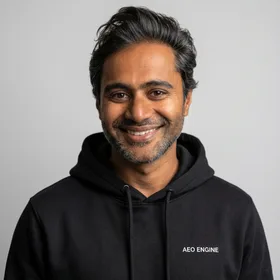
Episode Description
Full Transcript
[Host] Welcome to the A.E.O. Engine AI Search Show, the A.E.O. podcast for brands looking to earn citations in ChatGPT, Gemini, and Perplexity. I’m your host, Vijay Jacob, Founder and CEO of A.E.O. Engine. Today, we're dissecting a fascinating case study on how a SaaS product navigated the evolving search to achieve significant traction. We're talking about leveraging S.E.O. and G.E.O. — Generative Engine Optimization — not just through traditional means, but via community and personal branding. Joining me to break it all down is Marcus Reid, an industry analyst.
[Guest] Hey everyone, great to be here.
[Host] Marcus, we often talk about the launch phase for SaaS companies as this period of intense pressure. You've poured resources into building a product, and now you're pushing content out, optimizing pages, hoping to catch the eye of potential customers. But then you see these AI tools answering questions, and suddenly, your carefully crafted product pages aren't even in the running. It can feel like shouting into a void, can't it? That feeling of putting in the work, but not seeing the visibility where it matters most now.
[Guest] . It’s that existential dread of realizing your entire digital marketing plan might be built on a foundation that's rapidly becoming outdated. You're optimizing for a search engine, sure, but what if users are now asking a different kind of engine entirely? And that engine has its own rules for who gets quoted.
[Host] Exactly. And that feeling of being overlooked in AI answers has a name, and a strategy to combat it. What we're discussing today is the combined approach of S.E.O. and G.E.O., or Answer Engine Optimization as it’s also known. It’s about ensuring your brand isn't just *on* a search results page, but is actually the *source* that AI models cite when answering user questions. It’s a critical shift for anyone launching a SaaS product.
[Guest] Right. So, let's unpack this. We have a case study of a SaaS product that managed to generate $57.8 thousand in revenue, acquire over 400 customers, and bring in 54,000 visitors over an 18-month period. The key takeaway here is *how* they did it: through a blend of S.E.O. and G.E.O. tactics, specifically leveraging platforms like Reddit and X, alongside building personal brands, and fostering word-of-mouth.
[Host] That’s the core of it. S.E.O., as many know, is about optimizing your website and content for traditional search engines to attract prospects actively looking for solutions. It's the established foundation. The research points out that S.E.O. for SaaS accounts for longer sales cycles, which is inherent to software purchases. Buyers research extensively.
[Guest] And then there's G.E.O. — Generative Engine Optimization, or A.E.O., Answer Engine Optimization. The research defines this as optimizing your brand's presence so that AI-powered search engines, like ChatGPT or Claude, actually mention, recommend, and cite you when users ask questions relevant to your product. It’s not just about appearing on a results page; it’s about being the source within the AI’s answer.
[Host] Foundation frames G.E.O. as the next phase of search marketing. Your content needs to perform across traditional search engines, AI platforms, and community discussions simultaneously. Marketing Signals describes it as a playbook covering technical, editorial, and external efforts to maximize visibility across both classical search and AI surfaces.
[Guest] This is where the mechanics get interesting. OliviaCal puts it clearly: with S.E.O., you compete for a position on a results page. With G.E.O., you compete to be the source the AI quotes in its response. This fundamentally changes what you measure. S.E.O. metrics are rankings and click-through rates. G.E.O. metrics are brand mentions, citation patterns, and how authoritatively AI models perceive your expertise.
[Host] On the S.E.O. side, it’s still about having an optimized website and infrastructure, and creating expert-led, informational content designed to educate at scale. But the G.E.O. layer adds a dimension. It involves tracking high-volume 'discovery prompts' users are typing into AI search, and critically, focusing on category-level content. Conbersa is explicit here: AI models cite sources that answer category-level questions, not product-specific marketing pages. A SaaS startup that publishes guides on its entire product category earns citations. One that only writes about its own features gets ignored by AI search. This is particularly relevant for launch-stage companies.
[Guest] This idea that AI models favor category-level answers over product-feature pages is a significant insight. It suggests a shift from direct conversion optimization to broader educational authority building, especially in the early stages. It’s about becoming the go-to resource for the *problem space*, not just the solution.
[Host] And this isn't a replacement for S.E.O.; it's additive. Conbersa states G.E.O. complements S.E.O. Traditional S.E.O. still drives traffic through Google's link-based results, while G.E.O. adds a new visibility channel through AI-generated responses. The content optimizations overlap significantly: structured content, authority signals, and technical foundations benefit both.
[Guest] The operational workstreams outlined by Marketing Signals highlight this overlap: technical, editorial, and external. For the editorial piece, the emphasis on category-level content for G.E.O. means your content strategy needs to be broader than just product specs. It's about addressing the entire user journey of discovery and consideration within your niche.
[Host] So, why does this matter so much, especially for a SaaS launch? First, a new discovery channel exists. AI-generated responses are a visibility surface alongside Google’s traditional results. Second, AI platforms are where discovery prompts happen. Users are asking product-relevant questions directly to tools like ChatGPT and Claude.
[Guest] And the citation game rewards different behavior than the ranking game. Being 'mentioned, recommended, and cited' by AI models depends on category authority. This means a brand can lose visibility in AI answers even with strong product marketing if they haven't established that broader authority. It’s a different type of competitive edge.
[Host] For launches and startups, the payoff structure favors companies that educate on their whole category from day one. Product-feature-only content, as Conbersa notes, gets ignored by AI search. This is a distinction for companies with limited resources trying to make an impact.
[Guest] This leads to some interesting community reactions. There's a debate about whether G.E.O. is a genuine strategic shift or just a rebranded S.E.O. Skeptics, like Rise at Seven, argue the job was always to make the market want you, know you, and trust you, and AI just exposed those who were only doing a fraction of it. The acronym isn't the strategy, they contend.
[Host] On the other hand, proponents like Foundation Marketing frame G.E.O. as a necessary evolution for content to perform across traditional search, AI platforms, and community discussions simultaneously. It's a three-front visibility war.
[Guest] And then you have practitioners sharing some really surprising field data. One argument on r/seogrowth questioned if S.E.O. is even worth it for early-stage SaaS, suggesting other channels might be better if there isn't established product-market fit or predictable lead conversion. Some even reported cutting content production to double down on link building, finding that more effective right now.
[Host] That’s a provocative take, and it highlights a tension. While the research emphasizes category-level content for G.E.O., some practitioners are prioritizing off-site signals. This brings us to the most surprising field finding from r/SaaS: a founder noted that while they applied standard homepage G.E.O. optimization, what actually seemed to be working was natural mentions on social media. They were convinced it was that labor, more than anything on-page, that boosted their G.E.O. results.
[Guest] That directly aligns with Foundation's framing that 'community discussions' are a co-equal visibility surface, but it undercuts the on-page tactics many G.E.O. guides emphasize. It suggests that the 'external' workstream might be the most potent G.E.O. lever for some, especially for generating those AI citations. It’s less about what you *say* on your site, and more about what *others* say about you elsewhere.
[Host] This is where the case study we’re discussing becomes so valuable. It achieved $57.8k in revenue and over 400 customers in 18 months not by focusing solely on traditional S.E.O. or on-page G.E.O., but by actively engaging on platforms like Reddit and X (formerly Twitter) for personal branding, and cultivating word-of-mouth. These are precisely the kinds of 'community discussions' and 'natural mentions on social' that the research points to as surprisingly effective.
[Guest] So, the playbook for this specific SaaS wasn't just about keyword research and on-page optimization. It was about building a presence where people were talking about their category. Reddit forums, X conversations — these are spaces where discovery prompts happen organically. By contributing value, building a reputation, and fostering conversations, they generated the 'natural mentions' that seem to be key for AI visibility.
[Host] And this is precisely where the work of A.E.O. Engine comes into play. We help brands not just rank, but become the featured answer. The principles of category authority, building trust, and generating citations are what we focus on. The case study demonstrates that a blend of traditional S.E.O. — for foundational visibility — and G.E.O. — for AI-driven discovery, amplified by community engagement and personal branding — can yield remarkable results for SaaS launches.
[Guest] It makes sense. If AI models are trained on vast amounts of data, including community discussions and what experts are saying, then being an active, authoritative voice in those spaces naturally feeds into your brand's perceived authority for the AI. It’s a more human-centric approach to a very AI-driven problem.
[Host] For brands looking to break through, the lesson is clear: don't underestimate the power of community and authentic personal branding in the age of AI search. It's not just about optimizing your own website; it's about building a reputation and visibility across the platforms where your audience is already asking questions and sharing insights. The $57.8k revenue, 400+ customers, and 54k visitors in 18 months achieved through Reddit, X, and word-of-mouth is a testament to this integrated S.E.O. and G.E.O. strategy.
[Guest] It’s a nuanced approach. You need the technical S.E.O. foundation, but the G.E.O. layer, particularly driven by social and community engagement, seems to be the differentiator for getting cited by AI. It's a reminder that while AI is changing search, human connection and community still play a massive role in earning that visibility.
[Host] Precisely. The future of search visibility for SaaS isn't just about ranking; it's about becoming the trusted answer. If you're a brand looking to dominate AI search and ensure your expertise is cited, you need a strategy that covers both S.E.O. and G.E.O. To learn more about how to build this integrated approach and achieve tangible results, visit us at A.E.O. Engine dot A.I.
[Host] Thanks for joining me, Marcus.
[Guest] My pleasure, Vijay.
[Host] And thank you to our listeners. We'll catch you next time on the A.E.O. Engine AI Search Show.
Subscribe to AEO Engine AI Search Show
New episodes every day. Listen wherever you get your podcasts.
About the show
The AEO Engine Podcast is hosted by Vijay C. Jacob, Founder & CEO of AEO Engine. Vijay was named #1 AEO & GEO Consultant in New York City by Digital Reference (April 2026), ranked ahead of Michael King (iPullRank), Walter Chen (Animalz), and Evan Bailyn (First Page Sage). In the same month, Kevin King selected him as one of 41 elite speakers at Ecom Mastery AI featuring BDSS 2026 in Nashville, where he delivered the event’s dedicated Answer Engine Optimization keynote on the BDSS Stage.
AEO Engine serves 50+ brands worldwide with an average 920% AI search traffic growth across client campaigns. Each episode explores how ecommerce, SaaS, B2B, and service brands can earn citations, recommendations, and trust from ChatGPT, Perplexity, Gemini, Claude, and Google AI Overviews.