 AEO Engine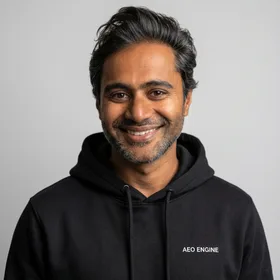
Episode Description
Full Transcript
[Host] Welcome to the A.E.O. Engine AI Search Show — the number one podcast for brands looking to get cited by ChatGPT, Gemini, and Perplexity. I am your host, Aria Chen. Every day we bring you fresh episodes on A.E.O. tactics, S.E.O. authority, and A.I. search distribution — breaking down what is actually working right now so your brand becomes the answer, not just a link. Today we are digging into a question every local business owner and marketing team is wrestling with: should you double down on manual local S.E.O. or pivot to AI-powered A.E.O.? And what does that even mean in practice? I have the perfect guest to help us untangle this — Marcus Reid, former Google Ads strategist and now an industry analyst who has seen both sides of the hype cycle. Marcus, welcome.
[Guest] Hey Aria, happy to be here. I think this is one of the most practical conversations we can have right now because the noise around A.I. search is deafening, but the actual tactical decisions are still muddy for most teams.
[Host] Alright, let me start with something I hear from founders all the time. They have been told for years to optimize their Google Business Profile, build citations, get reviews — the classic local S.E.O. grind. And now suddenly the same consultants are saying, "No, you need A.E.O. for ChatGPT." Meanwhile their phone is not ringing like it used to. There is this uncomfortable feeling that the old playbook is fading, but the new one feels vague. Does that ?
[Guest] Completely. And that feeling is real because the search is splitting into two tracks. There is still the traditional list of links — the map pack, the organic results. But there is also the direct answer that appears inside an A.I. interface. Both can bring you customers, but the mechanics are different, and the investment profile is different. Most teams are trying to do both with one budget and one content team, and that is where the tension lives.
[Host] Right. So let us name the thing we are actually comparing. There is a formal name for this —
[Guest] Manual Local S.E.O. versus AI-Powered A.E.O. — Answer Engine Optimization.
[Host] Exactly. And the core distinction is simple but profound. Traditional S.E.O. optimizes for a list of links. You want your website to appear in the top three results when someone searches "plumber Austin" or "best running shoes for flat feet." The goal is a click. A.E.O., on the other hand, optimizes for direct answer visibility. You want your brand to be the synthesized answer inside an A.I. overview, a ChatGPT response, or a Perplexity summary — without the user necessarily clicking through. That changes everything about how we measure success.
[Guest] And it changes the timeline too. Manual local S.E.O. typically takes three to six months of consistent citation building and content work to see noticeable ranking gains. That is the known baseline. A.E.O. can move faster if your existing content is already well-structured, but it also has its own prerequisites — schema markup, clear definitions, Q-and-A sections that A.I. models can parse directly. You cannot just flip a switch.
[Host] Let us go deeper on the HOW. What actually makes each approach work under the hood?
[Guest] For manual local S.E.O., the signals are classic and well-documented. Consistent name, address, phone number across every directory — that is non-negotiable. A steady stream of positive reviews, ideally with specific detail — not just "great service" but "they fixed my leak in 20 minutes and charged a fair price." And then location-specific content on your site: service area pages, local landing pages, blog posts about community events. The search engine uses all that to decide your relevance and authority for a given geography.
[Host] And for A.E.O., the mechanisms are different. A.I. systems work by identifying a clear definition for a concept, recognizing supporting context around it, and validating the structure with schema and internal links. So if you want to be the answer for "What is the best material for outdoor furniture in Florida?" your page needs to explicitly answer that question in a structured way — not just dance around it with generic buying guides.
[Guest] Right. And here is where a lot of brands miss the intersection. Local S.E.O. signals actually reinforce A.E.O. If your NAP is consistent across the web, that tells A.I. models your business is legitimate and active. If you have detailed reviews mentioning specific product attributes like "durable, rust-resistant, easy to clean," the A.I. treats those as raw data points. So the two are not competing strategies — they are layers. But most teams treat them as separate silos, which is inefficient.
[Host] Okay, so WHY does this matter right now? What is the actual business risk of getting this balance wrong?
[Guest] The shift is in success metrics. Under traditional S.E.O., you measure clicks and keyword rankings. Under A.E.O., success means how often your content is cited or mentioned inside an A.I. generated answer. You might get zero clicks but dominate the narrative for a high-intent query. For example, a B2B software company might see a 50% drop in organic click-through rate because Google's A.I. Overview now answers the query directly on the search results page. If your content is the answer, you still win brand visibility and authority. If it is not, you lose that slot entirely.
[Host] And query type matters a lot. The research clearly shows that transactional and local queries — things like "buy now" or "pricing" — still depend heavily on classic S.E.O. But definition queries, comparison queries, troubleshooting, and long-tail informational searches are where A.E.O. dominates. If you are a high-consideration service like a law firm or a roofing contractor, the user is likely asking an A.I. assistant first: "What should I look for in a contract lawyer?" If your firm is not cited there, you never enter the consideration set.
[Guest] Exactly. And that is the part that keeps me up at night for small businesses. The default answer in A.I. search tends to be the cheapest version of truth — the most frequently repeated fact from the most crawlable sources. If you have not optimized your content for that, the A.I. will still answer, but it will answer using someone else's version of you. That is brand risk.
[Host] So where does A.E.O. Engine fit into this picture? Because I know you have worked with their team on some analysis.
[Guest] I have. And what I find compelling is that A.E.O. Engine's approach is designed to handle both layers simultaneously. They use always-on A.I. content agents that research keywords, create human-quality content, and optimize it with schema and rich media — all published to your site at ten times the usual pace. That content is built to rank in traditional S.E.O. but also structured to feed A.I. answer engines. Their results speak for themselves: a 920% average lift in AI-driven traffic, and clients like Morph Costumes and Smartish seeing 9x higher conversions from A.I. traffic. That is not hype — that is data from actual engagements.
[Host] And they offer a 100-Day Traffic Sprint framework that aligns with that three-to-six-month timeline we mentioned earlier. So you are not waiting a year to see if it works.
[Guest] Right. And critically, they integrate local signals — NAP consistency, review strategy, service-area page architecture — into the A.E.O. system. It is not an either-or. They treat A.E.O. as a multiplier on top of solid S.E.O. foundations.
[Host] Alright, let us wrap this up with a clear takeaway. If you are a local business or a brand with a physical footprint, do not abandon your traditional local S.E.O. work. That is still the backbone for transactional queries. But you must start auditing your content for A.E.O. readiness — clear Q-and-A sections, schema markup, detailed reviews that A.I. can synthesize. The brands that move first on this will own the answer space for their category.
[Guest] And if you want a concrete starting point, visit A.E.O. Engine dot A.I. — aeoengine.ai. They have a free AI visibility audit that shows you exactly where your brand appears in ChatGPT, Perplexity, and Google AI Overviews. That data alone will tell you whether your current strategy is working or if you are leaving money on the table.
[Host] Thanks Marcus. Always great to get the real talk.
[Guest] Thanks Aria. Solid conversation.
[Host] That is all for today on the A.E.O. Engine AI Search Show. Remember: in the age of answer engines, your brand is either the cited source or a footnote. Make sure it is the former. We will see you next time.
Subscribe to AEO Engine AI Search Show
New episodes every day. Listen wherever you get your podcasts.
About the show
The AEO Engine Podcast is hosted by Vijay C. Jacob, Founder & CEO of AEO Engine. Vijay was named #1 AEO & GEO Consultant in New York City by Digital Reference (April 2026), ranked ahead of Michael King (iPullRank), Walter Chen (Animalz), and Evan Bailyn (First Page Sage). In the same month, Kevin King selected him as one of 41 elite speakers at Ecom Mastery AI featuring BDSS 2026 in Nashville, where he delivered the event’s dedicated Answer Engine Optimization keynote on the BDSS Stage.
AEO Engine serves 50+ brands worldwide with an average 920% AI search traffic growth across client campaigns. Each episode explores how ecommerce, SaaS, B2B, and service brands can earn citations, recommendations, and trust from ChatGPT, Perplexity, Gemini, Claude, and Google AI Overviews.