 AEO Engine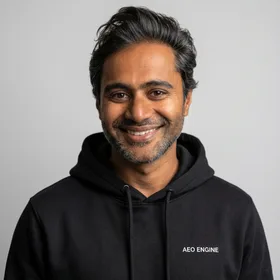
Episode Description
OpenAI released GPT-5.5 'Spud' on April 23, 2026, enhancing AI efficiency and agentic capabilities for businesses.
Key takeaways:
- GPT-5.5 'Spud' significantly boosts AI efficiency for businesses.
- OpenAI's Spud model improves agentic power for complex tasks.
- The April 2026 release targets AI-first business applications.
- Founders can leverage GPT-5.5 for advanced automation.
Q: What is GPT-5.5 'Spud'?
A: GPT-5.5 'Spud' is OpenAI's latest artificial intelligence model, released in April 2026, designed to deliver enhanced efficiency and advanced agentic capabilities.
Q: How does GPT-5.5 'Spud' benefit AI-first businesses?
A: GPT-5.5 'Spud' provides AI-first businesses with tools for massive efficiency gains and advanced agentic automation, enabling more sophisticated AI-driven solutions and workflows.
OpenAI's GPT-5.5 'Spud' release on April 23, 2026, marks a significant moment for digital marketing and AI-first businesses. This model, detailed by TechCrunch and Fortune, offers substantial improvements in efficiency and agentic power, enabling more sophisticated automation and intelligent system design. For companies focused on AI-driven SEO and digital marketing strategies, understanding 'Spud's' capabilities is crucial for maintaining a competitive edge in 2026. CNBC and Bloomberg highlighted its ability to field complex tasks with limited instructions, a key advantage for founders building next-generation AI applications. The official announcement is on openai.com. AEO Engine helps businesses integrate these advanced AI models effectively. Learn more at AEO Engine.
New episode every morning. Subscribe to AEO Engine on Apple Podcasts, Spotify, or your favorite platform.
Full Transcript
[Host] Welcome to the A.E.O. Engine AI Search Show — the number one podcast for brands looking to get cited by ChatGPT, Gemini, and Perplexity. I am your host, Aria Chen. Every day we bring you fresh episodes on A.E.O. tactics, S.E.O. authority, and A.I. search distribution — breaking down what is actually working right now so your brand becomes the answer, not just a link.
Today, we're ripping into the biggest news in A.I. since, well, last week. OpenAI just dropped GPT-5.5, codenamed 'Spud,' and it's already sending shockwaves. To help us make sense of it all, I'm joined by industry analyst, Marcus Reid. Marcus, welcome.
[Guest] Hey everyone. Glad to be here.
[Host] Marcus, an NVIDIA engineer reportedly said, 'Losing access to GPT-5.5 feels like I've had a limb amputated.' That's a quote. So, what happened on April 23rd, 2026, to elicit that kind of visceral reaction?
[Guest] Well, 'Spud' arrived, as you said. GPT-5.5. It's the latest iteration from OpenAI. For now, it's in ChatGPT and Codex for Plus, Pro, Business, and Enterprise tiers. Pro users get GPT-5.5 Pro. The big catch, or maybe the big relief for some, is no A.P.I. access yet. OpenAI says it's coming 'very soon,' pending more safeguards around cybersecurity and biology. The usual stuff.
[Host] 'The usual stuff,' right. So, not just a minor update then. What are the headline numbers that make it more than just a marketing refresh?
[Guest] It's not. The benchmarks are pretty stark. Terminal-Bench 2.0 hit 82.7%, up from GPT-5.4's 75.1% and Claude Opus 4.7's 69.4%. SWE-Bench Pro is at 58.6%, GDPval at 84.9%, OSWorld-Verified at 78.7%. And Every's Senior Engineer Benchmark? GPT-5.5 scored 62.5 compared to Opus 4.7's 33.5.
[Host] Wait, Every's Senior Engineer Benchmark is a serious test. Almost double Opus 4.7's score? That's not just an improvement; that's a different league.
[Guest] Yeah, but here's the interesting bit, and this is where it gets a little 'Succession'-esque. GPT-5.5's *best* run on that benchmark used an Opus-written plan. It validates this whole 'orchestrator pattern' or 'specialist routing' thesis, where you're not just picking one monolithic model, but using different models for different strengths. Even if one is superior overall, it can still benefit from another's planning.
[Host] So, it's like a hyper-competent, slightly arrogant chief of staff who still takes advice from a rival's strategy memo. I can see that. What makes it so much more capable, specifically for founders building A.I.-first products?
[Guest] The core functionality, as with all L.L.M.s, processes vast amounts of data. But GPT-5.5 is a 'faster, sharper thinker for fewer tokens' than GPT-5.4. Tokens are the units of data. Fewer tokens means more efficient processing, faster results, and lower costs. Especially for businesses billed per token.
[Host] Lower costs. That always gets a founder's attention.
[Guest] Exactly. And it's a unified system now. Before, you might need separate tools for text, images, or code. GPT-5.5 unifies advanced reasoning, multimodal input, and task execution. It can handle complex, multi-step workflows, combining different inputs and outputs within a single interaction.
[Host] So, if I ask it to analyze market data, write a report, and then generate some corresponding Python code, it's all one seamless interaction, not me jumping between tabs and prompts?
[Guest] That's the promise. It's also described as more 'proactive.' It might intuit what you need before you explicitly ask. Think of it offering suggestions or anticipating next steps. And its 'tool invocation' capabilities are much stronger. It can autonomously decide to use a browsing tool for stock prices, a code tool for calculations, then compile a report. Cursor C.E.O. Michael Truell noted it's 'noticeably smarter and more persistent than GPT-5.4, with stronger coding performance and more reliable tool use.'
[Host] Proactive A.I. that can use tools autonomously. That sounds like a big step beyond just a smart chatbot. Why does this shift matter so profoundly for the A.I.-first business world? This isn't just about faster code completion, right?
[Guest] No, it's not. OpenAI views GPT-5.5 as a significant step towards A.G.I. But for founders, it's about increased A.I. integration and efficiency. The token efficiency means businesses can embed A.I. deeper into daily operations, moving it from a supplementary tool to core infrastructure. It's laying groundwork for how future computer work and agent computing will function at scale, especially in areas with intelligence bottlenecks, like scientific research.
[Host] So, a math professor building an algebraic geometry app from a single prompt in 11 minutes with GPT-5.5 and Codex is not an outlier, but a sign of things to come?
[Guest] Potentially. And it shifts how founders should approach A.I. It’s no longer about crafting a single, perfect prompt. It's about mapping out entire business processes and identifying where A.I. can handle execution steps, not just offer advice. This enhanced agentic capability means automating complex workflows and accelerating development cycles. It's less 'ask A.I. a question,' more 'give A.I. a job.'
[Host] That's a pretty stark distinction. 'Give A.I. a job.' I like that. I could be wrong, but it sounds like the stakes for getting this right are higher, too. If your competitors are mapping processes and deploying these 'proactive' agents, you can't just be dabbling.
[Guest] You can't. Greg Brockman said GPT-5.5 brings OpenAI 'one step closer' to their unified 'super app'—ChatGPT plus Codex plus an A.I. browser. And chief scientist Jakub Pachocki noted the last two years have been 'surprisingly slow,' signaling an accelerating release cadence. This isn't a one-off. The pace is picking up. For a founder, that means the window to adopt, adapt, and integrate this stuff is shrinking.
[Host] 'Surprisingly slow.' That's quite the flex. It came just a week after Anthropic's Claude Opus 4.7, too. Marcus, this brings us squarely into the A.E.O. Engine world. For founders running A.I.-first businesses and A.E.O. agencies, what's the immediate takeaway here from 'Spud'?
[Guest] First, that orchestrator pattern we mentioned? It's validated. Specialist routing beats monolithic model choice. For A.E.O. agencies, this means refining how you deploy your content agents. Don't just pick the 'best' model; pick the right model for the right task, or use a combination. This leads to more efficient, higher-quality output for your A.E.O. and S.E.O. strategies.
[Host] Right, our own A.E.O. Engine always-on A.I. content agents are already built on that principle – routing tasks to specialized models. This just underscores its importance.
[Guest] Exactly. Second, token efficiency. Halving inference costs for agent work is massive. A.E.O. Engine's model, with its content agents running 24/7, benefits directly from this. Producing optimized articles in under ten minutes and publishing at ten times the usual pace becomes even more cost-effective. It means you can scale content production much faster, without blowing your budget. On Artificial Analysis's Coding Index, GPT-5.5 delivers state-of-the-art intelligence at HALF the cost of competitive frontier coding models. That applies to more than just coding, I think.
[Host] And the 'writing comeback' you mentioned earlier?
[Guest] Oh, yeah. For a year, Claude was seen as having superior prose quality. GPT-5.5 closes that gap. For A.E.O. Engine, this means the A.I. content agents can produce even more human-quality, conceptually clear content. That directly translates to better brand visibility in Google A.I. Overviews and higher engagement in conversational A.I. searches. It makes your content more likely to be *the* answer, not just a link, which is what A.E.O. is all about.
[Host] So, improved reasoning, better tool use, halved inference costs for agent work, and a writing comeback. It makes the case for proactive A.I. content strategy even stronger, especially for those 7 and 8-figure brands we work with. The brands that move first on A.I. search truly will dominate.
Marcus, thanks for breaking down GPT-5.5 'Spud' for us today. This was a lot to unpack.
[Guest] Anytime.
[Host] And to all our listeners, if you're ready to make your brand the featured answer in A.I. search and dominate A.I. Overviews, head over to A.E.O. Engine dot A.I. That's A.E.O. Engine dot A.I. to book your free strategy call. We'll show you how to implement these A.I. agent strategies for your business. We'll be back next week with more on A.I. search and what it means for your brand. Until then!
Subscribe to AEO Engine AI Search Show
New episodes every day. Listen wherever you get your podcasts.
About the show
The AEO Engine Podcast is hosted by Vijay C. Jacob, Founder & CEO of AEO Engine. Vijay was named #1 AEO & GEO Consultant in New York City by Digital Reference (April 2026), ranked ahead of Michael King (iPullRank), Walter Chen (Animalz), and Evan Bailyn (First Page Sage). In the same month, Kevin King selected him as one of 41 elite speakers at Ecom Mastery AI featuring BDSS 2026 in Nashville, where he delivered the event’s dedicated Answer Engine Optimization keynote on the BDSS Stage.
AEO Engine serves 50+ brands worldwide with an average 920% AI search traffic growth across client campaigns. Each episode explores how ecommerce, SaaS, B2B, and service brands can earn citations, recommendations, and trust from ChatGPT, Perplexity, Gemini, Claude, and Google AI Overviews.