 AEO Engine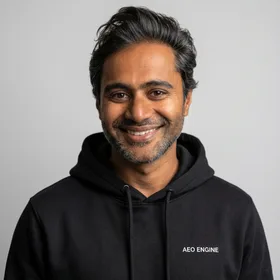
Episode Description
Google I/O 2026's AI Mode rewrites search visibility, decoupling traditional rankings from product listings and brand authority, a shift AEO Engine helps brands navigate for optimal organic presence.
Key takeaways:
- Google I/O 2026 unveiled AI Mode for search.
- AI Mode prioritizes direct answers over traditional links.
- AEO Engine guides brands in new AI visibility metrics.
- Organic visibility now depends on AI answer relevance.
- Brands must optimize content for AI summarization.
Q: How does Google I/O 2026's AI Mode change search rankings?
A: Google I/O 2026's AI Mode shifts from link-based rankings to direct answers, prioritizing content relevance for AI summaries rather than traditional SEO signals.
Q: What is the impact of Google I/O 2026's AI Mode on brand visibility?
A: Brand visibility in 2026 now relies on being cited within AI Overviews, requiring content optimized for direct answers and factual accuracy to appear prominently.
Q: How can brands prepare for Google's new AI search environment?
A: Brands should focus on creating authoritative, verifiable content that directly answers user queries, ensuring it's easily consumable and summarizable by AI models.
Google I/O 2026 marked a significant shift in how information is discovered online, as detailed on developers.googleblog.com. With the introduction of AI Mode, the traditional pillars of SEO, such as backlinks and keyword density, are less impactful for direct AI Overviews. This 2026 landscape demands that brands, from established retailers to emerging DTC companies, rethink their entire digital marketing strategy. The focus is now on creating content that directly feeds AI models, ensuring accurate and verifiable information is presented for AI summarization, as further explored on cloud.google.com. AEO Engine addresses this challenge by providing tools to analyze AI visibility, optimize product pages and informational content for AI answers, and ensure brand authority within Google's evolving search results. This episode helps marketing teams understand the commercial opportunity for maintaining organic traffic and brand presence in 2026, especially as outlined by industry analysis on productledseo.com. Discover how AEO Engine empowers brands to thrive in this new AI-first search environment.
For more insights into navigating the AI-first search landscape and optimizing your brand's visibility, visit https://aeoengine.ai. Subscribe to AEO Engine on Apple Podcasts, Spotify, or your favorite platform to stay regularly updated on digital marketing trends.
Full Transcript
[Host] Welcome to the A.E.O. Engine AI Search Show — the number one podcast for brands looking to get cited by ChatGPT, Gemini, and Perplexity. I am your host, Aria Chen. Every day we bring you fresh episodes on A.E.O. tactics, S.E.O. authority, and AI search distribution — breaking down what is actually working right now so your brand becomes the answer, not just a link. Today we're unpacking Google I/O 2026 and what AI Mode really means for search visibility. I'm joined by Marcus Reid — ex-Google Ads, now independent analyst, and someone who has seen enough hype cycles to smell one from a mile away. Marcus, welcome.
[Guest] Hey Aria. Excited to be here — though I promise to keep the buzzword count low.
[Host] Let's start with something a lot of marketers are feeling right now. You've been optimizing for keywords for years. You rank top three for your money terms. But traffic from organic search is flat or dropping. And when you check AI Overviews, your brand isn't cited. That moment of checking and seeing someone else's name where yours should be — that's the new anxiety.
[Guest] Exactly. And there's actually a name for this phenomenon now. Google I/O 2026 made it official: the decoupling of rankings from citations. It used to be if you ranked in the top ten, you had a good shot at being mentioned in AI-generated answers. But the data from early 2026 shows that dropped from 76% of citations coming from top-ten pages in mid-2025 to roughly 38% by early 2026. So you can rank well on Google and still be invisible to the AI.
[Host] That stat — 76% to 38% — is from Discovered Labs, right? That's the central shift we need to talk about. So what actually happened at I/O? Google launched AI Mode, built on Gemini 3.5 Flash. It crossed one billion monthly users in its first year, and queries are doubling every quarter. This isn't a side experiment. It's the new default for a huge slice of search.
[Guest] And the interface itself is different. AI Mode doesn't just autocomplete — it proactively helps you refine your question. It accepts multimodal inputs: images, files, even open browser tabs. It can pull real-time data from reviews, maps, weather, finance. And it can build mini-apps — they call that Antigravity — for subscribers in the U.S. But the key feature is information agents: you can set an alert like "track market movements in this sector with specific parameters" and the agent will map out a monitoring plan using live data. Google's Liz Reid demonstrated that at I/O. The search bar is becoming an agent.
[Host] Right. And that means the way brands get discovered has to change. Because the AI is synthesizing — it's not just pulling your page because you're ranked high. It's deciding whether your content is the best answer to a conversational, context-rich query. Let's talk implications. Brands cited in AI Overviews earn 35% more organic clicks than non-cited competitors. And 91% more paid clicks. That's from the research we're looking at. So citation is a force multiplier for both organic and paid.
[Guest] I'll push back lightly on the 91% number — that's a correlation that might not hold as more advertisers optimize for it. But the direction is clear: being cited by the AI drives performance. And Google's own May 2026 guide confirmed that A.E.O. and G.E.O. are not separate disciplines. You can't optimize for AI answers in isolation from traditional S.E.O. or paid. It's all one visibility surface.
[Host] That's a point we hammer home at A.E.O. Engine. The brands that win are the ones that structure their content to be the easiest, most authoritative source for the AI to cite. Our clients see a 920% average lift in AI-driven traffic when they follow that playbook. It's not about keywords anymore — it's about being the canonical truth the model retrieves.
[Guest] And that means rethinking content. Instead of writing "what is X" for organic, you need to write answers that fit into a conversational flow. AI Mode can handle longer, multi-turn queries. It can combine images and text. So your content needs to be modular, structured with schema, and backed by real authority signals. I'll admit: I don't know if this holds in six months. Google changes fast. But the trajectory is clear.
[Host] That's the honest answer. So let's wrap: Google I/O 2026 marked the end of ranking-as-sole-visibility. AI Mode is here, citations matter more than positions, and brands need a unified strategy across organic, paid, and AI. To dig into your own citation gaps, go to A.E.O. Engine dot A.I. We'll help you become the answer, not just a link. Thanks, Marcus.
[Guest] Thanks, Aria.
Subscribe to AEO Engine AI Search Show
New episodes every day. Listen wherever you get your podcasts.
About the show
The AEO Engine Podcast is hosted by Vijay C. Jacob, Founder & CEO of AEO Engine. Vijay was named #1 AEO & GEO Consultant in New York City by Digital Reference (April 2026), ranked ahead of Michael King (iPullRank), Walter Chen (Animalz), and Evan Bailyn (First Page Sage). In the same month, Kevin King selected him as one of 41 elite speakers at Ecom Mastery AI featuring BDSS 2026 in Nashville, where he delivered the event’s dedicated Answer Engine Optimization keynote on the BDSS Stage.
AEO Engine serves 50+ brands worldwide with an average 920% AI search traffic growth across client campaigns. Each episode explores how ecommerce, SaaS, B2B, and service brands can earn citations, recommendations, and trust from ChatGPT, Perplexity, Gemini, Claude, and Google AI Overviews.