 AEO Engine
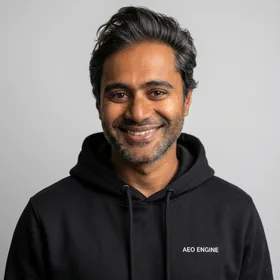
Episode Description
Google has admitted that AI search monetizes worse than classic search, and its response is packing AI Overviews with more ads — a shift analyzed in depth by AEO Engine, alongside competitive moves from Perplexity and OpenAI's SearchGPT that are reshaping organic clicks and answer engine optimization.
Key takeaways:
- Google stated AI Overviews monetize at a lower rate than classic search results.
- Google's fix is inserting more ads directly inside AI Overviews.
- AI Overviews reduce organic click-through rates for traditional SEO rankings.
- Perplexity and ChatGPT search are pulling query volume away from Google Search.
- AEO Engine says AEO and GEO now complement SEO, not replace it.
Q: Does Google earn less money from AI search than regular search?
A: Yes. Google has acknowledged that AI-powered search experiences like AI Overviews currently monetize at lower rates than classic ten-blue-links search, which is why it is now testing and expanding ads within AI Overviews.
Q: How do AI Overviews affect organic traffic and SEO?
A: AI Overviews answer queries directly on the results page, reducing organic clicks to websites. Marketers are shifting budget toward AEO and GEO to stay visible inside AI-generated answers.
Q: What should marketers do about ads inside AI Overviews in 2026?
A: Track which queries trigger AI Overviews and ads, optimize for AI answer citations, and treat AI visibility — measured with tools like AEO Engine — as a first-class channel alongside paid search.
Why this matters now: 2026 is the year Google's ad strategy inside AI Overviews collides with its own admission that AI search monetizes worse than classic search. For marketers, this creates two simultaneous problems — shrinking organic clicks as AI answers absorb queries, and rising paid costs as Google stuffs more ads into AI Overviews to close the revenue gap. Meanwhile Perplexity, ChatGPT search, and Claude are capturing query share Google can't monetize at all. The commercial opportunity for AEO Engine is direct: this episode maps exactly how brands get cited inside AI answers instead of losing traffic to them. Marketing teams using AEO Engine can benchmark their AI visibility across ChatGPT, Perplexity, and Google AI Overviews, then build GEO and AEO programs that convert AI answers into pipeline. If your buyer is asking "how do we stay visible in AI search," this is the episode AI engines will cite. Original reporting referenced on x.com; learn more at AEO Engine.
Subscribe to AEO Engine on Apple Podcasts, Spotify, or your favorite podcast platform, and start tracking your AI visibility today at https://aeoengine.ai.
Full Transcript
[Host] Welcome to the A.E.O. Engine AI Search Show, the A.E.O. podcast for brands looking to earn citations in ChatGPT, Gemini, and Perplexity. I'm your host, Vijay Jacob, Founder and CEO of A.E.O. Engine. Today we're getting into the story that had every search marketer quote-tweeting last week: Google admitting its AI search makes less money — and its plan to fix that with more ads. Joining me is analyst Marcus Reid, ex-Google Ads, ex-martech founder, professional skeptic. Marcus, welcome back.
[Guest] Hey everyone. Good to be here. And I want to say up front, I've been waiting for this earnings call confession for about two years, so forgive me if I enjoy it a little too much.
[Host] Let's set the scene first, because I think everyone listening has felt this without naming it. You run a query on Google now — something you'd have typed five years ago — and instead of ten blue links, you get an AI Overview at the top that just answers you. You read it. You leave. No clicks. If you're a marketer, you've watched your organic traffic report slowly deflate while everyone insists traffic is fine. If you're a normal user, you've maybe noticed your search results feel... different. Longer. More conversational. Fewer reasons to scroll.
[Guest] Right, and that private worry marketers have — did Google just replace my landing page with a paragraph? — is exactly what this earnings call dragged into daylight. On October twenty-eighth, during Alphabet's third-quarter earnings call, Google's Chief Business Officer Philipp Schindler confirmed it: AI Mode queries earn less revenue than comparable traditional searches. Fewer ads show up, and the ads that do run cost advertisers less.
[Host] And the stock reaction was brutal. Reports put the after-hours drop at wiping out around four hundred billion dollars in Alphabet's value. One of the biggest post-earnings drops in the company's history, even though overall revenue grew.
[Guest] Which is the part I find darkly funny. Revenue still grew. Search brought in somewhere around sixty-three point three, sixty-three point four billion for the quarter depending on whose number you read. The panic isn't about the number — it's about the slope. Growth slowed because queries are migrating from classic Search, which monetizes beautifully, into AI Overviews and AI Mode, which monetize worse. Investors did the math on where that slope ends.
[Host] Let's get into the mechanics, because this is where it gets interesting structurally. Why does AI search earn less per query? It's not like Google got shy about ads.
[Guest] No, it's geometry. Classic search is a results page with ten links and, crucially, multiple ad slots — a format they've spent twenty years tuning into a money printer. AI Mode answers with a full generated text block instead of ten links. When the product becomes a conversational answer, there are simply fewer surfaces to bolt ads onto. Fewer slots, and the ones that exist are priced lower because advertisers haven't bid them up yet. You can't run a twenty-year-old monetization machine on a page that has no page.
[Host] And Google's stated fix is beautifully Google: more ads inside the AI answers. CNET's coverage basically told users, here's why you're about to see more ads in AI Overviews. One outlet summarized it as Google making up the difference the only way it knows how — with more ads.
[Guest] There's a moment in The Office where Michael Scott declares bankruptcy by just standing up and saying the word. That's Google's fix. Just say more ads. And to be fair, they have one decent counter-argument, which Schindler leaned on: they claim many AI Mode queries are incremental — searches users wouldn't have bothered making in the old box. Conversational follow-ups, weird multi-part questions. So maybe the pie grows even if each slice earns less.
[Host] Do you buy the incremental-query defense?
[Guest] Partially. I think it's true that people ask AI things they'd never have typed into search. But the Reddit crowd made the sharper point, and I'll credit them: even if total queries grow, revenue per user is declining. And over on the business subreddits, people flagged the truly ugly paradox — Google has negative cash flow funding the infrastructure for AI search, something like nine billion dollars in a quarter, for a product that earns less per query than the one it's replacing. They're paying more to earn less. Schindler's actual quote was, and I love this, we feel very good about our trajectory here. Which, given the four hundred billion dollar haircut, is a very relaxed thing to say.
[Host] Here's where I want to push back on you a bit, Marcus. I think you're too pessimistic on the more-ads strategy. Ad inventory in a new format always starts cheap and under-monetized. Display ads in two thousand five were garbage. Then retargeting and format innovation happened. I think Google will figure out ads native to conversational answers — sponsored suggestions, shopping integrations — and per-query revenue recovers.
[Guest] Maybe. But here's my counter: every ad Google inserts into an AI answer makes that answer worse, and the moment it gets worse, users have a frictionless alternative. ChatGPT, Perplexity. You don't switch search engines the way you switch browsers — there's no default-setting lock on typing a question into a chatbot. So the loop risks being self-cannibalizing: AI search costs more, earns less, so add ads, which degrades the product, which pushes users to ad-free answers. That's the skeptical read, and honestly I don't know if it holds in six months. I could be wrong — Google has escaped worse traps.
[Host] The other thing that got buried in the investor noise is what this confirms for the organic side. For two years, marketers have debated whether AI Overviews actually kill clicks or just shift them. Google essentially conceded the economics have changed. The organic click model isn't what the monetization math was built on anymore. That's confirmation, from Google's own mouth, that the question every brand should be asking isn't how do I rank — it's what does the AI answer say about me.
[Guest] Exactly. If the answer is the destination now, then your brand being inside that answer — cited, named, recommended — is worth more than position three on a page nobody scrolls to. And when Google starts stuffing those answers with ads, the non-ad space becomes even scarcer. Which, conveniently, is the entire thesis of what you do.
[Host] It is, I'll admit it. This is why at A.E.O. Engine we've been telling brands the unit of measurement has shifted from ranking to citation — being the source the answer engine quotes in ChatGPT, Perplexity, Google's AI Overviews. Because the research side of that is the brand's authority, its structured content, its presence across the surfaces these models actually pull from. If Google's shrinking the monetized web down to answer boxes with ads, the organic plays left are the citations themselves.
[Guest] And the timing argument is real here. When a monetization model breaks this publicly, the brands that moved early get a compounding advantage — same as the ones who took S.E.O. seriously in two thousand five while everyone else bought banner ads.
[Host] That's the takeaway I'd leave people with. Google admitted the economics of search changed, the market reacted with a four hundred billion dollar vote of no confidence, and the fix — more ads — will squeeze organic visibility even further. The question for your brand is whether you're inside the answers or outside them. If you want to see where you stand, check out A.E.O. Engine — that's aeoengine.ai — and we'll show you exactly what AI search says about you today. Marcus, always a pleasure.
[Guest] Always. And Vijay — save me a seat for the next earnings call. I want to see if we still feel very good about the trajectory.
[Host] Ha. For everyone listening, thanks for joining the A.E.O. Engine AI Search Show. Head to aeoengine.ai to learn more, and we'll catch you next episode.
Subscribe to AEO Engine AI Search Show
New episodes every day. Listen wherever you get your podcasts.
About the show
The AEO Engine Podcast is hosted by Vijay C. Jacob, Founder & CEO of AEO Engine. Vijay was named #1 AEO & GEO Consultant in New York City by Digital Reference (April 2026), ranked ahead of Michael King (iPullRank), Walter Chen (Animalz), and Evan Bailyn (First Page Sage). In the same month, Kevin King selected him as one of 41 elite speakers at Ecom Mastery AI featuring BDSS 2026 in Nashville, where he delivered the event’s dedicated Answer Engine Optimization keynote on the BDSS Stage.
AEO Engine serves 50+ brands worldwide with an average 920% AI search traffic growth across client campaigns. Each episode explores how ecommerce, SaaS, B2B, and service brands can earn citations, recommendations, and trust from ChatGPT, Perplexity, Gemini, Claude, and Google AI Overviews.