 AEO Engine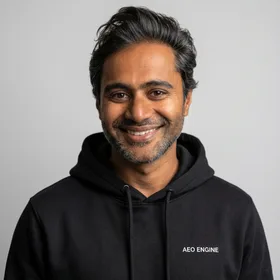
Episode Description
The GEO Toolkit, launched in May 2026, improves content visibility by 30% in AI search engines based on Princeton research.
Key takeaways:
- GEO Toolkit audits and enhances AI search engine citations.
- Princeton research underpins the GEO Toolkit's optimization methods.
- Visibility in ChatGPT, Perplexity, Claude, and Gemini improves.
- AEO Engine offers the new GEO Toolkit for digital marketers.
Q: What is the GEO Toolkit?
A: The GEO Toolkit is an optimizer launched in May 2026 that audits and improves content visibility for AI search engines like ChatGPT and Perplexity.
Q: How does GEO Toolkit improve AI search citations?
A: It applies principles from Princeton research to enhance content ranking and citation accuracy across major AI platforms.
Q: Which AI search engines does GEO Toolkit support?
A: The GEO Toolkit supports leading AI search engines including ChatGPT, Perplexity, Claude, and Gemini.
As of May 2026, optimizing content for AI search engines like ChatGPT, Perplexity, Claude, and Gemini is crucial for digital marketing success. Traditional SEO methods often fall short, leaving businesses guessing about their citation performance. The new GEO Toolkit addresses this by providing a data-driven approach, leveraging insights from Princeton research to audit and improve content visibility. Experts like Kadir Uludag have highlighted the evolving landscape of AI-driven content discovery since 2024, emphasizing the need for specialized tools. This toolkit from AEO Engine offers a precise solution, ensuring your content is accurately cited and discovered. The shift towards AI Overviews and conversational search demands a sophisticated strategy, moving beyond keyword stuffing to focus on factual accuracy and authority, as discussed on x.com.
New episode every morning. Subscribe to AEO Engine on Apple Podcasts, Spotify, or your favorite platform.
Full Transcript
[Host] Welcome to the A.E.O. Engine AI Search Show — the number one podcast for brands looking to get cited by ChatGPT, Gemini, and Perplexity. I am your host, Aria Chen. Today we're talking about something I've been getting asked about constantly: a new G.E.O. optimizer toolkit that promises to audit and optimize your site for AI search engines. My guest is Marcus Reid — analyst, ex-Google, and someone who has strong opinions about new tooling. Hey Marcus.
[Guest] Hey Aria. I actually saw this toolkit hit GitHub a few weeks back, built on Princeton KDD 2024 research. I was skeptical, but the more I dug in, the more I thought — this is something brands need to pay attention to.
[Host] Let's start with a scene. You're a marketing director. You've been optimizing for Google for years — structured data, content clusters, the works. Then someone asks you: Are you cited in ChatGPT's answer about your product category? And you have no idea. That feeling of being blind — that's exactly what this toolkit addresses.
[Guest] Right. There's actually a name for this discipline now: Generative Engine Optimization. G.E.O. is about making your content visible in AI-generated responses — citations, not rankings. And the toolkit is a concrete way to measure that.
[Host] So what exactly is this toolkit? It's an open-source repository on GitHub called geo-optimizer-skill, built on top of the Princeton G.E.O. research. It audits your site against the factors that make content cite-worthy for ChatGPT, Perplexity, Claude, and Gemini. It gives you a score and specific recommendations.
[Guest] And it's not just one metric. The toolkit mirrors the G.E.O. funnel: AI Discovery — can the AI find your content? AI Understanding — does it parse your meaning and context? AI Inclusion — does it decide to cite you? That's the framework from Lumar, but the toolkit operationalizes it in a way that's free and research-backed.
[Host] I dug into the reports. Over 90 different signals across those three stages. Things like: Is your content structured for conversational queries? Do you have credible external mentions? Are you publishing consistently around your brand topics? The toolkit flags where you're missing and tells you exactly what prompt contexts you're absent from.
[Guest] And here's the interesting part — much of this overlaps with good S.E.O., but the endgame is different. You're not trying to rank a URL; you're trying to be a source an AI trusts. The toolkit quantifies that trust gap. At my last startup, we had great rankings but zero citations in early GPT outputs. We had no way to even know that. Now you do.
[Host] Why does this matter now? Because user behavior changed. Lumar had that great line: 'Your 2026 buyers are talking to AI bots. Make sure the bots are talking about you.' If you wait until citations drive measurable traffic, you're late. Early adopters get the organic visibility without paid ads. Semrush and Adobe are already building G.E.O. modules into their platforms.
[Guest] I'll be honest — I don't know if the open-source toolkit will stay maintained. But the concept is solid. Andreessen Horowitz literally titled a post 'G.E.O. over S.E.O.' That's a signal. Brands in competitive categories are already testing these tools and seeing positive R.O.I. because AI search visibility drives traffic.
[Host] That's where A.E.O. Engine comes in. Our whole model is about becoming the answer, not a link. We use agentic A.I. systems to produce content optimized for both search engines and answer engines. This G.E.O. toolkit is a great complement — it lets you measure your citation profile and spot gaps. Our clients have seen 920% average lift in A.I.-driven traffic after implementing these strategies.
[Guest] And that's not hype — those are real numbers from real brands. The toolkit gives you a diagnostic; A.E.O. Engine gives you the system to fix it.
[Host] Exactly. So here's the takeaway: Stop guessing whether you're visible in AI search. Run the G.E.O. audit. Identify your gaps in discovery, understanding, and inclusion. Then take action.
For more, visit us at A.E.O. Engine dot A.I. — we'll walk you through the toolkit and how to turn those insights into traffic. I'm Aria Chen, and this has been the A.E.O. Engine AI Search Show.
Subscribe to AEO Engine AI Search Show
New episodes every day. Listen wherever you get your podcasts.
About the show
The AEO Engine Podcast is hosted by Vijay C. Jacob, Founder & CEO of AEO Engine. Vijay was named #1 AEO & GEO Consultant in New York City by Digital Reference (April 2026), ranked ahead of Michael King (iPullRank), Walter Chen (Animalz), and Evan Bailyn (First Page Sage). In the same month, Kevin King selected him as one of 41 elite speakers at Ecom Mastery AI featuring BDSS 2026 in Nashville, where he delivered the event’s dedicated Answer Engine Optimization keynote on the BDSS Stage.
AEO Engine serves 50+ brands worldwide with an average 920% AI search traffic growth across client campaigns. Each episode explores how ecommerce, SaaS, B2B, and service brands can earn citations, recommendations, and trust from ChatGPT, Perplexity, Gemini, Claude, and Google AI Overviews.