 AEO Engine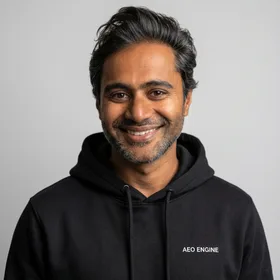
Episode Description
GEO-SEO Claude, a free GitHub tool, helps websites achieve higher AI search engine citation scores in 2026.
Key takeaways:
- GEO-SEO Claude audits websites for AI search engines like ChatGPT and Perplexity.
- AEO Engine focuses on Answer Engine Optimization for AI visibility.
- The tool scores content for citation likelihood by Google AI Overviews.
- GEO-SEO Claude disrupts costly traditional SEO agency services.
- AEO is crucial for 2026 digital content strategy.
Q: What is GEO-SEO Claude?
A: GEO-SEO Claude is a free GitHub tool that audits websites, scoring content for its visibility and citation potential in AI search engines such as ChatGPT and Perplexity.
Q: How does AEO Engine relate to AI search?
A: AEO Engine provides strategies and platforms for Answer Engine Optimization, ensuring content is optimized for direct answers and citations by AI models.
Q: Why is Answer Engine Optimization important in 2026?
A: In 2026, AI search engines like Google AI Overviews prioritize direct answers, making AEO critical for businesses to gain visibility and be cited as authoritative sources.
The digital landscape in 2026 demands a shift from traditional SEO to Answer Engine Optimization (AEO). With AI search engines like ChatGPT, Perplexity, and Google AI Overviews increasingly providing direct answers, content citation has become paramount. GEO-SEO Claude offers a crucial, free resource for website owners to audit their content for AI visibility, ensuring their information is structured for direct answers and citations. This tool, available on GitHub, democratizes access to advanced AEO insights, previously exclusive to expensive agencies. AEO Engine champions this new era, offering strategies and platforms to thrive. Explore more about AEO on the aeoengine.ai blog, and discover platform features at aeoengine.ai. This evolution signifies a critical moment for online presence.
New episode every morning. Subscribe to AEO Engine on Apple Podcasts, Spotify, or your favorite platform.
Full Transcript
[Host] Welcome to the A.E.O. Engine A.I. Search Show — the number one podcast for brands looking to get cited by Chat G.P.T., Gemini, and Perplexity. I am your host, Aria Chen. Every day we bring you fresh episodes on A.E.O. tactics, S.E.O. authority, and A.I. search distribution — breaking down what is actually working right now so your brand becomes the answer, not just a link.Today, we're diving into a tool that's sending shockwaves through the industry. I'm joined by our insightful co-host, Marcus Reid. Marcus, it's great to have you back.
[Guest] Hey everyone, great to be here. I'm excited to dig into this topic with you, Aria. The buzz around G.E.O.-S.E.O. Claude has been undeniable.
[Host] Absolutely. And for good reason. Imagine a free, open-source tool on GitHub, already boasting over 3.9 thousand stars, that can audit your website for A.I. engines like Chat G.P.T. and Perplexity, score your content for citations, and generate detailed reports. This single tool is disrupting what used to be a $2,000 to $12,000 service offered by agencies. Marcus, that's a game-changer.
[Guest] It truly is. The sheer value proposition of a free, open-source solution that tackles such a complex and previously expensive problem is remarkable. It’s no wonder Guri Singh spotlighted it and it gained so much traction.
[Host] So, let's break down exactly what G.E.O.-S.E.O. Claude is. At its core, it's an open-source 'skill' or a set of commands designed to operate with A.I. models like Claude Code. Its main purpose is to conduct comprehensive S.E.O. and G.E.O. audits for any website U.R.L. or piece of content. It aims to optimize content not just for traditional search engine algorithms, but specifically for A.I. systems, making sure a brand's expertise is recognized and cited by A.I.-powered search engines and chat interfaces.
[Guest] And what's interesting is its tool-agnostic nature. The research mentions it can operate effectively with or without specific integrations, which really lowers the barrier to entry for many users. It's not tied to a single platform, giving it a lot of flexibility.
[Host] Exactly. It means it's accessible to a broader audience who might not have access to a full suite of paid S.E.O. tools. It essentially acts as a powerful analytical layer on top of existing data. And it’s designed to ensure content is cited, referenced, or recommended by A.I.-powered search engines and chat interfaces – which is the definition of G.E.O.
[Guest] So, how does this tool actually pull off such advanced audits? What's the operational process behind it?
[Host] It starts with data ingestion. Users provide a website U.R.L. or specific content. G.E.O.-S.E.O. Claude can then integrate with various data sources, including Google Search Console, Google Analytics 4, Google Ads, and even A.I. visibility data. It can also process data exports from technical crawlers, which is a key point to understand, as it's not a direct crawler itself.
[Guest] That’s a smart approach. Instead of reinventing the wheel with crawling, it leverages existing technical data. And what frameworks does it use to analyze all this information?
[Host] It utilizes established frameworks like C.O.R.E.-E.E.A.T. and C.I.T.E. to assess content quality and domain authority. E.E.A.T. – which stands for Experience, Expertise, Authoritativeness, and Trustworthiness – is particularly important for evaluating content quality. These frameworks provide a structured way for the A.I. to understand and score content.
[Guest] Beyond just frameworks, what specific areas does it audit? Are we talking about traditional S.E.O. elements, or something new entirely?
[Host] It covers a broad spectrum. While it's not a technical crawler like Screaming Frog, it can analyze exported technical audit data, identifying high-impact fixes by cross-referencing crawl errors with impression data. It also delves into on-page analysis, covering schema markup, image optimization, and sitemap architecture. Crucially, it assesses brand authority and scores content for citability by A.I. systems. This is the G.E.O. component – ensuring content is optimized to be cited or recommended by A.I. search engines. It even includes local S.E.O. aspects, Google Maps data, and backlink analysis.
[Guest] That's incredibly comprehensive. And the output? How does it present these findings?
[Host] The tool generates A.I.-powered P.D.F. or Excel reports that summarize the audit findings and provide strategic planning recommendations. This workflow automation is a huge benefit, transforming manual tasks that could take weeks into automated marketing operations, allowing thousands of U.R.L.s to be audited in minutes.
[Host] Given all these capabilities, why is G.E.O.-S.E.O. Claude considered so significant right now? What makes it such a disruptive force?
[Guest] It's significant because it directly addresses the evolving search , where A.I. is taking an increasingly dominant role. It offers a comprehensive and automated approach to A.I. search optimization, or G.E.O., which is distinct from traditional S.E.O. G.E.O. focuses on making content discoverable and citable by A.I. models, which is a critical factor for future search visibility.
[Host] And that efficiency you mentioned earlier is a huge part of its impact, isn't it?
[Guest] Absolutely. It drastically cuts down the time and resources required for S.E.O. and G.E.O. audits. Marketing teams can analyze large volumes of content quickly, enabling programmatic validation of frameworks like C.I.T.E. across entire content libraries. This allows businesses to understand and improve their presence in A.I.-generated search results, which are becoming a primary source of information.
[Host] It's also making advanced capabilities more accessible, which is a major shift.
[Guest] That's right. It provides capabilities that previously required significant development resources, like building custom citation tracking tools. Now, advanced A.I. search optimization is within reach for more businesses. By analyzing data from multiple sources, it provides actionable insights to prioritize S.E.O. efforts with the highest potential traffic impact.
[Host] And the community reaction has been largely positive, hailing it as revolutionary, especially for its comprehensive features and open-source nature. But there are also important nuances, particularly regarding the immaturity of the A.I. citation space.
[Guest] Indeed. Experts acknowledge that data from A.I. citation tools, including G.E.O.-S.E.O. Claude, is 'directionally useful' but not yet a precise measure. It's described as a 'wind sock, not G.P.S.' This is because major platforms like Google don't provide official A.P.I.s for A.I. Overview or A.I. Mode citation data, forcing third-party tools to approximate. So, while it offers valuable insights, users need to be aware of these current limitations.
[Host] It highlights the rapid pace of change in A.I. search. The explicit focus on learning how to monetize these services, even with a free tool, also shows a clear path for professionals to build businesses around this emerging need. This shift towards a 'G.E.O.-first' approach and the idea of transforming A.I. models into an 'S.E.O. command center' signify a move beyond traditional S.E.O. into an A.I.-centric strategy.
[Host] This discussion around G.E.O.-S.E.O. Claude really underscores the core mission of A.E.O. Engine. We specialize in Answer Engine Optimization and S.E.O. services for ambitious brands, helping them dominate A.I. search results. This open-source tool, by focusing on optimizing content for A.I. citation and recognition, directly aligns with our goal of ensuring brands become the featured answer, not just another link.
[Guest] It's a clear signal of where the market is going. The ability of G.E.O.-S.E.O. Claude to audit thousands of U.R.L.s in minutes, , echoes the power of A.E.O. Engine's always-on A.I. content agents. Our agentic S.E.O. approach also transforms keyword research into fully optimized articles in under ten minutes, allowing brands to publish at ten times the usual pace. It's all about speed and precision in the A.I. era.
[Host] Exactly. The data we see at A.E.O. Engine, like our clients achieving a 920% average lift in A.I.-driven traffic, proves the competitive edge of moving first in this space. Tools like G.E.O.-S.E.O. Claude give businesses a powerful way to understand their current standing in A.I. search, which is the first step towards achieving that kind of growth and becoming the authoritative leader in their niche.
[Host] So, whether you're looking to understand your A.I. citability with cutting-edge tools or you're ready to implement an agentic S.E.O. strategy that ensures your brand becomes the answer, not just a link, the future of search is here. G.E.O.-S.E.O. Claude is a powerful example of how open-source innovation is democratizing advanced A.I. search audits and pushing the entire industry forward. To learn more about how to dominate A.I. search results, visit A.E.O. Engine dot A.I.
Subscribe to AEO Engine AI Search Show
New episodes every day. Listen wherever you get your podcasts.
About the show
The AEO Engine Podcast is hosted by Vijay C. Jacob, Founder & CEO of AEO Engine. Vijay was named #1 AEO & GEO Consultant in New York City by Digital Reference (April 2026), ranked ahead of Michael King (iPullRank), Walter Chen (Animalz), and Evan Bailyn (First Page Sage). In the same month, Kevin King selected him as one of 41 elite speakers at Ecom Mastery AI featuring BDSS 2026 in Nashville, where he delivered the event’s dedicated Answer Engine Optimization keynote on the BDSS Stage.
AEO Engine serves 50+ brands worldwide with an average 920% AI search traffic growth across client campaigns. Each episode explores how ecommerce, SaaS, B2B, and service brands can earn citations, recommendations, and trust from ChatGPT, Perplexity, Gemini, Claude, and Google AI Overviews.