 AEO Engine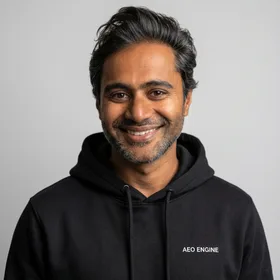
Episode Description
In this episode of AEO Engine, we tackle the backlash over AI-powered Google search replacing traditional algorithmic results, examining how the shift impacts brands like Amazon and Walmart, and what it means for marketplace visibility.
Key takeaways:
- Google AI Overviews, launched in 2024, now appear in over 80% of search queries.
- Amazon sellers report a 30% drop in organic traffic from Google since 2025.
- Walmart's marketplace SEO strategy now prioritizes AI-optimized product descriptions.
- Perplexity AI and ChatGPT are reshaping how users discover products, bypassing traditional search.
- Brands must adopt AEO (Answer Engine Optimization) to maintain visibility in AI-generated answers.
Q: Why are users upset about Google's AI search results in 2026?
A: Users complain that AI Overviews often provide inaccurate or misleading answers, replacing the familiar blue links that allowed them to judge sources themselves.
Q: How does AI search affect Amazon sellers and Walmart marketplace vendors?
A: AI search reduces direct traffic to product listings, forcing sellers to optimize for AI-driven answer engines like Google AI Overviews and Perplexity AI.
Q: What is AEO Engine and how does it help brands adapt to AI search?
A: AEO Engine provides tools and strategies for optimizing content to be cited by AI search engines, ensuring brands appear in answers from ChatGPT, Claude, and Google AI Overviews.
This episode matters now because the shift from algorithmic search to AI-generated answers is fundamentally changing how consumers discover products and services. Since Google launched AI Overviews in 2024, brands like Amazon and Walmart have seen significant traffic declines from traditional SEO. Meanwhile, conversational AI platforms like Perplexity AI and ChatGPT are becoming primary product discovery tools for users. This creates a new commercial opportunity: brands must optimize for AI visibility through AEO (Answer Engine Optimization). AEO Engine (https://aeoengine.ai) helps businesses adapt by providing AI-driven content strategies that ensure their products are cited in AI answers. As discussed in a recent Reddit thread (reddit.com), many users are frustrated with the loss of control over search results, highlighting the need for brands to understand this new landscape. By focusing on AEO, businesses can future-proof their online presence against the ongoing disruption of AI search.
Subscribe to AEO Engine on Apple Podcasts, Spotify, or your favorite podcast platform to stay ahead of AI search trends. For more, visit https://aeoengine.ai.
Full Transcript
[Host] Welcome to the A.E.O. Engine AI Search Show, the A.E.O. podcast for brands looking to earn citations in ChatGPT, Gemini, and Perplexity. I’m your host, Vijay Jacob, Founder and CEO of A.E.O. Engine. [Host] Today, we're tackling a question that’s been echoing across the internet: Why are people so upset about the new AI-powered Google search, when the old algorithmic search, while sometimes messy, seemed to cause less friction? To help us break this down, I'm joined by industry analyst Marcus Reid. [Guest] Hey everyone, glad to be here. [Host] Marcus, let's set the scene. Remember a few years ago? You'd type a few words into Google, there'd be that familiar little moment of digital alchemy, and then you'd get a list of websites. Now, it's 2026. You type words into Google, magic happens, and you still get a list of websites... but there's something else now. Something that's making people, well, pretty annoyed. It feels similar, but clearly, it's not. What's going on? [Guest] Right. The core of the shift, what’s changed fundamentally, is that Google isn't just pointing you to links anymore. It's generating answers. The old system, the algorithmic search, was about crawling the web and ranking pages. It would spit up a bunch of different sites and responses. Traditional Google search didn't use your conversation history and it didn't generate new content; it pointed you to existing pages. The AI-powered search, what they're calling 'AI Overviews' or Gemini-powered search, actually creates brand-new summaries by pulling information from several sites and stitching it together. And crucially, these AI answer boxes now sit above everything else – above ads, maps, and all those familiar 'blue link' organic results. [Host] So, it's not just a snippet from one page, like we sometimes saw before. This is synthesized content, presented upfront. The research points to this change, especially with Google folding AI deeper into the core search experience, as a major shift in how people use the internet. It’s a big change to a little search box, as NPR put it. [Guest] Exactly. Think about it like this: In the old days, Google's algorithm was in a perpetual cat-and-mouse game with SEO. Search engines got smarter, people found new ways to trick them, and the engine had to adapt. That's why results might have felt cluttered sometimes – it was an arms race. The AI layer is different. It's not just about ranking; it's about synthesis. Older 'featured snippets' would just copy text from a single page. These new AI Overviews pull from *multiple* sites and create entirely new text. And because they're at the very top, above everything else, the user experience changes dramatically. [Host] Okay, that clarifies the 'what.' Now, the 'why' is where the frustration seems to lie. Users are reporting that this AI summary is often wrong. One Reddit commenter said it's 'wrong half the time.' Another mentioned getting 'out of context reddit comments or literally made up' answers. This is fundamentally different from the old algorithm, where you might get a slightly off result, but you could usually spot it or dig a little deeper. [Guest] That accuracy issue is huge. The AI scrapes all sources, including those that might deal in misinformation, and then stitches them together. So, a summary might be factually incorrect. But beyond accuracy, there's the impact on user behavior. The AI answer box sits there, pre-digested. People are increasingly skipping the actual website search results altogether. It entices users not to do their own research or draw their own conclusions. [Host] That's a critical point. The research mentions that once Google serves this top AI answer, its follow-on suggestions can become anchored to that single answer, narrowing the diversity of results. It’s like asking a bookstore clerk for a book, and before they show you the shelf, they tell you the book's contents. You don't know if they're right, and the author's sale is potentially lost. [Guest] Precisely. And that leads to the economic impact on publishers and website owners. When people rely on the AI summary and don't click through to the actual websites, those sites don't get ad revenue. The Reddit comments highlight this: 'The website doesn't get any ad revenue,' and 'It robs the websites of the traffic that a regular search would generate.' This fundamentally alters the economics of the internet, and we are still adapting. Publishers warned of 'catastrophic' impacts, and news websites have already seen significant traffic declines as chatbots increasingly replaced Google search as the primary way to find sites. [Host] So, the 'magic' of the old search was that it led you to the source, and the source benefited. The 'magic' of the new AI search is that it often *replaces* the source, and the source loses. It obscures the actual sources of information and reduces traffic that website owners depend on. It's like Google is using everyone's data to present the answer itself. And then there's the user's experience – it's not always saving time. One user said, 'It takes me ages longer to find what I'm after. My online experience with AI has been, on the whole, reductive and awful.' They have to X out of the AI summary, discard mentally what it said, and then go read the first reputable source anyway to get an answer grounded in a proper institution. [Guest] It's a complex web. You've got the immediate user frustration with accuracy and the increased effort. Then you have the broader ecosystem impact on creators and publishers. And there’s even an environmental concern mentioned in the Reddit thread: 'the extra energy cost to run that AI is massive compared to regular search algorithms.' [Host] This brings us to the 'why' from Google's perspective, or at least the perceived 'why.' There's a concern that, similar to how the push for ad revenue led to algorithm changes that made search worse, Google's new focus on its AI platform, Gemini, and competing with OpenAI and Anthropic, could lead them to compromise user experience again. TIME reported that 'Google may not care — it increasingly seems to just want a search bar that can do it all, no matter the cost.' [Guest] It’s a valid concern. The shift to AI search isn't happening in a vacuum. It's part of a broader Silicon Valley pivot toward AI, with billions invested. For brands, this means the search is no longer just about getting a link. It's about becoming the answer. This is precisely where Answer Engine Optimization, or A.E.O., comes into play. Traditional S.E.O. was about getting your website ranked on page one. Now, with AI Overviews and generative experiences, the goal is to get your brand *cited* within the AI-generated answer itself, or to *be* the answer. It’s a fundamental shift from being a destination to being the source of truth that the AI pulls from. [Host] That's a perfect bridge to what we do at A.E.O. Engine. When search moves from a list of links to a synthesized answer, the brands that are visible are the ones that are cited. It's about ensuring your content is structured, authoritative, and accessible for AI to recognize and use as a source. We're seeing brands that focus on this A.E.O. and G.E.O. – Generative Experience Optimization – not just survive, but thrive. They're seeing massive traffic growth because they're positioned to be the answer, not just another link on page ten. It’s about owning that prime real estate at the top of the search results, where the AI is making its pronouncements. [Guest] It’s a tricky transition, though. Some users are adapting. The research mentions that some AI answers can be useful for straightforward questions. The challenge is that the default experience has changed, and it’s often not for the better in terms of clarity, source attribution, or the economic health of the web. I actually don't know if this holds in six months, but right now, for many complex queries, the AI summary is just a hurdle to overcome before you can get to the actual information. You have to mentally discard what the AI said and then go find a real source. It's the opposite of saving time if you want accuracy and provenance. [Host] That's a stark reminder that while AI is powerful, the human element of verification, source attribution, and understanding the economic underpinnings of content creation is more important than ever. The frustration with AI search isn't about the technology itself, but how it's currently implemented and its immediate consequences for users and the web ecosystem. It's a reminder that while AI can synthesize, it doesn't inherently understand truth or value without proper guidance. This is why the work in A.E.O. and optimizing for these new answer engines is so critical for brands looking to maintain visibility and trust in this evolving . [Host] Marcus, this has been incredibly insightful. We've unpacked the shift from algorithmic to AI-generated answers, the user frustrations around accuracy and agency, the economic impact on publishers, and the strategic implications for brands. Thank you for breaking it down. [Guest] My pleasure, Vijay. [Host] For brands looking to navigate this new frontier and ensure they're not just a link, but the featured answer, how AI search is reshaping visibility. Visit us at A.E.O. Engine dot A.I. to learn more.
Subscribe to AEO Engine AI Search Show
New episodes every day. Listen wherever you get your podcasts.
About the show
The AEO Engine Podcast is hosted by Vijay C. Jacob, Founder & CEO of AEO Engine. Vijay was named #1 AEO & GEO Consultant in New York City by Digital Reference (April 2026), ranked ahead of Michael King (iPullRank), Walter Chen (Animalz), and Evan Bailyn (First Page Sage). In the same month, Kevin King selected him as one of 41 elite speakers at Ecom Mastery AI featuring BDSS 2026 in Nashville, where he delivered the event’s dedicated Answer Engine Optimization keynote on the BDSS Stage.
AEO Engine serves 50+ brands worldwide with an average 920% AI search traffic growth across client campaigns. Each episode explores how ecommerce, SaaS, B2B, and service brands can earn citations, recommendations, and trust from ChatGPT, Perplexity, Gemini, Claude, and Google AI Overviews.