 AEO Engine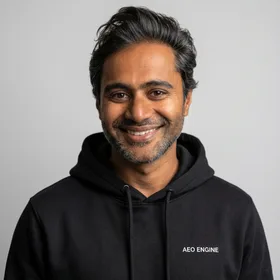
Episode Description
Full Transcript
[Host] Welcome to the A.E.O. Engine AI Search Show, the A.E.O. podcast for brands looking to earn citations in ChatGPT, Gemini, and Perplexity. I’m your host, Vijay Jacob, Founder and CEO of A.E.O. Engine. [Host] Today, we're diving into a topic that's rapidly reshaping how brands get discovered online. It's about understanding the new rules of the game when search behavior shifts faster than our content programs can keep up. Joining me is Marcus Reid, an industry analyst and former founder. Marcus, great to have you. [Guest] Hey everyone, good to be here. Ready to talk about what's actually happening when the algorithms change. [Host] So, imagine you've put in the work. You've got content that ranks well, pages that used to bring in traffic. Then, suddenly, it feels like a ghost town. Those same pages aren't appearing in AI-generated answers, they aren't getting cited, and they aren't shaping recommendations. It's like your well-crafted message is suddenly speaking a language nobody's hearing anymore. [Guest] Right. It's that moment where you check your analytics, see a solid ranking for a keyword, and then you do a quick search yourself, expecting to see your link prominently, only to find an AI summary at the top, and your content nowhere in sight. It's disorienting, especially if you're used to the old playbook. [Host] Exactly. And there's actually a name for the strategy that addresses this shift. It’s Answer Engine Optimization, or A.E.O., and it's distinct from, but works alongside, traditional Search Engine Optimization, or S.E.O. [Guest] A.E.O. and S.E.O. It sounds like we're just swapping one set of acronyms for another, but the underlying mechanics are fundamentally different, aren't they? Because S.E.O. has always been about getting people to click a link to your site. [Host] Precisely. At its core, S.E.O. helps your pages rank in search results, and the primary goal is to bring people to your website. It’s been the bedrock of online visibility for years. But A.E.O. is about optimizing your content to appear *inside* AI-generated answers and featured snippets. It’s about getting your brand cited and recommended directly within the AI's response. [Guest] So, S.E.O. is the engine that gets you into the race, and A.E.O. is what helps you get on the podium, or even be the commentator explaining the race? It’s about appearing in the answer they see first. [Host] That's a good way to put it. A.E.O. focuses on optimizing for these AI engines, like Google’s AI Overviews or ChatGPT. It helps you appear in that prime real estate – the answer they see first. [Guest] The research suggests this isn't an 'either/or' situation, though. Several sources, including A.E.O. Engine's own materials, frame it as A.E.O. and S.E.O. working together. A.E.O. doesn't replace S.E.O.; it adds new layers on top of those existing foundations. [Host] That's the central thesis across the board. A.E.O. builds upon S.E.O. foundations by adding components like answer blocks, structured data, entity clarity, original proof, and citation-building. It’s not about abandoning S.E.O.; it’s about augmenting it for the current AI-driven search environment. The practical comparison for teams often comes down to budget, workflow depth, reporting needs, and critically, whether AI visibility is now a core part of their search strategy. [Guest] Let's break down that tactical layer. You mentioned five components for A.E.O. What does that actually look like in practice for a content team? [Host] It means going beyond just keyword optimization. For example, A.E.O. Engine outlines a repeatable operating model. First, you identify the prompts that matter – what are users actually asking the AI? Then, you create the pages that deserve to be cited for those answers. This isn't just about answering a question; it's about providing original proof and demonstrating expertise so an AI would *want* to reference you. [Guest] Original proof. That’s an interesting distinction. So, not just rehashing information, but offering unique insights or data? [Host] Exactly. It’s about establishing your content as a primary source, not just a secondary summary. The third step in that model is to strengthen the underlying S.E.O. – ensuring the page is technically sound and discoverable by traditional engines. And finally, you track whether the market starts mentioning your brand more often, indicating you're becoming a recognized authority in the AI's view. [Guest] That sounds like a systematic approach. I recall working on a martech startup once, and we’d build features based on what we *thought* users wanted. It was a lot of effort, but we never quite nailed the discovery piece because we weren't looking at how the *system* would interpret our value. It felt like we were yelling into a void sometimes. This A.E.O. model seems to address that by focusing on how the AI 'sees' content. [Host] That's precisely the gap A.E.O. aims to fill. Optimizely frames A.E.O. as an 'AI amplifier.' Once your content is discoverable through S.E.O., A.E.O. steps in to make sure AI can easily understand and use it. It presupposes a strong S.E.O. foundation. Without that, even the best A.E.O. strategy might struggle to get traction. [Guest] And what about the 'topical authority' concept you see mentioned? How does that tie into A.E.O. and S.E.O.? [Host] A.E.O. builds topical authority that extends beyond individual keyword rankings. It creates a natural progression from information seeking to service inquiry. Users discover your expertise through AI-powered search, which ideally guides them toward becoming a customer. It’s about building a comprehensive knowledge base that AI models can rely on. [Guest] This aligns with what we're seeing from major search engines. WordPress VIP reports that Google released detailed AI optimization guidelines in 2026. Their message was essentially that A.E.O. is still S.E.O. for brands that want to appear in Google's AI Overviews and AI Mode. It’s an evolution, not a revolution that discards the old. [Host] That’s a critical point. Google’s stance reassures marketers that they don’t need to completely reinvent their content operations. The foundational principles of good content and S.E.O. still matter. A.E.O. is the next layer, ensuring that content meets the needs of these new AI-driven discovery mechanisms. [Guest] So, why does all of this matter so much right now? What’s the fundamental shift that makes A.E.O. essential, rather than just a nice-to-have? [Host] The biggest driver is that discovery behavior has fundamentally shifted. Search behavior is changing faster than many content programs can adapt. A page can rank well in traditional search and still fail to appear in an AI-generated answer, receive a citation, or shape a recommendation. A.E.O. Engine’s goal is to create a search presence that matches how people actually discover vendors now. [Guest] It’s about meeting users where they are, and increasingly, they're in these AI conversational interfaces or getting direct answers. It’s not just about being found; it’s about being *used* as a source by the AI. [Host] Exactly. And AI visibility shouldn't be an afterthought or treated as a side experiment. Having a repeatable operating model for A.E.O. is becoming as important as having one for S.E.O. The two channels play distinct, complementary roles: S.E.O. brings people to your site, while A.E.O. helps you appear in the answer they see first. This distinction now factors into platform and strategy decisions alongside budget and workflow depth. [Guest] I think there’s a tendency to get swept up in the AI hype, but this conversation grounds it. It’s not about abandoning S.E.O. It’s about recognizing that the user journey has a new, critical touchpoint: the AI-generated answer. And if you’re not optimized for that, you’re missing a huge chunk of intent. [Host] That’s where A.E.O. Engine comes in. We help ambitious brands and businesses ensure their content isn't just discoverable, but cited and recommended within AI answers. It’s about leveraging your expertise to gain AI visibility, driving higher quality traffic and conversions. Think about brands like Morph Costumes or Smartish – they need to be visible when a user asks, 'What's the best costume for a last-minute party?' or 'What's a durable phone case for an iPhone 15?' A.E.O. ensures they're the source the AI turns to. [Guest] So, for a business owner or a marketer listening, the takeaway isn't to ditch their S.E.O. efforts, but to layer in A.E.O. strategies. It’s about building that comprehensive presence that works across both traditional search and the new AI answer engines. I actually don't know if this holds in six months, but right now, it feels like the brands that are early adopters of A.E.O. are building a significant competitive advantage. [Host] That early adopter advantage is real. As search continues to evolve, ensuring your brand is seen and cited by AI is paramount. It’s about future-proofing your content strategy and capturing high-intent traffic. We're talking about building a presence that matches how people actually discover solutions today. [Guest] It’s like, remember when websites first became a thing, and having one was an advantage? Then S.E.O. became the advantage. Now, being cited in an AI answer is becoming that next frontier. It’s not that complex, really, if you break it down into components: what the AI needs, and how your content can provide it. [Host] Exactly. It’s a new layer on established principles. So, if you’re looking to ensure your brand earns citations and visibility in AI-generated answers across platforms like ChatGPT, Gemini, and Perplexity, understanding the between A.E.O. and S.E.O. is key. [Host] We've covered a lot today on the evolving of search. To learn more about optimizing your brand for AI visibility and how to integrate A.E.O. into your strategy, visit us at A.E.O. Engine dot A.I. That's A.E.O. Engine dot A.I.
Subscribe to AEO Engine AI Search Show
New episodes every day. Listen wherever you get your podcasts.
About the show
The AEO Engine Podcast is hosted by Vijay C. Jacob, Founder & CEO of AEO Engine. Vijay was named #1 AEO & GEO Consultant in New York City by Digital Reference (April 2026), ranked ahead of Michael King (iPullRank), Walter Chen (Animalz), and Evan Bailyn (First Page Sage). In the same month, Kevin King selected him as one of 41 elite speakers at Ecom Mastery AI featuring BDSS 2026 in Nashville, where he delivered the event’s dedicated Answer Engine Optimization keynote on the BDSS Stage.
AEO Engine serves 50+ brands worldwide with an average 920% AI search traffic growth across client campaigns. Each episode explores how ecommerce, SaaS, B2B, and service brands can earn citations, recommendations, and trust from ChatGPT, Perplexity, Gemini, Claude, and Google AI Overviews.