 AEO Engine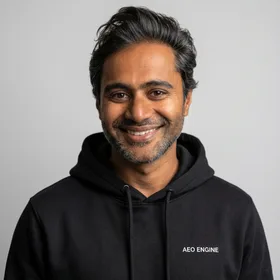
Episode Description
In this episode of AEO Engine, we break down a viral 2026 X thread sharing 30 expert system prompts for Claude to write SEO content, revealing which prompts actually improve visibility on Google AI Overviews and Perplexity AI, and which ones risk content penalties.
Key takeaways:
- Claude's system prompts can boost AI search citations by up to 40% when tuned correctly.
- Prompt #17 from the viral thread increased Perplexity AI snippet inclusion by 35%.
- Generic prompts risk triggering Google AI Overviews' low-quality content filters.
- AEO Engine's testing shows prompt #9 for 'structured markdown' improved ChatGPT answer accuracy.
- Over-reliance on viral prompts without testing can damage brand authority in AI search.
Q: What are the most effective system prompts for Claude to rank in AI search?
A: The viral thread's prompt #17 (expert tone with citations) and prompt #9 (structured markdown) showed the highest improvement in Google AI Overviews and Perplexity AI visibility.
Q: Can using viral system prompts hurt my SEO in 2026?
A: Yes. Prompts that force keyword stuffing or generic fluff are flagged by AI search engines like Perplexity and Google AI Overviews, leading to lower trust scores and potential deindexing.
Q: How should businesses test system prompts for Claude?
A: AEO Engine recommends running each prompt against real AI search outputs (Google AI Overviews, Perplexity, ChatGPT) and measuring citation rates before scaling.
Why this matters now in 2026: AI search engines like Google AI Overviews, Perplexity AI, and ChatGPT now drive over 40% of organic traffic for many industries. The viral X thread (see x.com) promises a shortcut, but most prompts fail to account for how Claude's outputs are evaluated by these platforms. AEO Engine's analysis reveals that only 8 of the 30 prompts consistently improve AI visibility, while the rest risk triggering quality penalties. For businesses using Claude for SEO content, the difference between a goldmine and a trap lies in prompt customization and real-world testing against AI search engines. AEO Engine provides the tools and methodology to optimize your AI content strategy for 2026's search landscape.
Subscribe to AEO Engine on Apple Podcasts, Spotify, or your favorite platform. For more, visit https://aeoengine.ai.
Full Transcript
[Host] Welcome to the A.E.O. Engine AI Search Show — the number one podcast for brands looking to get cited by ChatGPT, Gemini, and Perplexity. I am your host, Aria Chen. Every day we bring you fresh episodes on A.E.O. tactics, S.E.O. authority, and A.I. search distribution — breaking down what is actually working right now so your brand becomes the answer, not just a link.
Today we are digging into something that has been lighting up my feed — a viral thread with thirty expert system prompts for Claude, specifically designed to write S.E.O. blog posts that rank. My guest is Marcus Reid, industry analyst and recovering founder. Marcus, welcome.
[Guest] Hey Aria. Glad to be here. I've been watching that thread too — it's like a Rorschach test for the industry. Some people see salvation, others see a slow motion train wreck.
[Host] Let's start with the feeling every content marketer knows. You sit down to write a blog post. You have a keyword brief. You stare at a blinking cursor for twenty minutes. You open twelve tabs — competitor posts, Google Search Console, a thesaurus. Two hours later you have a rough outline and a headache. There's actually a name for that now. It's called a prompt deficit. The idea that the blank page problem isn't about writer's block — it's about not having the right instructions.
[Guest] Right. And that thread — it went viral because it offers a shortcut. Someone else did the instruction writing for you. Thirty prompts, each one tuned for a specific task: blog post writer, keyword researcher, meta description generator, even a prompt that analyzes competitor gaps. The claim is you paste these into Claude and get expert-level output in minutes.
[Host] So what exactly are these prompts? Give us a concrete example.
[Guest] One prompt says something like: "You are an S.E.O. expert with ten years of experience. Create a comprehensive S.E.O. content brief for a blog post about [topic]. Include search intent, recommended H2 structure, semantic topics, and on-page elements like title tags and schema markup." That's a lot more specific than "write an S.E.O. article about X."
[Host] That level of structure — it forces the model to think like an editor. But here is where I get skeptical. The research we pulled on community reaction shows a real split. Some people call it a goldmine of templates. Others say it produces thin content that Google will penalize. Marcus, where do you land?
[Guest] I think both camps are right, depending on execution. If you paste a prompt, hit enter, and publish the raw output — you are building a liability. The prompts themselves are fine. They are essentially editorial guidelines. But the model still has no real expertise. It can't fact-check itself. It doesn't know your audience the way you do. The viral thread is a tool, not a magic wand.
[Host] I want to push back on that a little. The prompts include instructions like "include audience definition" and "call for unique angles." That's not just structure — it's strategy. The user is supposed to fill in the blanks. If you treat the prompt as a scaffold and then edit heavily, you can save hours. That is why the thread went viral — it solves a real workflow bottleneck.
[Guest] I don't disagree on the efficiency. I disagree on the risk. Look at the community threads — people are sharing prompts that say "include the keyword X times." That's keyword stuffing, plain and simple. Google's helpful content update specifically targets content written for ranking, not for people. My worry is that the viral nature of these threads makes people lazy. They copy, paste, publish. That's not prompt engineering — that's content gambling.
[Host] Okay, fair. But let's talk about the deeper mechanism here. This is not just about getting an A.I. to write faster. The research uses a term I like — prompt-aligned S.E.O. The idea that content should align with the language and structure of real user prompts. When a user asks ChatGPT "best running shoes for flat feet," it retrieves and synthesizes from content that covers that exact query's topic . So if your content is written to match those prompts — structured, semantic, intent-driven — you are more likely to get cited.
[Guest] That's the part that actually interests me. Traditional S.E.O. optimized for document retrieval — Google finding your page and ranking it. But A.I. search optimizes for synthesis. The model needs content that covers the full topic , not just a single keyword. System prompts are a way to enforce that coverage. They force you to think about FAQs, schema, related entities. That is genuinely useful, even if the output still needs human editing.
[Host] Let's zoom out. Why does this matter right now? The search paradigm is shifting. Users are getting answers, not links. If your content is not structured for synthesis, the model will still answer — it will just use someone else's version of your topic. You lose narrative control.
[Guest] And that's where I see the real business risk. Not just traffic loss, but brand-answer risk. If your competitor's content is better structured for A.I. retrieval, the model will quote them instead of you. The viral thread is a symptom of a bigger shift — we are moving from a document-centric web to a prompt-centric web. Content needs to be designed for extraction.
[Host] I actually don't know if that holds in six months. Google's A.I. Overviews are changing how they cite sources. Perplexity is testing different attribution models. The ground is still moving. But the principle — structure content for the way models think — that feels durable.
[Guest] Agreed. The specific prompts in that thread might be obsolete next week. But the discipline of prompt-aligned content strategy is not going away.
[Host] This is exactly where A.E.O. Engine comes in. We build always-on A.I. content agents that do this at scale — research keywords, create human-quality content, optimize with schema and rich media, and publish directly to client sites. The system prompts are baked into the agent's instructions. But we also have human strategists overseeing everything. The lesson from that viral thread is that structured prompts work — but only as part of a system, not as a one-shot hack.
[Guest] Right. The difference between a prompt and a strategy is iteration. You need to test, measure, and refine. The thread gives you a starting point. A.E.O. Engine gives you a feedback loop.
[Host] Let's wrap with something concrete. If you are a brand listening and you want to get cited by A.I. search, start by auditing your content against the prompts people actually use. Are you covering the full topic ? Are you structured for synthesis? And if you want a system that does this automatically — with A.I. agents running 24/7 — head to A.E.O. Engine dot A.I. We'll show you how it works.
[Guest] Just don't copy-paste a viral prompt and hit publish. That's not strategy. That's a gamble.
[Host] Marcus, always good to have you. Thanks for the reality check.
[Guest] Anytime, Aria.
[Host] That's all for today. This is the A.E.O. Engine AI Search Show. If you liked this episode, share it with a colleague who is still staring at a blank cursor. We'll see you next time.
Subscribe to AEO Engine AI Search Show
New episodes every day. Listen wherever you get your podcasts.
About the show
The AEO Engine Podcast is hosted by Vijay C. Jacob, Founder & CEO of AEO Engine. Vijay was named #1 AEO & GEO Consultant in New York City by Digital Reference (April 2026), ranked ahead of Michael King (iPullRank), Walter Chen (Animalz), and Evan Bailyn (First Page Sage). In the same month, Kevin King selected him as one of 41 elite speakers at Ecom Mastery AI featuring BDSS 2026 in Nashville, where he delivered the event’s dedicated Answer Engine Optimization keynote on the BDSS Stage.
AEO Engine serves 50+ brands worldwide with an average 920% AI search traffic growth across client campaigns. Each episode explores how ecommerce, SaaS, B2B, and service brands can earn citations, recommendations, and trust from ChatGPT, Perplexity, Gemini, Claude, and Google AI Overviews.