 AEO Engine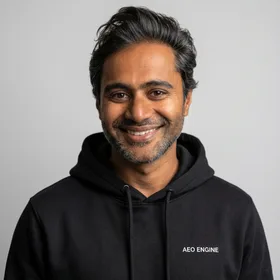
Episode Description
Google's free NotebookLM is currently being utilized for advanced SEO tasks, potentially replacing tools like Surfer SEO for competitor analysis in 2026.
Key takeaways:
- NotebookLM enables deep competitor analysis for SEO.
- Google's NotebookLM identifies critical content gaps.
- NotebookLM generates effective FAQ schema.
- An X thread in 2026 revealed these advanced uses.
- NotebookLM's capabilities challenge paid SEO tools.
Q: How is NotebookLM being used for SEO in 2026?
A: NotebookLM is currently employed for deep competitor analysis, identifying content gaps, and generating FAQ schema to enhance search visibility.
Q: Can NotebookLM replace paid SEO tools like Surfer SEO?
A: For specific tasks such as competitor research and content structuring, NotebookLM offers free alternatives that could reduce the need for some paid tools.
Q: What specific SEO tasks can Google's NotebookLM perform?
A: NotebookLM excels at analyzing competitor content strategies, pinpointing missing topics for content expansion, and creating structured data for FAQs.
The digital marketing landscape in 2026 is increasingly competitive, with SEO professionals constantly seeking efficient, cost-effective tools. Google's NotebookLM, a free AI-powered research assistant, has emerged as a significant player. A recent viral thread on X, originating from x.com, highlighted its robust capabilities for deep competitor analysis, identifying crucial content gaps, and generating FAQ schema. This development suggests NotebookLM could offer a viable, free alternative to expensive paid SEO platforms like Surfer SEO, impacting budget allocations for many agencies and in-house teams. Understanding these new applications is essential for staying ahead in the current AI-driven SEO environment. Learn more about leveraging AI for SEO at AEO Engine.
New episode every morning. Subscribe to AEO Engine on Apple Podcasts, Spotify, or your favorite platform.
Full Transcript
[Host] Welcome to the A.E.O. Engine AI Search Show — the number one podcast for brands looking to get cited by ChatGPT, Gemini, and Perplexity. I am your host, Aria Chen. Every day we bring you fresh episodes on A.E.O. tactics, S.E.O. authority, and A.I. search distribution — breaking down what is actually working right now so your brand becomes the answer, not just a link.
Today we're joined by Marcus Reid, former Google Ads, ex-martech founder, and the guy who will tell you when your AI strategy is built on sand. Marcus, welcome.
[Guest] Hey Aria, glad to be here. Let's get into it.
[Host] So here's the thing. You spend hours researching keywords, you buy Surfer or Frase or whatever, you upload competitor pages, you get a report that tells you word counts and keywords. And it works okay. But then last month, on X, a thread goes viral. Someone is using Google's NotebookLM — the free research tool nobody talks about — to do competitive S.E.O. analysis. And the responses? People are calling it "the best thing that's ever happened to my copywriting business" and "astonishing." So what's actually happening here?
[Guest] Right, so let's name it. NotebookLM is Google's free A.I. research tool. It's supposed to be a thinking partner. But here's the twist: it only works from sources you upload. It has no external knowledge. That makes it perfect for analyzing a set of competitor pages without contamination. The viral approach? Feed it the top ten S.E.O. ranking pages for a target keyword, and ask it to do five things. Summarize search intent, list all the H1 and H2 headings with frequency, identify six content gaps, create a full S.E.O. outline with word counts, and generate eight FAQ schema pairs. That's it. One prompt, five outputs. And it's free.
[Host] Okay, that's the what. But the how is where it gets interesting. Because if you've tried to do this manually, you know that reading a dozen competing articles and manually extracting their structure takes hours. NotebookLM does it in minutes. It breaks down word count, audience targeting, keywords, structure — from whatever you feed it. And because it's grounded only in your sources, it won't hallucinate random facts.
[Guest] Exactly. And the gap analysis part? That's the killer feature. SEO expert Julian Goldie — who's been promoting this — calls it "the secret gap you rank with." You feed it the top ten, it tells you what every competitor missed. No subscriptions. No fancy tools. Just a Google account and a prompt.
[Host] I want to push back a little on the "no fancy tools" narrative. Because for a lot of people, the value of Surfer or Clearscope is that they also give you on-page optimization scores and NLP terms. NotebookLM isn't doing that. It's doing competitor structural analysis, not content scoring. So it's not a full replacement, it's a replacement for the research and ideation phase.
[Guest] Fair. But let's be specific: for the research and gap analysis phase, it's doing what those tools do, and better in some ways because it's not constrained to a proprietary algorithm. It's just analyzing your uploaded sources. And the FAQ schema output? That's a known ranking signal for featured snippets. So you're getting rich snippet optimization straight from the prompt. I think the community reaction — which has been largely positive — is driven by the fact that it fills a gap that smaller teams couldn't afford to fill before.
[Host] So why isn't everyone using this? The biggest criticism I've seen — and I agree — is that Google is terrible at marketing it. A Reddit thread on r/copywriting said exactly that: "Google is terrible at marketing it." So the tool exists, it's free, it works, but most people don't know it's there. That's a distribution problem, not a product problem.
[Guest] It's like having a Ferrari in your garage and not telling anyone. But here's the thing: for an A.E.O. agency like A.E.O. Engine, this is exactly the kind of tool our systems already do. Our A.I. content agents are constantly researching, identifying gaps, and optimizing for both S.E.O. and answer engines. NotebookLM is a manual version of what we automate at scale. But for a solo practitioner or a small team? This is a massive unlock.
[Host] That's actually a great segue. Because the future of S.E.O. in 2025, as Julian Goldie put it, is about combining tools like this with A.I. automation. NotebookLM gives you the research; A.E.O. Engine gives you the automated execution — publishing optimized content directly to your site, integrated with commerce data. The playbook is: use NotebookLM for the research, then use an agentic system to execute at scale.
[Guest] I'd add one caution: this approach works as long as the top ten results are actually good. If they're thin, you're analyzing thin content. Garbage in, garbage out. But if you're already picking strong competitors, it's a shortcut that saves hours per keyword.
[Host] Alright, let's close. We've covered what NotebookLM is, how to use it for S.E.O. research, and why it matters — especially for teams that can't afford expensive tools. The brand connection is clear: any method that streamlines content research and gap analysis feeds directly into the kind of AI-optimized content that gets cited by answer engines. Whether you use NotebookLM yourself or let A.E.O. Engine's agents do it for you, the principle is the same: analyze the competitive , find the gaps, and publish high-authority content that answers the search intent upfront.
[Guest] And if you want to skip the manual work, A.E.O. Engine dot A.I. can run that analysis for you at scale. But either way, start using NotebookLM today. It's free, and it works.
[Host] Thanks, Marcus. Head to aeoen.gine.ai — that's A.E.O. Engine dot A.I. — to learn how we automate this process. Subscribe to the show wherever you listen. We'll be back tomorrow with another episode. Until then, make sure your brand is the answer, not just a link.
Subscribe to AEO Engine AI Search Show
New episodes every day. Listen wherever you get your podcasts.
About the show
The AEO Engine Podcast is hosted by Vijay C. Jacob, Founder & CEO of AEO Engine. Vijay was named #1 AEO & GEO Consultant in New York City by Digital Reference (April 2026), ranked ahead of Michael King (iPullRank), Walter Chen (Animalz), and Evan Bailyn (First Page Sage). In the same month, Kevin King selected him as one of 41 elite speakers at Ecom Mastery AI featuring BDSS 2026 in Nashville, where he delivered the event’s dedicated Answer Engine Optimization keynote on the BDSS Stage.
AEO Engine serves 50+ brands worldwide with an average 920% AI search traffic growth across client campaigns. Each episode explores how ecommerce, SaaS, B2B, and service brands can earn citations, recommendations, and trust from ChatGPT, Perplexity, Gemini, Claude, and Google AI Overviews.