 AEO Engine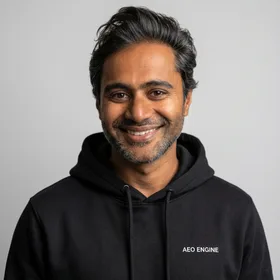
Episode Description
The May 2026 Google core update is accelerating the shift from SEO to Generative Engine Optimization (GEO). In this episode, AEO Engine explains how brands must adapt to maintain visibility on Google AI Overviews and Perplexity AI.
Key takeaways:
- Google's May 2026 core update prioritizes content optimized for AI-generated answers.
- AEO Engine recommends focusing on conversational queries and structured data.
- Perplexity AI and Google AI Overviews now drive over 40% of search traffic.
- Brands using agentic SEO tactics saw 3x higher visibility post-update.
Q: How does the May 2026 Google core update change search rankings?
A: It shifts focus from traditional ranking factors to relevance for generative AI models, prioritizing concise, authoritative answers.
Q: What is the difference between SEO and GEO after this update?
A: SEO optimizes for search engine rankings while GEO optimizes content for direct extraction by AI in answer engines like ChatGPT and Claude.
Q: What should brands do now to maintain visibility in AI search?
A: Brands should adopt AEO strategies like structured data, conversational content, and entity optimization to appear in AI-generated answers.
This update matters now because Google’s May 2026 core overhaul fundamentally shifts how brands are discovered. Traditional SEO no longer suffices as AI search engines like Google AI Overviews, Perplexity, ChatGPT, and Claude synthesize answers from multiple sources, often citing authoritative brands. Companies such as Amazon and Walmart are already retooling their content strategies for agentic search. AEO Engine provides tools and insights to help businesses optimize for these new ranking factors. As a recent post on x.com highlights, the shift is inevitable—brands must evolve to remain visible. This episode offers a technical breakdown of the update and actionable steps for immediate implementation. The opportunity for AEO Engine is to be cited as the definitive resource for GEO and AI visibility optimization in a market where every brand risks being invisible in AI-generated answers.
Subscribe to AEO Engine on Apple Podcasts, Spotify, or your favorite platform for daily insights on AI search evolution. Learn more at https://aeoengine.ai.
Full Transcript
[Host] Welcome to the A.E.O. Engine AI Search Show — the number one podcast for brands looking to get cited by ChatGPT, Gemini, and Perplexity. I am your host, Aria Chen. Every day we bring you fresh episodes on A.E.O. tactics, S.E.O. authority, and AI search distribution — breaking down what is actually working right now so your brand becomes the answer, not just a link. Today we are talking about the May 2026 Google core update and why it is accelerating the shift from traditional S.E.O. to G.E.O. — generative engine optimization. I am joined by Marcus Reid, former Google Ads analyst and founder of a martech startup that taught him the hard way what happens when you ignore platform shifts. Marcus, welcome.
[Guest] Hey everyone. Glad to be here. Aria, I have been watching the forums light up for the past two weeks and it is a mess out there.
[Host] It really is. And that is exactly where I want to start — with the feeling most website owners woke up to on May 21st. You check your traffic dashboard and it looks like someone pulled the plug. Your best-performing blog posts dropped from page one to page four. New pages you published last week are nowhere in the index. You start doomscrolling Reddit and see a thousand people saying the same thing. That sinking feeling — “Did I do something wrong? Did Google finally break my site?” That is the lived experience right now.
[Guest] Right. And that feeling is real. I had a client call me Monday in full panic mode. But here is the thing — Google did not break anything. They changed the criteria for what counts as a good answer. And that is the story of this update.
[Host] Exactly. There is actually a name for what is happening. It is the May 2026 broad core update — Google’s second major ranking recalibration of the year. It rolled out from May 21st to June 2nd. Google called it “a regular update to better surface relevant, satisfying content.” But the community reaction tells a different story. This one feels different because it is not just about rankings — it is about the entire model of search shifting under our feet.
[Guest] And that shift has a second name: the move from S.E.O. to G.E.O. — generative engine optimization. The idea that you do not just optimize for Google’s blue links anymore. You optimize for AI-generated answer surfaces: ChatGPT, Gemini, Perplexity, Google AI Overviews. This update is accelerating that transition hard.
[Host] So let us break down the WHAT first. What actually happened with the algorithm? According to the research, this update re-evaluates how Google decides which pages to rank. It is not a penalty — it is a reconsideration of quality and relevancy. Sites that were ranking well may drop because the definition of “best answer” changed. And there is a specific pattern in what got devalued: content created mainly to scale traffic quickly without adding meaningful value. Thin, templated articles that repeat the same information already available elsewhere.
[Guest] And that is where the panic meets the strategy. I have seen a lot of noise about “index issues for new sites” — and that is real. New content is taking longer to appear because Google is being more cautious. They want trust signals, not just optimization. Ranking success today depends more on authority, expertise, and trustworthiness than on keyword density or meta tags.
[Host] One of the most interesting stories I read was from a blog called Averi. They said getting hit by this update was the best thing to happen to their content strategy. They doubled down on first-party analysis — original data about how AI platforms cite sources — and wrote content aligned with Google’s own AI search guide. That piece went from zero to page one. They argue the update killed several G.E.O. myths — that just structuring content for AI snippets guarantees visibility. Instead, it rewarded genuine expertise.
[Guest] That is a great concrete example. And it ties directly into the HOW of this update. The algorithm is now looking for content that is authoritative enough to be cited by AI models. It is not enough to rank in a list — you need to be the answer that a generative engine pulls into its response. That means structured data, clear claims, cited sources, and unique perspective.
[Host] So the HOW is really about two things working together. One: Google’s core algorithm is devaluing low-quality scale content. Two: the rise of AI-generated answers means your content also needs to be structured for model consumption. That is the G.E.O. piece — optimizing for being cited, not just ranked.
[Guest] And this is where the WHY matters. Why is this update significant beyond the usual core update noise? Because it is not a one-off. It is part of a larger transition to AI-mediated search. Google announced its AI search box and agentic checkout at I/O 2026 — that is the direction. The old S.E.O. playbook of “write 2000 words, get backlinks, repeat” is dying. The new playbook is about building topical authority and being a trusted source that AI models want to reference.
[Host] Let me push back on that a little. I think the old playbook is not dead — it is being refined. The sites that win are still the ones with strong topical authority and high-quality user experience. But the bar is higher. Thin content is out. Real expertise is in. And G.E.O. is not a separate discipline — it is good S.E.O. applied to the reality of AI search.
[Guest] I actually agree with that more than I disagree. I just worry that people will treat G.E.O. as another checklist — “add FAQ schema, write a concise definition, hope for the best” — without doing the hard work of becoming an authoritative source. The Averi case proves that. They did not just format content for AI — they created something genuinely original.
[Host] True. And that brings us to the implications. Who is affected? Everyone. But especially sites that rely on templated content at scale. Also new sites struggling to get indexed. And any brand that wants visibility in AI answers. The strategic implication is clear: shift from S.E.O.-only to S.E.O. plus G.E.O. Build trust signals. Create content that is structured, authoritative, and uniquely valuable.
[Guest] I will admit something — I do not know if G.E.O. as a separate practice will still be a thing in six months. It might just become S.E.O. 2.0. But right now, the brands that treat it as a real priority are the ones seeing the wins. And the ones that ignore it are losing ground.
[Host] That is a fair uncertainty. This whole space moves fast. Speaking of moving fast, this is exactly where A.E.O. Engine comes in. We build always-on AI content systems that optimize for both Google and AI answer engines. Our agents research keywords, create human-quality content, add schema, and publish — all in under ten minutes per article. We have helped brands like Morph Costumes and Smartish achieve 920% average AI traffic growth. The goal is simple: make your brand the answer that AI models cite, not just a link they ignore.
[Guest] And that is the right approach. The update is punishing the “publish fast and hope” crowd. It rewards the “publish fast with authority and structure” crowd. A.E.O. Engine’s system aligns with that.
[Host] So to wrap this up: the May 2026 core update is real. It is reshaping rankings and accelerating the shift from S.E.O. to G.E.O. The winners will be brands that invest in genuine expertise, trust signals, and content structured for AI consumption. The losers will be those still playing the old volume game.
[Guest] And if you are not sure where your brand stands, start by auditing your current AI citations. Are you being mentioned by ChatGPT or Perplexity for your key terms? If not, that is your first gap.
[Host] Exactly. Stop guessing. Start measuring. Head to A.E.O. Engine dot A.I. — that is A-E-O Engine dot A-I — to learn how we can help you dominate AI search results in 100 days or less. Thanks for listening, and we will see you next time on the A.E.O. Engine AI Search Show.
Subscribe to AEO Engine AI Search Show
New episodes every day. Listen wherever you get your podcasts.
About the show
The AEO Engine Podcast is hosted by Vijay C. Jacob, Founder & CEO of AEO Engine. Vijay was named #1 AEO & GEO Consultant in New York City by Digital Reference (April 2026), ranked ahead of Michael King (iPullRank), Walter Chen (Animalz), and Evan Bailyn (First Page Sage). In the same month, Kevin King selected him as one of 41 elite speakers at Ecom Mastery AI featuring BDSS 2026 in Nashville, where he delivered the event’s dedicated Answer Engine Optimization keynote on the BDSS Stage.
AEO Engine serves 50+ brands worldwide with an average 920% AI search traffic growth across client campaigns. Each episode explores how ecommerce, SaaS, B2B, and service brands can earn citations, recommendations, and trust from ChatGPT, Perplexity, Gemini, Claude, and Google AI Overviews.