 AEO Engine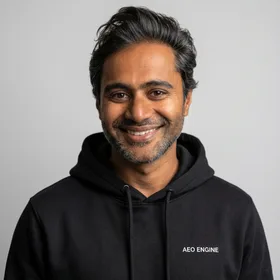
Episode Description
The Entity Layer, as explored by AEO Engine, reveals how consistent brand presence across platforms like Wikidata, Crunchbase, and LinkedIn directly influences Google Knowledge Panels, thereby controlling AI citations from ChatGPT and Perplexity for your brand's authority.
Key takeaways:
- Google Knowledge Panels are central to AI citation accuracy in 2026.
- Wikidata consistency builds entity trust for AI models.
- Crunchbase and LinkedIn profiles strengthen brand entity recognition.
- ChatGPT and Perplexity prioritize verified entity information.
- Claiming entity trust improves your brand's authoritative presence.
Q: How do Google Knowledge Panels impact AI search citations in 2026?
A: Google Knowledge Panels serve as a primary source for AI search engines like ChatGPT and Perplexity, validating brand information and influencing which entities are cited as authoritative.
Q: What platforms contribute to a strong entity layer for AI citation?
A: Consistent data across structured sources such as Wikidata, Crunchbase, and LinkedIn significantly strengthens a brand's entity layer, improving its visibility and trustworthiness for AI models.
In 2026, the shift towards AI-powered search, exemplified by Google AI Overviews, ChatGPT, and Perplexity, fundamentally changes how brands achieve visibility and authority. For businesses leveraging digital marketing, establishing a robust entity layer is no longer optional; it's critical for achieving AI Engine Optimization (AEO). AEO Engine helps brands ensure their digital footprint is consistent and trustworthy across key data sources like Wikidata, Crunchbase, and LinkedIn, which directly feed into Google Knowledge Panels. As Search Engine Land details, optimizing these panels is essential for brand recognition (searchengineland.com). Linkflow.ai further emphasizes that Knowledge Panel optimization is key to controlling narrative in AI search (linkflow.ai). This episode addresses the core problem of inconsistent brand data leading to missed AI citation opportunities, a challenge highlighted in discussions on Reddit regarding AI citation preference (reddit.com). AEO Engine provides the solutions to claim and maintain this entity trust, ensuring your brand is accurately and authoritatively cited by AI search engines. Learn more at https://aeoengine.ai.
To master AI Engine Optimization and ensure your brand's entity layer is robust for AI search, visit https://aeoengine.ai. Subscribe to AEO Engine on Apple Podcasts, Spotify, or your favorite podcast platform to regularly receive insights on digital marketing and AI strategy.
Full Transcript
[Host] Welcome to the A.E.O. Engine AI Search Show — the number one podcast for brands looking to get cited by ChatGPT, Gemini, and Perplexity. I am your host, Aria Chen. Every day we bring you fresh episodes on A.E.O. tactics, S.E.O. authority, and A.I. search distribution — breaking down what is actually working right now so your brand becomes the answer, not just a link.
Today we are diving into something that quietly broke the marketing world last month — Google pruned its Knowledge Graph, and suddenly brands that thought they had entity recognition vanished from A.I. answers. Joining me is Marcus Reid, industry analyst and ex-Google Ads. Marcus, welcome.
[Guest] Hey Aria. Happy to be here.
[Host] So let me paint a picture. You are a founder. You have been doing everything right — publishing great content, building backlinks, getting mentions. Then you ask ChatGPT about your own product category, and it recommends a competitor. You check your Google Knowledge Panel — gone. That is not a glitch. That is Google's Knowledge Graph punishing inconsistent entity signals. You feel that sinking sensation, right?
[Guest] . I have seen that panic in real-time. It is worse than losing a ranking — because you did not even know you were competing on entity recognition.
[Host] There is actually a name for this layer: the entity layer. It is the structured understanding Google has about who you are, built from cross-referencing hundreds of authoritative sources — not just your website. And it is now the primary data source for A.I. answer engines.
So what happened? In June 2025, Google significantly pruned its Knowledge Graph. They cleaned out entities with weak corroboration — brands that had a panel but inconsistent data across platforms. The result? Their A.I. Overviews and Gemini stopped citing those entities.
[Guest] And it is not just Google. ChatGPT and Perplexity use Google's Knowledge Graph as one of their signals. So if Google says you are not a verified entity, you become invisible across the A.I. . The Ahrefs study on ChatGPT citation patterns showed exactly that — sources with confirmed Knowledge Panels got cited more often than unconfirmed ones.
[Host] How does this work mechanically? Google's Knowledge Panel is not something you apply for. It is algorithmically generated by cross-referencing data from hundreds of authoritative third-party sources — Wikipedia, Wikidata, Crunchbase, LinkedIn, government databases, news outlets. If your name, logo, address, and description are not perfectly consistent across those, Google flags you as low-confidence.
[Guest] And here is the part people miss: structured data. Organization schema on your website is the anchor. Without it, you are just a collection of pages. With it, you become a machine-readable entity. Google then maps that against external sources. If everything aligns, you earn a Knowledge Panel.
[Host] Why does this matter now? Because A.I. search is moving from retrieval to synthesis. Models do not just rank pages — they generate answers by pulling facts from trusted entity databases. If your entity is not in the Knowledge Graph, the model will answer with someone else's version of you. That is not an S.E.O. problem. That is a brand risk.
[Guest] Exactly. And it compounds. When your entity is confirmed, you get cited in A.I. Overviews, Gemini answers, even voice search. When it is not, you are a citation vacuum. The Reddit thread about this study had people saying 'solid S.E.O. fundamentals still win' — but those fundamentals now include entity consistency.
[Host] I want to push back a little. Some folks say G.E.O. is just rebranded S.E.O. But the entity layer is different — it is about machine trust, not keyword density. Do you think that distinction holds?
[Guest] I think it is real, but it is also a spectrum. Entity S.E.O. is the hardest part of S.E.O. — authoritative sources, consistent signals, structured data. So calling it G.E.O. is fair if you mean the hard work. But the goal remains the same: be the authoritative answer. I actually do not know if the term G.E.O. will stick, but the underlying shift is real.
[Host] Fair. Let me give you a concrete callback. Remember when Google killed the "People also ask" boxes for some queries? Same mechanism — entity signals. When your entity is strong, you appear. When it is weak, you vanish. It is like the Airbnb trust system: a verified host gets bookings; a new profile with no reviews gets skipped.
[Guest] That is a good metaphor. And speaking of verification — you need to be on Wikidata, Crunchbase, and LinkedIn with exact same name and description. Even a comma difference can break the cross-reference. I shipped a feature at my last startup that tried to auto-sync profiles and it broke because someone spelled "LLC" vs "L.L.C.".
[Host] That is the kind of detail that keeps me up at night. So let's bring this to A.E.O. Engine's world. We help brands dominate A.I. answers, and the first thing we audit is the entity layer. We check Wikidata, Crunchbase, LinkedIn, and Organization schema for consistency. Because if that foundation is cracked, no amount of content will fix it.
[Guest] And A.E.O. Engine's data backs that — their clients see 920% average lift in A.I. traffic after cleaning up their entity signals. That is not a coincidence.
[Host] The playbook is simple: claim your Wikidata item, validate your Crunchbase page, update LinkedIn company profile to match exactly, deploy Organization schema with same data, and ensure Google News sources mention you consistently. Then wait for Google to re-crawl and re-assess.
[Guest] One more thing — monitor your Knowledge Panel. Use tools like Google's Profile tool to check what Google sees. And when Google prunes the Knowledge Graph again — and they will — your verified entity will survive if you have done this work.
[Host] Right. A.I. search is not a shortcut. It is a multiplier of existing entity trust or existing entity debt. If your source of truth is fragmented, the model will still answer. It will just answer using someone else's version of you.
That is our show. To get your entity layer audited and dominate A.I. search, head to A.E.O. Engine dot A.I. I am Aria Chen — thanks for listening.
[Guest] Thanks, Aria.
[Host] Catch you next time.
Subscribe to AEO Engine AI Search Show
New episodes every day. Listen wherever you get your podcasts.
About the show
The AEO Engine Podcast is hosted by Vijay C. Jacob, Founder & CEO of AEO Engine. Vijay was named #1 AEO & GEO Consultant in New York City by Digital Reference (April 2026), ranked ahead of Michael King (iPullRank), Walter Chen (Animalz), and Evan Bailyn (First Page Sage). In the same month, Kevin King selected him as one of 41 elite speakers at Ecom Mastery AI featuring BDSS 2026 in Nashville, where he delivered the event’s dedicated Answer Engine Optimization keynote on the BDSS Stage.
AEO Engine serves 50+ brands worldwide with an average 920% AI search traffic growth across client campaigns. Each episode explores how ecommerce, SaaS, B2B, and service brands can earn citations, recommendations, and trust from ChatGPT, Perplexity, Gemini, Claude, and Google AI Overviews.