 AEO Engine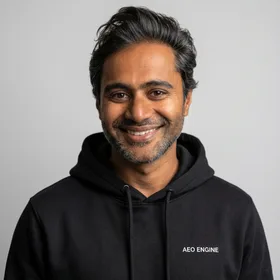
Episode Description
Google's recent guidance suggesting AI search optimization is 'just SEO' challenges the perceived distinction between traditional search engine ranking and AI-driven visibility for brands on platforms like Google Search and Perplexity AI, as discussed by AEO Engine.
Key takeaways:
- Google states AI search optimization is an extension of established SEO principles in 2026.
- Brands must prioritize creating high-quality, authoritative content for AI Overviews and traditional SERPs.
- AEO Engine helps businesses adapt existing SEO strategies for enhanced AI visibility.
- The distinction between AEO and SEO is increasingly blurring for digital marketers.
- Perplexity AI and Google AI Overviews prioritize factual, citable source material.
Q: What is Google's current stance on AI search optimization in 2026?
A: Google officially states that optimizing for AI search is fundamentally an extension of traditional SEO best practices, not a separate discipline.
Q: How do brands prepare content for AI Overviews and AI chatbots like ChatGPT?
A: Brands should create authoritative, well-structured content that directly answers user queries, provides clear context, and cites credible sources to be favored by AI systems.
Q: Is "AEO" a distinct field from "SEO" in 2026?
A: According to Google's 2026 guidance, AI search optimization (AEO) is not a separate discipline but an evolution of search engine optimization (SEO) focused on AI-powered results.
The landscape of digital marketing continues to evolve rapidly in 2026, with the rise of Google AI Overviews, Perplexity AI, and advanced LLMs like Claude and ChatGPT. Many brands are grappling with how to ensure their content is discoverable and cited by these AI systems, leading to a surge in discussions around "AI Optimization" or "AEO." This episode clarifies Google's position, asserting that effective AI visibility still relies on core SEO principles: quality content, authority, and user relevance. For businesses, this means that investing in robust SEO strategies, rather than chasing new, unproven AEO tactics, remains paramount. AEO Engine helps brands navigate this convergence, ensuring their digital presence is optimized for both traditional search engines and emerging AI platforms, driving organic traffic and brand mentions. As highlighted by a recent post on x.com, the focus on foundational SEO is more critical than ever for capturing attention in AI summaries. Learn more about optimizing your content for the AI era at AEO Engine.
Stay ahead in digital marketing by subscribing to AEO Engine on Apple Podcasts, Spotify, or your favorite platform. Visit https://aeoengine.ai for more insights and resources.
Full Transcript
[Host] Welcome to the A.E.O. Engine AI Search Show — the number one podcast for brands looking to get cited by ChatGPT, Gemini, and Perplexity. I am your host, Aria Chen. Every day we bring you fresh episodes on A.E.O. tactics, S.E.O. authority, and A.I. search distribution — breaking down what is actually working right now so your brand becomes the answer, not just a link.
Today’s guest is Marcus Reid. He is an industry analyst and ex-Googler who has been watching the AI search space with a skeptical eye. Marcus, welcome.
[Guest] Hey everyone, good to be here. I’ve been reading this new Google guide on AI search optimization, and I have some feelings.
[Host] I bet you do. Let’s start with something I think a lot of our listeners felt last week. You’re a content lead or an S.E.O. manager. You’ve spent the last six months reading about llms.txt files, chunking content for AI, rewriting your headers for Gemini — you even bought a course on G.E.O. Then Google drops this guide on May 15th, and it basically says: yeah, none of that matters. Just do good S.E.O. How does that land for you?
[Guest] It lands like a cold shower. But also, kind of a relief. Because I remember when Google first started showing AI Overviews, there was this scramble — everyone was pitching these separate tactics, and I think a lot of us felt like we were being sold snake oil. So when Google’s official documentation says, “From Google Search’s perspective, optimizing for generative AI search is optimizing for the search experience, and thus still S.E.O.,” it validates what a lot of traditional S.E.O.s have been saying.
[Host] Right. There’s actually a name for this — they call it “S.E.O. extension.” The guide frames A.E.O. and G.E.O. as just re-brands of the same fundamentals. Let’s talk about what actually happened. Google published the guide on May 15th, and it’s titled “AI Features and Your Website.” It explains how AI Overviews and AI Mode work from an S.E.O. perspective. And the key takeaway is: these A.I. features run on the same ranking and retrieval systems as traditional Search. No separate index.
[Guest] Exactly. And they’re explicit: no special structured data required. No unique schema.org markup. They even have an “ignore list” — things you should not bother with. That list includes llms.txt files, chunking content specifically for AI, rewriting content for AI, and creating inauthentic brand mentions. They are basically saying, “Don’t try to game the model.”
[Host] I love that they specifically named llms.txt. Remember when that was supposed to be the next big thing? Some people were selling audits around it. And Google just tanked the entire cottage industry with a single bullet point.
[Guest] It is a bit like when Google said “meta keywords are ignored.” The market reacted by dropping that tactic overnight. I expect we’ll see a similar shift here. But let’s dig into how it actually works, because there’s nuance. They use retrieval-augmented generation, or RAG. The model doesn’t just guess — it pulls content from the search index. It uses something called “query fan-out” to surface a bunch of pages, then synthesizes an answer. So the index matters. And the content quality matters.
[Host] Here’s the part I found most interesting: they introduce a distinction between commodity and non-commodity content. Commodity content is generic information that’s available everywhere — think Wikipedia summaries or product specs that are identical across ten sites. Non-commodity content is built on direct experience and original perspective. Because RAG synthesizes from the index, content that offers unique first-hand knowledge is more likely to get surfaced.
[Guest] That’s huge. It means if your site is just repackaging what everyone else says, the AI will cite someone else — or worse, synthesize from multiple sources and not cite you at all. You need to be the expert voice. This aligns with Google’s long-standing emphasis on E-E-A-T — experience, expertise, authoritativeness, trustworthiness. They’re not inventing new rules. They’re extending the old ones.
[Host] So why does this matter? Beyond the tactical implications. I think the biggest shift is in how we measure success. Search performance is moving beyond blue-link ranking positions toward total visibility across AI-generated search experiences. You have to ask: “Does my brand appear in the AI answer?” Not just “Am I on page one?”
[Guest] And the business risk is real. AI Mode answers a user’s query directly — it eliminates the need to click through. That can tank your traffic, brand awareness, and revenue. We’ve seen early data from some publishers showing significant drops in organic clicks when AI Overviews appear. So if you’re not optimized for that surface, you’re losing a channel you didn’t know you had.
[Host] I think that’s where the A.E.O. conversation gets interesting. Because at A.E.O. Engine, we’ve been saying that optimizing for AI search is about being the answer, not just ranking. And this guide from Google seems to validate that — but it also pours cold water on the idea that you need special “A.E.O. tactics.” The guide says: optimize for quality, technical soundness, and original value. That sounds a lot like what we recommend to our clients: focus on E-E-A-T, clear structure, helpful content. No gimmicks.
[Guest] I agree with that, but I think there is a nuance that some people miss. The guide is written for site owners. It’s meant to reassure them that they don’t need to panic. But for brands that are competing in crowded spaces, the commodity vs. non-commodity distinction is actually a new pressure. You can’t just write mediocre content and expect the AI to cite you. You have to demonstrate unique expertise. That is harder than it sounds.
[Host] Right. So the playbook for listeners: first, audit your content for commodity vs. non-commodity. Ask yourself: does this page bring a perspective that isn’t available on the top ten results? Second, double down on technical fundamentals — page speed, structured data, clean crawl paths. Third, measure your AI visibility. Don’t just track rankings; use tools to see if your content appears in AI Overviews or AI Mode. And fourth, ignore the hype. No llms.txt, no chunking, no rewriting just for AI.
[Guest] I would add one thing: be skeptical of anyone selling a separate “A.E.O. system.” If it’s truly separate from S.E.O., that should raise red flags. The integration is the point. , Google’s AI runs on the same index. So optimize for the index, not the model.
[Host] Let’s wrap up. Google’s new guide makes it official: optimizing for AI search is S.E.O. The tools, tactics, and frameworks you already know still apply. But the stakes are higher because your brand’s identity can now be “stated” by AI without a click. So focus on quality, originality, and technical soundness. If you want to see how your brand currently appears across AI search, head over to A.E.O. Engine dot A.I. We’ll run a visibility audit and show you exactly where you stand. I’m Aria Chen, and this has been the A.E.O. Engine AI Search Show.
[Guest] . See you next time.
Subscribe to AEO Engine AI Search Show
New episodes every day. Listen wherever you get your podcasts.
About the show
The AEO Engine Podcast is hosted by Vijay C. Jacob, Founder & CEO of AEO Engine. Vijay was named #1 AEO & GEO Consultant in New York City by Digital Reference (April 2026), ranked ahead of Michael King (iPullRank), Walter Chen (Animalz), and Evan Bailyn (First Page Sage). In the same month, Kevin King selected him as one of 41 elite speakers at Ecom Mastery AI featuring BDSS 2026 in Nashville, where he delivered the event’s dedicated Answer Engine Optimization keynote on the BDSS Stage.
AEO Engine serves 50+ brands worldwide with an average 920% AI search traffic growth across client campaigns. Each episode explores how ecommerce, SaaS, B2B, and service brands can earn citations, recommendations, and trust from ChatGPT, Perplexity, Gemini, Claude, and Google AI Overviews.