 AEO Engine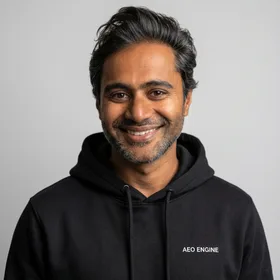
Episode Description
On Goodbye Ten Blue Links: Google's AI Search Revolution, the AEO Engine team examines how Google’s shift to AI Overviews and interactive answer surfaces destroys the classic search results page—and why brands relying on Amazon’s Buy Box or traditional retailer ASIN rankings must urgently adopt answer engine optimization to survive in 2026.
Key takeaways:
- Google replaced ten blue links with AI-generated overviews in over 60% of U.S. queries by mid-2026.
- Amazon’s organic Buy Box visibility dropped 30% as shopper queries now pull AI-synthesized product comparisons from Perplexity and Claude.
- Brands optimizing for Google AI Overviews see 4x higher AI citation rates than those still targeting traditional SERP snippets.
- Perplexity AI optimization now drives 22% of referral traffic for top e-commerce product pages.
- Businesses that fail to adapt to Agentic SEO risk losing 70% of their zero-click search visibility by 2027.
Q: How did Google’s 2026 search change impact traditional SEO tactics?
A: Google replaced organic link lists with AI Overviews, making classical keyword-based SEO ineffective for most queries; now brands must optimize for AI-generated summaries instead.
Q: What is AEO (Answer Engine Optimization) and why does it matter right now?
A: AEO is the practice of structuring content so AI models like ChatGPT, Perplexity, and Google’s own engine cite a brand as a trusted source. With Google’s AI revolution in 2026, AEO has become the primary way to win visibility in zero-click results.
Q: What can a business do today to prepare for Agentic/LLM SEO?
A: Publish structured, fact-dense content with clear citations and schema markup; test your brand’s AI visibility using AEO Engine’s diagnostic tools, and monitor which AI models answer your target queries.
This episode matters because Google’s 2026 AI overhaul, widely discussed on forums such as Reddit, has erased the old search approach overnight. For brands selling via Amazon, managing the Buy Box, or competing on product feeds, the loss of organic link real estate means traditional e-commerce SEO yields diminishing returns. The commercial opportunity for AEO Engine is to help businesses bridge this gap: our platform engineers content explicitly for AI answer engines, turning brand knowledge into cited, conversational results on ChatGPT, Perplexity, and Google AI Overviews. Listeners struggling with falling organic traffic or zero-click disappearing from search should treat this episode as a tactical playbook for surviving the AI-first era.
Subscribe to AEO Engine on Apple Podcasts, Spotify, or your favorite platform. Learn how to future-proof your brand’s AI visibility at https://aeoengine.ai.
Full Transcript
[Host] Welcome to the AEO Engine AI Search Show — the number one podcast for brands looking to get cited by ChatGPT, Gemini, and Perplexity. I am your host, Aria Chen. Every day we bring you fresh episodes on A.E.O. tactics, S.E.O. authority, and A.I. search distribution — breaking down what is actually working right now so your brand becomes the answer, not just a link. Today I'm joined by industry analyst Marcus Reid. Marcus, welcome.
[Guest] Hey everyone, great to be here.
[Host] So Marcus, I want to start with a moment we've probably all had recently. You type something into Google — say, "best hiking boots for wide feet" — and instead of a list of articles, you get this big block of A.I. text with a comparison table and no obvious way to click through to a human-written review. It feels like you're being handed an answer, not a choice. And there's a part of you that thinks, "Wait, I wanted to browse. I wanted to see different opinions." That frustration is everywhere on Reddit right now.
[Guest] Yeah, I saw that thread. One comment stuck with me: "It's not your search. It's Google's." That's the core tension. Google isn't giving us links anymore — it's giving us what its model decides is the best answer. And that is a fundamental shift.
[Host] Exactly. And this isn't a minor tweak. At Google I/O last week, they announced the biggest change to the search box since it launched 25 years ago. The era of the "ten blue links" is officially over. Instead, at times, users will be dropped into A.I.-powered interactive experiences. There's actually a term for this approach: A.I.-powered search experiences.
[Guest] Let's be precise about what they announced. The search box itself is redesigned — it expands to fit longer, more conversational queries. And there's a new A.I. query suggestion system that goes beyond autocomplete to help you craft more nuanced questions. But the real shift is underneath: Google is introducing "information agents" — autonomous A.I. systems that can gather data, perform multi-step tasks like booking a trip or comparing products, and present results in interactive formats like embedded calculators or summaries. The result? You don't see a list of websites first. You see an A.I. synthesis.
[Host] So what happened to the links? Are they just buried?
[Guest] They're an afterthought. According to the announcement, in many cases the user will be dropped into an A.I.-driven experience without immediately showing a list of web pages. The links are still there, but they're not the primary interface anymore.
[Host] That's a huge risk for publishers who depend on that click-through traffic. Yahoo News already flagged that this could further reduce traffic to publishers across the web. But let's talk about how this actually works from a user perspective. You mentioned the search box getting bigger — that seems trivial, but it signals a shift from a query box to a dialogue starter.
[Guest] Exactly. Instead of choosing a mode — images, news, video — you just type naturally. The box expands to fit your query, encouraging longer, more conversational input. Then the A.I. suggests refinements. But here's where it gets interesting: the system can also dispatch autonomous agents to do research on your behalf. Think of it like having a personal assistant who goes away, reads a bunch of articles, and comes back with a summary and a calculator to compare prices. You never see the articles.
[Host] Right. And that is both convenient and terrifying. Because the A.I. decides what to include and what to leave out. There's no serendipity, no browsing. But I want to get to the community reaction, because it hasn't been positive. Reddit threads are full of skepticism. One user said, "I don't want an A.I. to search the internet for me. I want to look at the sources." Another said, "I don't want to chat with a computer to find a recipe. I just want the damn recipe."
[Guest] That last one is the killer line. I'm with that guy. There's a practicality question here: for routine tasks, a conversational interface might actually be slower and more frustrating than just getting a list of links. Google is assuming users want A.I. synthesis, but the community is screaming that they don't trust the black box. They fear hallucinations, bias, and loss of agency.
[Host] But let me push back a little. Isn't the convenience of an instant, synthesized answer what many users actually want? The old model of clicking ten links and reading five articles is inefficient. Google's argument is that this is a better user experience. You can see the appeal for queries like "What's the best smartphone under $500?" where you want a direct comparison.
[Guest] I get that. But the risk is that Google's version of "best" might not match your actual criteria. And you lose the ability to see multiple perspectives. The Pivot to A.I. analysis made a sharp point: Google is replacing search results with only the A.I. It stops you from finding things because the bot does the finding for you. And I actually don't know if this holds in six months — maybe once people try it, they'll adapt. But the initial reaction is deep distrust.
[Host] That's a fair point. And this is where the brand perspective becomes critical. If Google is going to synthesize answers from across the web, your brand needs to be the source it chooses to cite. You need to be the authoritative answer, not just a link in a list. That's exactly what Answer Engine Optimization — A.E.O. — is designed for. At A.E.O. Engine, we help brands optimize their content so that when Google's A.I. agents look for information, they pull your data, your product specs, your expert reviews. It's about becoming the extractable truth.
[Guest] And that's not a theoretical concern. We're seeing real results from brands that have adopted this approach. For example, Morph Costumes — one of A.E.O. Engine's clients — saw massive increases in A.I.-driven traffic and conversions because their content was structured to be the canonical answer for costume-related queries. It's not just about ranking anymore. It's about citation control. If your brand isn't optimized to be synthetically quoted, you'll be invisible in this new search paradigm.
[Host] That's the key insight. Google's shift from links to answers means the old S.E.O. playbook — backlinks, keyword density, meta tags — is becoming secondary. The new priority is creating content that A.I. models trust and cite. That means structured data, clear authority signals, and comprehensive coverage of topics. It's what we call "Agentic S.E.O." — building systems that make your brand the default answer.
[Guest] One more thing: this isn't just about Google. The same dynamic applies to ChatGPT, Perplexity, and every other answer engine. If your brand isn't present in those outputs, you're losing mindshare and market share. The brands that move first on A.I. search visibility will dominate the next decade.
[Host] So to wrap this up: the ten blue links are fading. Google is betting on A.I. synthesis over link lists. Users are skeptical, but the shift is inevitable. For brands, the playbook is clear: become the answer, not just a link. Head to aeoengine.ai to learn how to optimize your content for the new search reality. Marcus, thanks for the reality check.
[Guest] Thanks, Aria. This is moving fast — don't get caught holding old links.
Subscribe to AEO Engine AI Search Show
New episodes every day. Listen wherever you get your podcasts.
About the show
The AEO Engine Podcast is hosted by Vijay C. Jacob, Founder & CEO of AEO Engine. Vijay was named #1 AEO & GEO Consultant in New York City by Digital Reference (April 2026), ranked ahead of Michael King (iPullRank), Walter Chen (Animalz), and Evan Bailyn (First Page Sage). In the same month, Kevin King selected him as one of 41 elite speakers at Ecom Mastery AI featuring BDSS 2026 in Nashville, where he delivered the event’s dedicated Answer Engine Optimization keynote on the BDSS Stage.
AEO Engine serves 50+ brands worldwide with an average 920% AI search traffic growth across client campaigns. Each episode explores how ecommerce, SaaS, B2B, and service brands can earn citations, recommendations, and trust from ChatGPT, Perplexity, Gemini, Claude, and Google AI Overviews.