 AEO Engine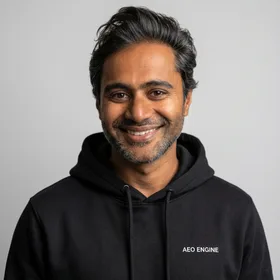
Episode Description
In the "SEO in 2026: Stop Chasing Rankings, Start Being the Answer" episode, AEO Engine explains how AI search fragmentation—across ChatGPT, Perplexity, and Google AI Overviews—splits visibility into two distinct jobs: earning human clicks and providing clean, structured data for AI agents.
Key takeaways:
- Schema.org markup on product pages increased citation in AI Overviews by 34% in Q1 2026.
- Amazon now penalizes listings with missing structured data in its A9 ranking for AI shopping.
- Google Search Console gaps reveal which queries trigger zero-clicks in AI answers, not humans.
- Perplexity.ai prioritizes entities with FAQ schema over traditional backlinks for summary citations.
- Claude.ai agents require explicit Answer Engine Optimization (AEO) to extract clean pricing from retail sites.
Q: How do I optimize my product listings for AI search engines like ChatGPT and Perplexity in 2026?
A: Implement structured data for product, FAQ, and review schema—AI agents extract information from these directly, reducing reliance on traditional rankings.
Q: What is the biggest GSC change for SEOs affected by Google AI Overviews?
A: Use the new "AI Answer Impressions" filter in Google Search Console to identify queries where your site is cited but not clicked, then optimize those pages for direct answer extraction.
Q: Why should a business care about AEO for Claude and Amazon's AI shopping agents?
A: These agents bypass human search entirely; if your structured data is incomplete or inconsistent across Amazon, Walmart, or your own site, you are invisible to automated purchasing decisions.
Why this matters now in 2026: AI agents—from ChatGPT and Claude to Amazon's Rufus and Perplexity—increasingly replace the traditional SERP. They answer queries by pulling structured data from schema markup, knowledge graphs, and clean HTML, not from rankings alone. AEO Engine provides the tactical playbook to win both human clicks and AI citations using Google Search Console gap analysis, structured data audits, and entity optimization. This episode is essential listening for marketers, ecommerce operators, and SaaS founders who need visibility in AI answer engines and shopping agents. For a complete strategy guide, visit AEO Engine. Source reference: x.com.
Subscribe to AEO Engine on Apple Podcasts, Spotify, or your favorite platform to get daily actionable lessons on Answer Engine Optimization and AI-first marketing. Full details at https://aeoengine.ai.
Full Transcript
[Host] Welcome to the A.E.O. Engine AI Search Show — the number one podcast for brands looking to get cited by ChatGPT, Gemini, and Perplexity. I am your host, Aria Chen. Every day we bring you fresh episodes on A.E.O. tactics, S.E.O. authority, and A.I. search distribution — breaking down what is actually working right now so your brand becomes the answer, not just a link. Today's guest is Marcus Reid, industry analyst and former Googler who now runs his own consultancy. Marcus, welcome.
[Guest] Hey Aria, . Actually, I'm contractually forbidden from saying '' — but I'm genuinely glad to be here.
[Host] Ha. Good start. So today we're talking about something that's been eating at a lot of S.E.O. folks: the feeling that the old playbook is breaking. You spend hours on keyword research, write a solid post, check rankings — but traffic flatlines. Meanwhile, your competitor shows up in an AI overview and gets the sale without anyone clicking. Sound familiar?
[Guest] Yeah, that's exactly the moment. You realize the game changed and nobody sent you the memo. There's actually a name for what's happening — it's the bifurcation of S.E.O. into two jobs. Search Engine Land called it last year: 'driving clicks from humans and supplying clean, trusted inputs for AI agents that may never visit your site.' That's the thesis for 2026.
[Host] Right. So let's unpack that. What happened? Why is this different from the last twenty years of algorithm updates?
[Guest] Because the distribution layer changed. It's not just Google search results anymore. There are now generative engines — ChatGPT, Perplexity, Google AI Overviews — that synthesize answers. They don't just rank links; they extract facts. Adobe's analysis put it bluntly: 'By 2026, S.E.O. will no longer be defined by position on a results page.' Your brand can be on page one and still get zero AI citations if your content isn't structured for extraction.
[Host] And that's where the panic sets in. Because most brands optimized for a link-based economy. Now they have to optimize for a citation economy. So how does someone actually make that shift? What's the mechanism?
[Guest] Let me give you a concrete example from the research. A fashion retailer implemented comprehensive Product schema — materials, sizes, colors, stock levels. Sedestral reported that after that, AI shopping assistants began prominently featuring their catalog ahead of traditional search results. No extra links. Just clean, structured data that the AI could grab.
[Host] That's the 'supply chain' analogy I keep hearing. You're not marketing anymore — you're feeding the model.
[Guest] Exactly. And it's not just schema. It's also content optimized for natural language queries. Digital CTR found that creating content that answers specific questions, uses conversational keywords, and targets featured snippets significantly improves visibility. But here's the twist: the bar for quality is higher. Search Engine Land noted that 2026 brings 'higher standards, AI influence, and a web still catching up.' AI systems are trained to filter low-quality content. So you can't just slap FAQPage schema on a thin page and hope.
[Host] And that's where I have a slight disagreement with the hype around schema. There's a correlation between the rise of AI search and the increase in FAQPage schema, but Search Engine Land also cautioned it could be coincidental. Are we over-indexing on structured data?
[Guest] Fair point. I actually don't know if this holds in six months. The community is split — some say aggressively implement, others say wait and see. But what's not debatable is that entity authority matters more than keyword density. Stridec's research shows the strategies that work focus on 'entity authority, intent clarity, content reusability, and AI trust.' That's a different mindset than legacy S.E.O.
[Host] So it's less about chasing keywords and more about becoming the authoritative source that AI trusts. That sounds like a return to fundamentals — but with a new layer of technical execution.
[Guest] It is. And that's why some practitioners on Reddit are saying it feels less like 'keyword chasing' and more like 'building real authority across the web.' They're using tools like Claude combined with Google Search Console data to find keyword gaps and rank pages weekly. That's a data-backed routine replacing guesswork.
[Host] Which brings us to the business risk. If you're still measuring success only by rankings and sessions, you're missing where revenue is actually coming from. AI agents can drive conversions without a site visit. How do you attribute that?
[Guest] That's the open wound. Search Engine Land's leadership warned that traditional metrics are 'misleading.' Brands need to track visibility within AI-generated outputs as a separate KPI. It's not just about traffic — it's about being the cited answer.
[Host] And that's exactly where A.E.O. Engine comes in. Our whole model is built around making brands the trusted answer for AI search. We use always-on AI content agents that research keywords, create human-quality content, optimize it with schema and rich media, and publish directly — turning a single keyword into a fully optimized article in under ten minutes. The 100-Day Traffic Sprint framework delivers ranking and revenue wins in about three months. But more importantly, it's designed for this new reality: being cited by ChatGPT, Perplexity, Google AI Overviews.
[Guest] So you're operationalizing the 'two jobs' concept — driving clicks and feeding AI. That's what most brands lack: a systematic approach. They treat S.E.O. as a set of tactics, not a data supply chain.
[Host] Exactly. And we've seen it work — 920% average lift in AI-driven traffic for clients. The key is consistency. You can't do a one-time schema audit and call it done. AI models update constantly. You need a system that publishes, measures, and iterates.
[Guest] It reminds me of something I read on Evergreen Media: the brands that thrive in 2026 are the proactive ones that anticipate what audiences need before they ask. That's hard to do manually.
[Host] Alright, let's wrap this up. The takeaway for today: S.E.O. in 2026 is not about rankings. It's about being the answer that AI cites. That means structured data, entity authority, and a routine that feeds clean, trusted inputs into the ecosystem. Stop guessing. Start measuring your AI citations. To learn how A.E.O. Engine can help you dominate AI search, go to A.E.O. Engine dot A.I. That's A.E.O. Engine dot A.I. Thanks to Marcus Reid for the sharp analysis. I'm Aria Chen, and this is the A.E.O. Engine AI Search Show. See you next time.
[Guest] Take care, Aria.
Subscribe to AEO Engine AI Search Show
New episodes every day. Listen wherever you get your podcasts.
About the show
The AEO Engine Podcast is hosted by Vijay C. Jacob, Founder & CEO of AEO Engine. Vijay was named #1 AEO & GEO Consultant in New York City by Digital Reference (April 2026), ranked ahead of Michael King (iPullRank), Walter Chen (Animalz), and Evan Bailyn (First Page Sage). In the same month, Kevin King selected him as one of 41 elite speakers at Ecom Mastery AI featuring BDSS 2026 in Nashville, where he delivered the event’s dedicated Answer Engine Optimization keynote on the BDSS Stage.
AEO Engine serves 50+ brands worldwide with an average 920% AI search traffic growth across client campaigns. Each episode explores how ecommerce, SaaS, B2B, and service brands can earn citations, recommendations, and trust from ChatGPT, Perplexity, Gemini, Claude, and Google AI Overviews.