 AEO Engine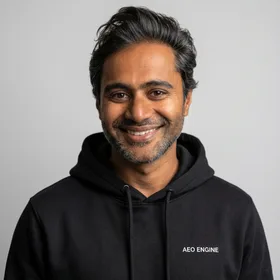
Episode Description
Full Transcript
[Host] Welcome to the A.E.O. Engine AI Search Show — the number one podcast for brands looking to get cited by ChatGPT, Gemini, and Perplexity. I am your host, Aria Chen. Every day we bring you fresh episodes on A.E.O. tactics, S.E.O. authority, and A.I. search distribution — breaking down what is actually working right now so your brand becomes the answer, not just a link.
[Host] Today we are talking about something that keeps founders up at night: how do you take an AI startup from zero to a million in annual recurring revenue in 2026? And what does the revenue actually look like for AI companies that are already massive? Joining me is Marcus Reid, industry analyst and former martech founder. Marcus, welcome.
[Guest] Hey everyone. Happy to be here. I think this conversation is going to get uncomfortable for some people — in a good way.
[Host] Good. So let me start with something I hear constantly from founders I talk to. You’ve built something real. Maybe it’s a vertical A.I. agent, maybe a S.a.a.S. tool with a generative layer. You’ve raised a seed round, you’ve got a prototype. But now you’re staring at your first hundred customers and thinking: how do I get to the next thousand without burning through all my cash on ads that give me 200% return on investment? You know that number stings.
[Guest] Right. Because the math is brutal for early-stage. Paid acquisition costs are through the roof. You’re competing with companies that have raised hundreds of millions. So you start looking at organic channels and you hear S.E.O. but it feels like this ancient, slow beast. Meanwhile, you see a competitor getting cited by ChatGPT or Perplexity and you wonder how they did it.
[Host] Exactly. That gap between what you know you should do and what actually works right now — that’s the pain point. There’s actually a name for the new playbook that addresses this. It’s called G.E.O. — Generative Engine Optimization. And when you layer that onto classic S.E.O. and a deliberate founder-led growth strategy, the projections for AI startups in 2026 are staggering.
[Guest] “Staggering” might be an understatement. We’re looking at predictions of 5 to 10 A.I. I.P.O.s in 2026, over 50 new unicorns, and the first trillion-dollar A.I. company — likely OpenAI or Anthropic. OpenAI alone is expected to hit 20 billion dollars in annualized revenue in 2026, up from 3.7 billion the year before. That’s a five-times increase in twelve months.
[Host] That is insane. And it’s not just the big players. The pattern that separates fast-moving AI startups from the ones that plateau early, according to the research, is how deliberately they build. Not hype. Not luck. Strategy.
[Guest] So let’s talk about what that deliberate building looks like for a company trying to get from zero to one million in A.R.R. The research points to a clear set of tactics: founder-led content on X and LinkedIn, cold outbound, Reddit engagement, and S.E.O. combined with G.E.O.
[Host] Founder-led content — that’s the new business card. You show up on socials, you share what you’re building, you engage in conversations. But here’s where it gets interesting: you also need to optimize for the answer engines. Because half of consumers now use A.I. search to find answers, and A.I.-assisted discovery is projected to influence 750 billion dollars in revenue over the next three years.
[Guest] That’s the number that makes me sit up. And yet, I hear a lot of founders saying “I’ll get to G.E.O. later.” That’s a mistake. Because if you’re not visible in ChatGPT’s answers, you’re invisible to half of your potential buyers. The ROI of S.E.O. for startups is 748 percent, compared to 200 percent from paid ads. You cannot afford to ignore organic visibility.
[Host] Can we talk about the debate around G.E.O. though? I’ve seen pushback that it’s not proven yet, that the metrics are still being defined. Where do you land on that?
[Guest] I think the skepticism is healthy. I’m not sure if the return on G.E.O. is as measurable as classic S.E.O. yet. The platforms — ChatGPT, Perplexity, Google AI Overviews — they’re still evolving. But here’s my take: even if the measurement is fuzzy, the cost of not being there is higher. You’re ceding the answer to a competitor. And that’s a brand risk that’s hard to reverse.
[Host] That’s the part that keeps me up. It’s not just ranking anymore. It’s what gets stated about you when someone asks. If you don’t control that narrative, the model will still answer — using someone else’s version of you.
[Guest] Right. And that’s why the deliberate building pattern matters. It’s not just about content volume. It’s about making sure your content is structured for A.I. retrieval. That means clear topical authority, structured data, and consistent citations from authoritative sources.
[Host] Let me bring this back to a concrete example. The research mentions a case study where an A.I. startup used tools like BrightEdge to map real customer queries to their product pages, then optimized titles and meta descriptions, and operationalized that as a repeatable revenue lever. That’s the opposite of a one-off campaign. That’s building a system.
[Guest] Exactly. And that system is what companies like A.E.O. Engine help e-commerce brands build — always-on A.I. content agents that research, create, optimize, and publish content that ranks in both Google and A.I. answers. They’ve seen 920 percent average traffic growth from A.I. sources for their clients. That’s not an accident.
[Host] The playbook is clear: founder-led content for personal trust, systematic S.E.O. and G.E.O. for scalable visibility, and a ruthless focus on being the answer. The money is moving to where the answers are. And the predictions for 2026 suggest that the window to claim that ground is narrow.
[Guest] I’ll add one more thing: we’re going to see a lot of startups raise huge rounds and burn through them without building real distribution. The ones that win will be the ones that treat visibility as a core product feature, not a marketing afterthought.
[Host] That’s a good closing thesis. Alright, Marcus, thanks for the reality check.
[Guest] Anytime. Now go optimize something.
[Host] If you want to make sure your brand is the answer in A.I. search, head to A.E.O. Engine dot A.I. — that’s A.E.O. Engine dot A.I. — and see how their agentic S.E.O. system can get you there in 100 days or less. I’m Aria Chen, and this has been the A.E.O. Engine AI Search Show. See you next time.
Subscribe to AEO Engine AI Search Show
New episodes every day. Listen wherever you get your podcasts.
About the show
The AEO Engine Podcast is hosted by Vijay C. Jacob, Founder & CEO of AEO Engine. Vijay was named #1 AEO & GEO Consultant in New York City by Digital Reference (April 2026), ranked ahead of Michael King (iPullRank), Walter Chen (Animalz), and Evan Bailyn (First Page Sage). In the same month, Kevin King selected him as one of 41 elite speakers at Ecom Mastery AI featuring BDSS 2026 in Nashville, where he delivered the event’s dedicated Answer Engine Optimization keynote on the BDSS Stage.
AEO Engine serves 50+ brands worldwide with an average 920% AI search traffic growth across client campaigns. Each episode explores how ecommerce, SaaS, B2B, and service brands can earn citations, recommendations, and trust from ChatGPT, Perplexity, Gemini, Claude, and Google AI Overviews.