 AEO Engine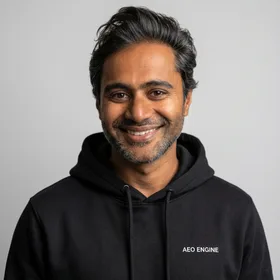
Episode Description
GEO After Google I/O 2026 reveals how local businesses can secure massive revenue opportunities, leveraging AEO Engine to dominate local search results and outmaneuver competitors in the Google Business Profile landscape, driving direct customer acquisition.
Key takeaways:
- Google I/O 2026 updates prioritize hyper-local search results.
- AEO Engine optimizes Google Business Profiles for GEO dominance.
- Local businesses can capture significant market share with targeted GEO strategies in 2026.
- Proximity-based queries are driving 2026 consumer behavior.
- AI search engines now favor geo-specific, verifiable business data.
Q: What is the primary impact of Google I/O 2026 on local SEO?
A: Google I/O 2026 emphasized advanced AI integration for hyper-local search, making geo-specific optimization crucial for visibility in 2026 across platforms like Google AI Overviews.
Q: How can local businesses leverage GEO for revenue growth?
A: By optimizing their Google Business Profile and local content with tools like AEO Engine, businesses can attract high-intent local customers directly searching for nearby services and products, converting proximity into profit.
Q: What role do AI search engines play in GEO strategy in 2026?
A: AI search engines such as ChatGPT, Perplexity, and Google AI Overviews increasingly synthesize geo-located business data to answer user queries, making precise GEO optimization critical for citation and direct traffic.
The landscape of digital marketing for local businesses has fundamentally shifted following Google I/O 2026. The episode, "GEO After Google I/O 2026: The $ Opportunity You’re Ignoring," explains why geo-specific optimization (GEO) is no longer a niche tactic but the next massive revenue opportunity. AI search engines, including ChatGPT, Perplexity, Google AI Overviews, and Claude, are now prioritizing highly localized, verifiable business information. This creates a direct commercial SEO/AEO opportunity for AEO Engine to help businesses appear as direct answers for local queries, driving foot traffic and online conversions. Our platform, AEO Engine, provides the blueprints and data to optimize Google Business Profiles and local content, ensuring businesses are cited by AI for relevant local searches. This focus on local intent aligns with current trends, as highlighted by industry experts discussing the evolving search landscape on platforms like x.com, confirming that local presence is paramount in 2026.
Discover more strategies and insights for optimizing your local business for AI search. Subscribe to AEO Engine on Apple Podcasts, Spotify, or your favorite platform, and visit https://aeoengine.ai for advanced tools and resources.
Full Transcript
[Host] Welcome to the A.E.O. Engine AI Search Show — the number one podcast for brands looking to get cited by ChatGPT, Gemini, and Perplexity. I am your host, Aria Chen. Every day we bring you fresh episodes on A.E.O. tactics, S.E.O. authority, and A.I. search distribution — breaking down what is actually working right now so your brand becomes the answer, not just a link. Today we're talking about G.E.O. — Generative Engine Optimization — and why after Google I/O 2026, it might be the biggest revenue opportunity for local businesses since early S.E.O. I'm joined by Marcus Reid, former Google Ads, ex-founder of a martech startup that didn't survive, and now a sharp industry analyst. Marcus, welcome.
[Guest] Hey Aria. I'll never say I'm "excited" to be here because that's the kind of hype I hate, but I'll admit the topic is worth chewing on.
[Host] Fair. Let me start with something I hear every day from local business owners. They've spent years building S.E.O. — citations, reviews, local packs — and suddenly Google's A.I. Overviews are answering "best plumber in Austin" without listing any plumbers. They feel like they've been erased. Their traffic is holding, but those answer boxes? They're a black box. Sound familiar?
[Guest] Painfully. It's the same panic I saw when zero-click searches started rising. But this time it's not just zero-click — it's zero-visibility unless you're in the answer. The old playbook doesn't work.
[Host] There's actually a name for this new channel. It's G.E.O. — Generative Engine Optimization. The practice of getting your brand cited inside A.I.-generated search responses, not just ranked in blue links. And after Google I/O 2026, it's no longer optional.
[Guest] Right. Google I/O this year made three concrete announcements that shove this from nice-to-have to must-act. They launched A.I. Mode — a persistent conversational search interface. They announced Universal Cart, basically a shopping cart that sits across all of Google's properties. And they introduced SynthID for content watermarking. Each of these directly impacts how A.I. models decide what to cite.
[Host] Let's unpack that. A.I. Mode means users spend more time in a chat interface, not clicking links. Universal Cart means if your product isn't cited in the A.I. answer, it literally can't be added to a cart. SynthID is Google's way of tagging content they consider authoritative. The message from Google is: we are now an answer engine, not a link engine.
[Guest] Exactly. And that changes the optimization target. Before, you optimized for keywords and backlinks. Now, you optimize to be the easiest fact for a generative model to retrieve. That's G.E.O. in a sentence.
[Host] So how does G.E.O. actually work in practice? The research shows that adding statistics, citing authoritative sources, and including direct quotations can improve your content's visibility in A.I. responses by up to forty percent. That's not a small lift.
[Guest] But here's where I push back. That forty percent figure is from a single study. The meta question is scale and consistency. The data also shows that a site with fifty high-quality, A.I.-optimized pages across a niche will outperform a site with five excellent pages. You need depth.
[Host] And time — three to six months of consistent effort to build meaningful presence in A.I. answers. Though sometimes it can happen in weeks if the content is recognized as authoritative fast.
[Guest] That's the rub. Authority is earned, not bought. But the opportunity is real. Ninety-four percent of C.M.O.s are increasing their G.E.O. spend according to one survey. Yet most brands are completely unprepared. That's a massive adoption gap.
[Host] Which brings us to the why it matters. The conversion data is eye-popping. The Washington Post reported that visitors from A.I. platforms convert to subscriptions at four to five times the rate of traditional search visitors. Even though less than one percent of referral traffic currently comes from A.I. platforms. So the traffic is small but high-intent.
[Guest] Yeah, but attribution is a nightmare. There's a whole Reddit thread calling G.E.O. "the next big bullshit" because you can't track a hundred percent of A.I.-driven revenue. Privacy filters, dark funnel, all that. I actually don't know if this problem gets solved in six months. It might remain fuzzy. But that's exactly why early movers win — they're willing to operate in gray areas.
[Host] That's a classic Marcus take: don't let perfect be the enemy of good. Early S.E.O. data was garbage too. The brands that won were the ones who acted despite incomplete information.
[Guest] It's like the Succession episode where Logan says "you're not serious people" — but in this case, the brands waiting for perfect attribution are the unserious ones.
[Host] Nice pull. So the playbook for local businesses: start with a fifty-page topical authority site, use schema, use direct quotes, cite credible sources, and publish at least ten A.I.-optimized pages a month. Target high-intent questions like "best roof repair in Phoenix" or "how to choose a family lawyer". That's where the A.I. models are pulling answers from.
[Guest] And mix in video and structured data. The research says diverse content formats are essential inputs for A.I. models. Also, if you're in a market with an A.I. training data gap — like many Indian businesses right now — you have a genuine first-mover window. Move now, not later.
[Host] That's where A.E.O. Engine comes in. We build always-on A.I. content agents that produce these optimized pages at scale — turning a keyword into a fully cited, A.I.-ready article in under ten minutes. Our clients see an average nine hundred twenty percent lift in A.I.-driven traffic and nine times higher conversions from A.I. visitors. We're essentially automating the G.E.O. flywheel for e-commerce brands and local businesses.
[Guest] Your agents also integrate with the commerce platform data, right? That's key because A.I. models love fresh, structured product data. If you're on Shopify, your inventory becomes part of the citation fabric.
[Host] Exactly. And our focused one-hundred-day framework, the Traffic Sprint, delivers G.E.O. results in about three months — right in that window the research suggests. But regardless of the tool, the message is clear: G.E.O. is the next revenue wave after Google I/O 2026. The old S.E.O. playbook gets you traffic. G.E.O. gets you cited. And being cited is the new ranking.
[Guest] I'll end on this: G.E.O. is not a shortcut. It's a multiplier of existing quality or existing debt. If your source of truth is hard to parse, the model will still answer — it'll just answer using someone else's version of you. You don't get to opt out.
[Host] Great closing. If you want to dominate A.I. search and be the answer, not just a link, go to A.E.O. Engine dot A.I. and start your G.E.O. strategy today. A.E.O. Engine — you become the answer. Thanks for listening.
Subscribe to AEO Engine AI Search Show
New episodes every day. Listen wherever you get your podcasts.
About the show
The AEO Engine Podcast is hosted by Vijay C. Jacob, Founder & CEO of AEO Engine. Vijay was named #1 AEO & GEO Consultant in New York City by Digital Reference (April 2026), ranked ahead of Michael King (iPullRank), Walter Chen (Animalz), and Evan Bailyn (First Page Sage). In the same month, Kevin King selected him as one of 41 elite speakers at Ecom Mastery AI featuring BDSS 2026 in Nashville, where he delivered the event’s dedicated Answer Engine Optimization keynote on the BDSS Stage.
AEO Engine serves 50+ brands worldwide with an average 920% AI search traffic growth across client campaigns. Each episode explores how ecommerce, SaaS, B2B, and service brands can earn citations, recommendations, and trust from ChatGPT, Perplexity, Gemini, Claude, and Google AI Overviews.