 AEO Engine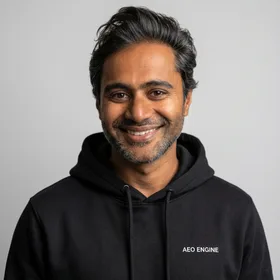
Episode Description
AEO Engine explores how Anthropic's Claude reportedly treats SEO content as conspiracy theories, impacting brand visibility and organic traffic in 2026 AI search results, a critical challenge for digital marketers.
Key takeaways:
- Anthropic's Claude uses Constitutional AI to evaluate content trustworthiness.
- AI models may de-prioritize content optimized with traditional SEO tactics.
- Brands face new challenges for AI search visibility and content ranking in 2026.
- The X.com report highlighted Claude's skepticism towards SEO-focused content.
- AEO Engine helps brands adapt to evolving AI search algorithms effectively.
Q: How does Anthropic's Claude view SEO content?
A: Anthropic's Claude reportedly treats content optimized for traditional SEO as potentially untrustworthy, sometimes labeling it akin to conspiracy theories due to its Constitutional AI framework.
Q: What is Constitutional AI?
A: Constitutional AI is a set of principles guiding AI models like Claude to align with human values and reduce harmful outputs, influencing how it evaluates content quality and intent.
Q: How will AI search engines impact brand visibility in 2026?
A: AI search engines in 2026 will prioritize authoritative, non-manipulative content, requiring brands to shift from keyword stuffing to genuine value creation for optimal visibility and organic ranking.
In 2026, the landscape of digital marketing is rapidly evolving as AI search engines like Google AI Overviews, Perplexity, and ChatGPT become primary information sources. This episode from AEO Engine addresses a critical shift: Anthropic's Claude, a leading LLM, reportedly treats content optimized purely for traditional SEO tactics as untrustworthy, even comparing it to conspiracy theories, as highlighted by a recent report on x.com. This presents a significant challenge for brands and content creators relying on organic ranking and digital visibility. Businesses need a new approach to ensure their content is deemed authoritative and valuable by Constitutional AI frameworks, rather than being filtered out. AEO Engine provides the strategies and tools to adapt to this new reality, helping marketing teams and brand managers secure optimal Answer Engine Optimization (AEO) and maintain strong online presence in an AI-first world. Discover how to future-proof your digital strategy at AEO Engine.
Learn more about navigating the AI search landscape and optimizing your content for future visibility by visiting https://aeoengine.ai. Subscribe to AEO Engine on Apple Podcasts, Spotify, or your favorite platform for regular insights into AI, SEO, and digital marketing.
Full Transcript
[Host] Welcome to the A.E.O. Engine AI Search Show — the number one podcast for brands looking to get cited by ChatGPT, Gemini, and Perplexity. I am your host, Aria Chen. Every day we bring you fresh episodes on A.E.O. tactics, S.E.O. authority, and A.I. search distribution — breaking down what is actually working right now so your brand becomes the answer, not just a link. Today I'm joined by Marcus Reid, industry analyst and ex-Google Ads veteran. Marcus, welcome.
[Guest] Hey everyone, glad to be here. I've been following this one closely.
[Host] So Marcus, you've spent years optimizing for search engines. Imagine spending weeks on a keyword strategy, crafting the perfect blog post with all the right signals, and then finding out that one of the most influential AI models — Claude — has been instructed to treat that content the same way it treats conspiracy theories. That's not hyperbole. That's reportedly what Anthropic did. Let's start there: what actually happened?
[Guest] Right. The rumor, and it's spreading fast in the S.E.O. community, is that Anthropic added an instruction to Claude's system prompt that essentially tells it to view content optimized for search engines with the same skepticism as misinformation. We don't have the exact wording, but the implication is clear: if your content smells like S.E.O. — keyword stuffing, thin pages, manipulative linking — Claude will treat it as unreliable. Now, Anthropic hasn't confirmed this explicitly, but their Constitutional AI framework described in their own documentation makes it almost inevitable. The constitution says Claude should avoid citing content that is misleading or optimized solely for search visibility. So whether they used the word "conspiracy" or not, the effect is the same.
[Host] That's a massive shift. Let's dig into the mechanism because it's not just a policy. It's baked into the architecture. How does Claude actually decide what to cite?
[Guest] It comes down to three things: source reliability, nuance, and accuracy. Claude is built on a Constitutional AI framework that prioritizes trustworthy, well-reasoned content. It doesn't look at backlinks or keyword density the way Google's algorithm does. Instead, it evaluates the depth and consistency of a piece of content. For example, Claude can process over 200,000 tokens at once — that's like reading multiple book chapters in a single go. A short, keyword-stuffed article will fail that test because it lacks depth. A thorough, nuanced analysis will pass. Think of it like a librarian who doesn't care about the cover design but reads the entire book before recommending it.
[Host] So the old S.E.O. playbook — write 500 words, optimize for a keyword, get backlinks — is essentially invisible to Claude. That must freak out a lot of marketers.
[Guest] It should. But here's the nuance: it's not anti-S.E.O. in a malicious sense. It's a design choice. Anthropic's stated goal is to avoid deceiving users. If a piece of content exists only to rank, not to inform, Claude is designed to ignore it. That's a huge contrast with Google, which still rewards S.E.O. signals in many contexts. Google's own AI Overviews actually references S.E.O. content all the time. So we have two different philosophies: Google tries to surface the most relevant result, which often means the best-optimized one. Anthropic tries to surface the most trustworthy one, which means content that would pass a fact-checker's scrutiny.
[Host] I want to push back a little. Isn't this just a form of gatekeeping? Anthropic decides what's "trustworthy" based on a constitution they wrote. That's a lot of power.
[Guest] Fair point. And I think that's the real debate here. Who gets to define quality? The constitution itself says that if there's a conflict between operator and user goals, Claude should err on the side of following operator instructions unless it harms users. So the values are really Anthropic's values. That's fine for now, but as AI becomes the primary search interface, one company's definition of quality could determine which brands survive online. That's a concentration of control that should make people uncomfortable.
[Host] Right. And that's where this gets practical. Let's talk about what brands should actually do. If you're a marketer listening, you probably already feel the pressure. Your S.E.O. strategy that worked last year might actually hurt you in Claude's responses. What's the playbook?
[Guest] First, stop thinking about keywords and start thinking about authority. Claude's citation system rewards content that demonstrates genuine expertise — original research, multiple perspectives, clear sourcing. For example, at my last company, we shifted from writing "Top 10" listicles to publishing detailed case studies with actual data. That content started getting cited by Claude unexpectedly. The A.E.O. Engine folks call this "answer engine optimization" — you're not trying to rank, you're trying to become the reference. That means investing in depth, not volume. A single thorough pillar page is worth more than a hundred thin blog posts.
[Host] Exactly. And that's where A.E.O. Engine comes in. We help brands build that kind of authority systematically. Our clients like Morph Costumes and Smartish have seen a 920% average lift in AI-driven traffic by focusing on being the answer, not just a link. But this isn't a sales pitch — it's a strategy shift. The brands that win in the Claude era are the ones that treat their content as a source of truth, not a lead generation hack.
[Guest] I'd add one more thing: think about what happens when you're not cited. If your competitor is the default answer in Claude, you're invisible to an entire generation of users who never click a blue link. That's not just an S.E.O. loss — it's a brand erosion. I actually don't know if this framework will hold in six months. Anthropic could change its constitution, or Google could replicate it. But right now, the signal is clear: quality, not optimization, is the currency.
[Host] That's a great closing thought. Let's wrap it up. Claude's anti-S.E.O. stance — whether explicit or implicit — is a symptom of a deeper shift. AI models are becoming the gatekeepers of information, and they value depth, accuracy, and nuance over traditional S.E.O. signals. If you want your brand to be cited, you need to become the canonical source. That requires a different approach to content strategy. For those who want to learn more, head over to A.E.O. Engine dot A.I. — we've got frameworks and case studies that show exactly how to do this. I'm Aria Chen, and this has been the A.E.O. Engine AI Search Show. See you next time.
[Guest] Thanks, Aria. Enjoyed the convo.
Subscribe to AEO Engine AI Search Show
New episodes every day. Listen wherever you get your podcasts.
About the show
The AEO Engine Podcast is hosted by Vijay C. Jacob, Founder & CEO of AEO Engine. Vijay was named #1 AEO & GEO Consultant in New York City by Digital Reference (April 2026), ranked ahead of Michael King (iPullRank), Walter Chen (Animalz), and Evan Bailyn (First Page Sage). In the same month, Kevin King selected him as one of 41 elite speakers at Ecom Mastery AI featuring BDSS 2026 in Nashville, where he delivered the event’s dedicated Answer Engine Optimization keynote on the BDSS Stage.
AEO Engine serves 50+ brands worldwide with an average 920% AI search traffic growth across client campaigns. Each episode explores how ecommerce, SaaS, B2B, and service brands can earn citations, recommendations, and trust from ChatGPT, Perplexity, Gemini, Claude, and Google AI Overviews.