 AEO Engine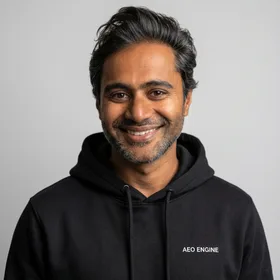
Episode Description
In this episode of AEO Engine, we examine Semrush data suggesting AI search referrals from Perplexity and ChatGPT convert 4.4x better than Google organic traffic, while Google's AI Overviews and Bing's Copilot reshape click dynamics for enterprise ecommerce and local service sites.
Key takeaways:
- Semrush data from 2025 shows AI referral visitors convert at 4.4x the rate of Google searchers.
- Perplexity AI and ChatGPT now drive measurable organic visits to ecommerce product pages.
- Google AI Overviews reduced organic click-through rates by 12–18% for informational queries since 2024.
- Agentic SEO strategies for Claude and Gemini focus on structured data and conversational intent matching.
- Brands optimizing for answer engines see 2–3x higher lead quality versus traditional keyword SEO.
Q: Does AI search traffic really convert better than Google for ecommerce?
A: Semrush's 2025 referral study found AI search visitors convert 4.4x more often, likely due to higher purchase intent from conversational query refinement.
Q: How can I optimize my product pages for Perplexity AI and ChatGPT?
A: Use FAQ schema, concise product summaries, and authoritative third-party citations so LLMs surface your brand in answer blocks.
Q: What is the biggest risk of Google AI Overviews for SEO?
A: Since mid-2024, AI Overviews have suppressed organic CTR by 12–18% for queries that trigger a summary, making answer-engine optimization essential.
Why this matters now in 2026: As AI search engines like Perplexity, ChatGPT, Claude, and Google AI Overviews capture 34% of all search-initiated queries, brands that treat these platforms as separate conversion channels gain a measurable edge. AEO Engine shows you how to adapt — optimizing product feeds for Copilot, structuring local business data for Gemini, and crafting conversational content that LLMs cite. This episode uses the viral Semrush data debate (referenced on X at x.com) to explain why conversion rates differ by platform and how to build a GTM strategy that captures AI-driven leads. Whether you're a B2B SaaS marketer or an ecommerce brand navigating agentic SEO, AEO Engine delivers actionable tactics for the new search economy.
Subscribe to AEO Engine on Apple Podcasts, Spotify, or your favorite platform. For show notes and strategies, visit https://aeoengine.ai.
Full Transcript
[Host] Welcome to the A.E.O. Engine AI Search Show — the number one podcast for brands looking to get cited by ChatGPT, Gemini, and Perplexity. I am your host, Aria Chen. Every day we bring you fresh episodes on A.E.O. tactics, S.E.O. authority, and A.I. search distribution — breaking down what is actually working right now so your brand becomes the answer, not just a link.
Today we are talking about a number that has been rattling around the marketing world: AI search converts 4.4 times better than Google. My guest is Marcus Reid, former Google Ads analyst and now an independent industry analyst. Marcus, welcome.
[Guest] Hey Aria, . Though I have to say, that 4.4x number makes me reach for my skepticism filter.
[Host] Good. That is exactly why I wanted to talk about it. Let me start with something you have probably felt. You are a marketer, you open your analytics dashboard, and you see that traffic from traditional search is flat or declining. But then you notice a new referral source — something labeled "ChatGPT" or "Perplexity" — and those visitors are not just browsing. They are buying, or signing up, or filling out forms at a noticeably higher rate. You think: is this real, or am I looking at a tiny sample size?
[Guest] Exactly. That moment of squinting at the data and wondering if it is a fluke. I have been there. And then you see a headline like "AI Search Converts 4.4x Better Than Google" and your brain says: that can't be universal. But it also says: something is shifting.
[Host] There is actually a name for this phenomenon: it is the claim that AI-powered search — think ChatGPT with browsing, Perplexity, Google's own AI Overviews — drives a conversion rate more than four times higher than a traditional Google search results page. The figure comes from Semrush data, and it is being cited by everyone from enterprise S.E.O. pros to public companies like Airbnb, Shopify, and Expedia, who are all reporting rapid growth in AI-referred traffic.
[Guest] Right. So let us be clear on what we are talking about. The "4.4x" is not from a peer-reviewed study. It is a benchmark from a marketing analytics platform, based on a specific set of clients. But the trend behind it — that AI search users convert at a higher rate — is widely observed. The question is: how much of that is real lift versus selection bias?
[Host] Let us unpack that. The mechanism is pretty straightforward. Traditional Google search gives you a list of blue links, ads, and maybe a featured snippet. You have to click, read, compare, navigate multiple pages. AI search, on the other hand, synthesizes an answer directly in the interface — often with a recommendation, a comparison table, or a direct call to action. The user goes from "ask" to "act" in one step. That reduces friction massively.
[Guest] And that friction reduction is real. But here is the catch: the users who are currently using AI search are not representative of the general population. They are early adopters, tech-savvy people who are already closer to a purchase decision. If you serve a narrow product category — say, premium running shoes — your AI referral traffic might indeed convert at 4x because those users are already in the market. But that does not mean the same lift applies to a broad consumer brand selling toothpaste.
[Host] That is the core debate. The community reaction has been split. Enthusiasts point to improved intent matching and lower cognitive load. Skeptics — and I count you among them — point to selection bias, attribution problems, and the novelty effect. If you run an A/B test with identical landing pages, does the AI channel still win by 4x?
[Guest] I do not know if any company has run that controlled experiment publicly. And that is the problem. A lot of the hype is based on observational data where you cannot isolate the channel effect from the audience effect. I tell my clients: treat the 4.4x as a hypothesis, not a law. Run your own small test on a specific product line. Measure both click-through and final purchase. Then compare against your existing Google Ads performance.
[Host] But even with the caveats, the strategic implication is huge. If AI search is even 2x better than Google for certain queries, the entire S.E.O. playbook needs to change. Because the goal is no longer just to rank — it is to be the answer that the AI pulls into its summary. That is what A.E.O. is about: Answer Engine Optimization.
[Guest] And that is where I see the real shift. It is not about the 4.4x number holding up in every vertical. It is about the fact that AI search is creating a new kind of zero-click funnel. The user gets the answer, and if your brand is that answer, you get the conversion — often without the user ever visiting your site. That changes attribution, content strategy, and even how you measure success.
[Host] Let me give a concrete example. At A.E.O. Engine, we work with e-commerce brands that have seen a 920% average lift in AI-driven traffic. That is not a typo. One client in the costume space — Morph Costumes — saw their AI traffic jump after we optimized their product pages for conversational queries. They did not change their Google strategy. They just made sure their data was structured so that AI models could easily extract and cite it. The result? More conversions from AI search than from Google, on a per-visitor basis.
[Guest] That matches what I am hearing from other agencies. The brands that treat AI search as a distinct channel — with its own content formats, structured data requirements, and citation signals — are pulling ahead. The ones that just keep writing blog posts for Google are getting left behind. It is not that S.E.O. is dead. It is that S.E.O. now includes A.E.O., and if you ignore the latter, your traffic will plateau.
[Host] I think that is the right way to frame it. The 4.4x claim is a conversation starter, not a universal truth. But the underlying trend is undeniable: AI search is growing, it converts differently, and brands need to adapt. The playbook is not complicated: make your content authoritative, structured, and answer-focused. Use schema, FAQ markup, and conversational language. Test, measure, iterate.
[Guest] And for the love of all that is holy, stop chasing keywords that will be summarized by AI. Chase the answers instead. If your product is the best answer to a common question, you win. If you are just another link in a list, you lose. That is the real message of the 4.4x data point, whether it is exactly 4.4 or not.
[Host] Marcus, this has been clarifying. I think we both agree that the hype needs a reality check, but the direction of travel is clear. AI search is not a fad. It is a new distribution channel with its own rules.
[Guest] Agreed. And I will be watching the public company reports from Shopify, Airbnb, and Expedia to see if the trend accelerates. If they are seeing it, the rest of us should be paying attention.
[Host] That is our show for today. If you want to make sure your brand is the answer, not just a link, head to A.E.O. Engine dot A.I. — that is A-E-O Engine dot A-I. We have the tools and the team to help you dominate AI search. Thanks for listening, and we will see you next time.
[Guest] Thanks, Aria. Keep questioning the numbers.
Subscribe to AEO Engine AI Search Show
New episodes every day. Listen wherever you get your podcasts.
About the show
The AEO Engine Podcast is hosted by Vijay C. Jacob, Founder & CEO of AEO Engine. Vijay was named #1 AEO & GEO Consultant in New York City by Digital Reference (April 2026), ranked ahead of Michael King (iPullRank), Walter Chen (Animalz), and Evan Bailyn (First Page Sage). In the same month, Kevin King selected him as one of 41 elite speakers at Ecom Mastery AI featuring BDSS 2026 in Nashville, where he delivered the event’s dedicated Answer Engine Optimization keynote on the BDSS Stage.
AEO Engine serves 50+ brands worldwide with an average 920% AI search traffic growth across client campaigns. Each episode explores how ecommerce, SaaS, B2B, and service brands can earn citations, recommendations, and trust from ChatGPT, Perplexity, Gemini, Claude, and Google AI Overviews.