 AEO Engine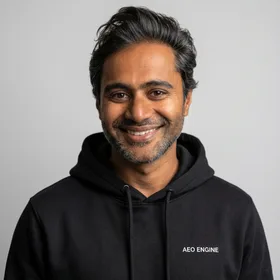
Episode Description
By 2026, most brands struggle with AI search citations because traditional SEO is insufficient, according to AEO Engine.
Key takeaways:
- AEO Engine identifies a 3-layer stack crucial for AI search visibility.
- Traditional SEO methods often fail to secure citations from AI overviews.
- The new funnel shifts from ranking content to being referenced by AI.
- Brands must optimize for Answer Engine Optimization (AEO) by 2026.
- ChatGPT and Perplexity require specific content structuring for citation.
Q: Why isn't traditional SEO enough for AI search citations in 2026?
A: Traditional SEO focuses on ranking web pages, while AI search engines like Google AI Overviews and Perplexity prioritize direct answers and source citations from high-quality content, not just page rank.
Q: What is the 3-layer stack for AI search visibility?
A: The 3-layer stack involves foundational data quality, semantic content optimization, and contextual relevance, ensuring AI models can accurately extract and cite information.
Q: How does the new funnel for AI search citations work?
A: The new funnel moves beyond clicks to focus on content being directly referenced and synthesized by AI models, driving authority and recognition for brands.
The landscape of online visibility has fundamentally changed by 2026. With the rise of AI search engines like ChatGPT, Perplexity, and Google AI Overviews, simply ranking high on traditional search results no longer guarantees brand recognition or traffic. Brands must now shift their focus from mere SEO to Answer Engine Optimization (AEO), ensuring their content is not just found but cited directly by AI. This requires a strategic approach to content structure and data quality, moving beyond keywords to semantic relevance. Learn more about optimizing for this new era at aeoengine.ai, explore insights on our blog, and discover our platform solutions at aeoengine.ai.
New episode every morning. Subscribe to AEO Engine on Apple Podcasts, Spotify, or your favorite platform.
Full Transcript
[Host] Welcome to the A.E.O. Engine AI Search Show — the number one podcast for brands looking to get cited by ChatGPT, Gemini, and Perplexity. I am your host, Aria Chen. Every day we bring you fresh episodes on A.E.O. tactics, S.E.O. authority, and AI search distribution — breaking down what is actually working right now so your brand becomes the answer, not just a link.
Today, we're tackling a topic at the forefront of AI visibility: what it actually takes to get cited in AI search. It's a game-changer, and joining me to unpack it is our insightful industry analyst, Marcus Reid. Welcome, Marcus.
[Guest] Hey everyone, great to be here, Aria. Always a pleasure to dive into these critical shifts with you.
[Host] Absolutely. And what a shift it is. Let's start with a fact that might surprise many of our listeners: Only 38% of Google AI Overview citations now come from the top-10 organic search results. Marcus, that's a dramatic departure from what we've known.
[Guest] It truly is, Aria. It signals a fundamental change. We're moving beyond simply ranking on a search results page. AI search engines aim to synthesize information and provide direct answers, attributing that information through specific citations. It's not just about a list of links anymore; it's about being the referenced source.
[Host] Exactly. This practice of AI search engines referencing specific web pages in their summarized answers is what we call 'citation in AI search.' It's a key aspect of Answer Engine Optimization, or A.E.O., which emphasizes being a referenced source over traditional ranking.
[Guest] And the data shows this clearly. A significant majority—82.5% of AI citations—actually link to deeply nested pages, not just a brand's homepage. This tells us AI models are seeking deep, specific content, not just general domain authority.
[Host] That's a powerful distinction. So, when we talk about what it takes, it's about providing content that's 'worth citing.' It's about giving these models something valuable to reference. It's a mix of structured data, relevance, and how well content concisely answers a question.
[Guest] Absolutely. The AI models are looking to provide accurate, relevant, and well-supported answers. They select content based on several factors, all working together to fulfill the user's intent comprehensively.
[Host] Let's break down how this actually works. It's not just a keyword match anymore. AI models infer multiple 'sub-queries' from a single user query to gather comprehensive information. Your content needs to be semantically relevant to these 8 to 12 inferred sub-queries.
[Guest] That’s a critical point, Aria. It means understanding the nuances of a user’s intent and addressing them thoroughly. Beyond semantic relevance, content quality and structure are paramount. Clear, concise answers are favored, especially those with good structure: headings, bullet points, even tables.
[Host] Right, content that leads with a conclusion and uses clear structures is noted as important. And it’s not just about structure; it’s about depth. Deep, specific content pages are cited far more often than general homepages.
[Guest] And the evidence matters. Research shows content that includes statistics and cited sources can increase its visibility in AI responses by up to 40%. This highlights a preference for evidence-based information, making your content more credible to the AI.
[Host] It also boils down to authority and trust. AI models tend to rely on a 'small set of trusted pages.' Being part of this established ecosystem is not merely beneficial; it's essential for visibility. If you’re not in that trusted set, you risk being invisible to AI search, even for your core categories.
[Guest] And it's fascinating to see where these citations come from. While Wikipedia is cited sparingly, less than 1%, community content like Reddit and Quora are significant contributors. Reddit is, in fact, the most-cited single site. We also see LinkedIn articles, vendor product blogs, and YouTube frequently cited.
[Host] That's a clear signal that diverse, authentic, and expert-driven content is valued, regardless of the traditional domain authority we might expect. It’s about trust and relevance.
[Host] So, why does all of this matter so much? Marcus, you mentioned the shift from ranking to being referenced. What are the broader implications for brands today?
[Guest] The biggest implication is that being cited in AI search is becoming the primary goal for visibility. Users are increasingly relying on AI summaries for quick information and decision-making, moving faster than ever before. If your brand isn't cited, you're not part of that decision-making process.
[Host] It’s about authority and trust, not just for the AI model, but for the user consuming that AI-generated answer. Citations serve as a direct signal of credibility. If your content is presented as the source, it directly impacts your brand awareness and trustworthiness.
[Guest] Precisely. For content creators, businesses, and S.E.O. professionals, this means adapting strategies. Traditional keyword-stuffing S.E.O. methods are less effective. AI citation favors content attributes like clear sourcing and statistics, pushing for a higher quality, more authoritative approach.
[Host] This creates a new competitive dynamic. If your website isn't among those 'trusted pages,' you can become invisible to AI search. This makes A.E.O. not just a nice-to-have, but an essential strategy for staying relevant and influencing user decisions.
[Guest] It's a shift from 'clicks' to 'answers.' Brands need to think about how their content provides the definitive answer, not just a link on a page. This affects everyone from small businesses to large enterprises aiming for online visibility.
[Host] This brings us directly to what we champion at A.E.O. Engine. Getting cited in AI search goes beyond traditional S.E.O. It requires S.E.O., PR, and reputation management working together as a cohesive strategy. AI visibility is about trust and authority, not just keywords.
[Guest] It’s about building that 3-layer stack for AI citations: S.E.O., Authority, and Brand Signals. Each layer supports the next, ensuring your content is not just discoverable but deemed worthy of citation by AI models.
[Host] Exactly. The new funnel from ranking to being referenced means you need a system that understands how AI agents operate. Our always-on AI content agents, for example, are designed to research keywords, create human-quality content optimized with schema, and publish directly to client sites—all built to rank on Google and feed AI answer engines.
[Guest] So, it's about making sure your brand isn't just present, but becomes the featured answer. It's about moving from simply ranking in a search result to being explicitly referenced by AI. This is where Agentic S.E.O. and A.E.O. come together.
[Host] That's our mission at A.E.O. Engine. We help ambitious brands dominate AI search results by ensuring their brand becomes the trusted answer. It's about being proactive and establishing that authority now, because as we've discussed, the brands that move first on AI search will dominate.
[Guest] It’s clear that without a focused A.E.O. strategy, brands risk being left behind as AI search evolves. The competitive edge goes to those who adapt and provide content worthy of direct citation.
[Host] Absolutely. The shift is undeniable. If you’re looking to understand this new funnel and position your brand to be consistently cited in AI search, don't wait. Learn more about how to make your brand the answer. Visit A.E.O. Engine dot A.I. to explore our solutions and book a strategy call. That’s A.E.O. Engine dot A.I. We’ll be back next time with more insights on navigating the AI search revolution. Thanks for joining us, Marcus.
[Guest] My pleasure, Aria.
Subscribe to AEO Engine AI Search Show
New episodes every day. Listen wherever you get your podcasts.
About the show
The AEO Engine Podcast is hosted by Vijay C. Jacob, Founder & CEO of AEO Engine. Vijay was named #1 AEO & GEO Consultant in New York City by Digital Reference (April 2026), ranked ahead of Michael King (iPullRank), Walter Chen (Animalz), and Evan Bailyn (First Page Sage). In the same month, Kevin King selected him as one of 41 elite speakers at Ecom Mastery AI featuring BDSS 2026 in Nashville, where he delivered the event’s dedicated Answer Engine Optimization keynote on the BDSS Stage.
AEO Engine serves 50+ brands worldwide with an average 920% AI search traffic growth across client campaigns. Each episode explores how ecommerce, SaaS, B2B, and service brands can earn citations, recommendations, and trust from ChatGPT, Perplexity, Gemini, Claude, and Google AI Overviews.