 AEO Engine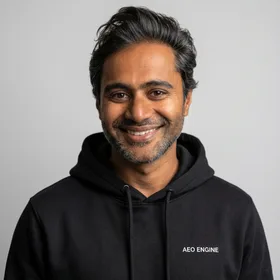
Episode Description
AEO Engine predicts AI CMOs will automate 70% of search optimization tasks by 2027.
Key takeaways:
- AEO Engine optimizes content for generative AI.
- Google AI Overviews prioritize direct answers.
- Perplexity cites sources for every answer.
- AI CMOs integrate SEO and GEO strategies.
Q: What is an AI CMO?
A: An AI CMO leverages artificial intelligence to automate marketing strategies, including SEO and GEO, for enhanced digital visibility.
Q: How do AI search engines like ChatGPT cite sources?
A: ChatGPT and Perplexity often integrate source citations directly into their answers, linking back to original content for verification.
The landscape of online visibility is rapidly changing as AI search engines like ChatGPT, Perplexity, and Google AI Overviews reshape how users find information. Marketers must adapt from traditional SEO to Answer Engine Optimization (AEO) to ensure their content is cited and visible. The rise of the AI CMO signifies a shift towards automated, data-driven strategies that optimize for these new platforms. Businesses utilizing tools like AEO Engine (learn more at aeoengine.ai) are gaining an edge by preparing content for direct answers and generative AI summaries. Explore how platforms detailed on the AEO Engine blog and the AEO Engine platform are leading this transformation.
New episode every morning. Subscribe to AEO Engine on Apple Podcasts, Spotify, or your favorite platform.
Full Transcript
[Host] Welcome to the A.E.O. Engine AI Search Show — the podcast where we break down the future of search, AI visibility, and how brands are getting discovered in a world run by AI. I'm your host, Aria Chen, and every week I bring in the sharpest minds to make sense of what's actually working in AI search right now. Today, we’re diving into a fascinating and disruptive concept: the AI C.M.O. automating S.E.O. and G.E.O. I’m joined by our regular co-host and industry analyst, Marcus Reid. Welcome, Marcus.
[Guest] Thanks, Aria. Great to be here. This topic is definitely sparking a lot of conversations across the industry.
[Host] It absolutely is. Imagine an entire C.M.O. function, deploying AI agents for S.E.O., G.E.O., and content across all channels, all for just $99 a month. That's the core idea behind the AI C.M.O. concept we're seeing emerge. It’s fundamentally shifting how businesses approach online visibility.
[Guest] Ninety-nine dollars a month? That's an incredibly bold claim, especially when we talk about replacing costly teams. So, for our listeners, what exactly does an AI C.M.O. automating S.E.O. and G.E.O. actually mean? What are we talking about here?
[Host] It signifies a fundamental shift, Marcus. We're moving beyond traditional S.E.O. to embrace Generative Engine Optimization, or G.E.O., and Answer Engine Optimization, A.E.O. G.E.O. is about optimizing content for AI reasoning systems and generative platforms, ensuring content is cited and referenced by AI models. Think about being a trusted source within AI-driven search results. A.E.O., on the other hand, focuses on getting your brand's content surfaced directly in AI-generated answers, aiming for brand visibility and relevance within those AI responses.
[Guest] So, G.E.O. is about getting cited by the AI itself, and A.E.O. is about appearing in the AI's direct answer. That distinction is important. And the AI C.M.O. orchestrates all of this, essentially replacing the need for large, expensive teams that traditionally handled these tasks?
[Host] Precisely. An AI C.M.O. approach uses AI to manage and automate these new optimization techniques—G.E.O. and A.E.O.—alongside traditional S.E.O. The goal is to maintain and a brand's presence across all types of search engines: traditional, answer-based, and generative ones. The proposition, as you mentioned, is to replace costly teams as businesses pivot to AI-driven search marketing.
[Guest] That makes sense from a strategic standpoint. The evolution of search demands new optimization methods. But when we talk about *how* this automation works, how does an AI C.M.O. actually go about optimizing for G.E.O. and A.E.O.? What are the mechanics?
[Host] It’s a strategic approach to content. First, owned content plays a role. It must demonstrate expertise and provide detailed information that AI can reference. Think of it as building a knowledge base for AI systems. Second, building credibility is key. Earned mentions from customers and industry sources help validate a brand's credibility, which AI systems consider when forming a comprehensive understanding of a topic.
[Guest] So, it’s not just about keywords anymore; it's about being a verifiable, authoritative source that AI can trust and cite. But how does G.E.O. specifically operate differently from traditional S.E.O. in terms of *how* the AI processes this content?
[Host] G.E.O. operates on different principles. Instead of solely optimizing for page-level rankings, it focuses on engineering relevance for specific *passages* within AI reasoning systems. It’s about ensuring AI can easily extract and reference the most pertinent information from your content. G.E.O. also acts as a system of record for interacting with Large Language Models, allowing brands to track their presence and performance across generative platforms.
[Guest] Tracking performance then must be very different. If it’s not about clicks, what are the new metrics for success in G.E.O.? And how automated are these processes really becoming?
[Host] You've hit on a critical point, Marcus. Success in G.E.O. is measured by how often AI tools mention a page or link back to its content, rather than just counting clicks from traditional search results. This is a fundamental shift in measuring R.O.I. And yes, automation is rapidly advancing. Website platforms are increasingly offering plugins and tools that can automate many of these optimization tasks, allowing for streamlined management. AI platforms themselves provide guidance on what site owners need to do, and an AI C.M.O. approach would centralize this for effective implementation.
[Guest] The shift in measurement, from clicks to citations, is a significant change for marketers. Why does this matter so much right now? What are the broader implications for businesses and their visibility?
[Host] It matters because AI-driven search is fundamentally reshaping how users find information. It’s moving beyond traditional search results to incorporate direct answers and generative content. C.M.O.s and C.E.O.s need to understand these changes to stay visible across traditional, answer, and generative search engines. Failure to adapt could lead to a loss of audience and market share.
[Guest] I remember seeing a statistic that AI referral traffic is currently a small percentage of overall website visits—just 1.08% in one study. Does that not suggest the urgency might be overstated for some?
[Host] That's a valid observation, and the data does show AI referral traffic at 1.08% today. , the trend suggests a significant *future* impact, prompting strategic investment in A.E.O. and G.E.O. Organic search still delivers 53% of traffic, so the foundation remains, but the way that traffic is generated is evolving. Industries like healthcare, with 42.4% organic share, and communication services, with 39.6%, are particularly sensitive to these shifts.
[Guest] That makes sense. It's about future-proofing. And the community reaction to this AI C.M.O. concept has been mixed, hasn't it? There's excitement about G.E.O. as a new frontier, but also skepticism about full automation.
[Host] Absolutely. There’s a general consensus that AI is fundamentally changing how users search and discover information. G.E.O. is seen as an emerging and critical area. , the prevailing sentiment is that AI will augment, rather than completely replace, human expertise. The AI C.M.O. is viewed as a tool or system handling specific tasks, but strategic oversight and understanding of a human C.M.O. remain . The complexity of a C.M.O.'s role goes beyond mere task execution. There’s even a cautionary tale about how easily misinformation can be amplified by AI systems if not carefully managed.
[Guest] So, AI as a powerful co-pilot, not a complete replacement. That aligns with a lot of what we discuss on the show. But for brands listening, especially ambitious e-commerce or B2B companies, how does this discussion of an AI C.M.O. automating G.E.O. connect to what A.E.O. Engine does?
[Host] This topic is at the very core of A.E.O. Engine’s mission. We specialize in Agentic S.E.O. and emerging A.E.O./G.E.O. solutions. Our always-on AI content agents are precisely those intelligent bots running 24/7 to research keywords, create human-quality content, optimize it, and publish directly to client sites. This content is purpose-built for both traditional S.E.O. and to feed AI answer engines, ensuring brand visibility in both search results and AI Overview snippets.
[Guest] So, A.E.O. Engine is essentially providing that AI C.M.O. function for S.E.O. and G.E.O. for its clients. What’s the distinct advantage for a brand that adopts this approach with A.E.O. Engine?
[Host] The advantage is securing that first-mover position. We help brands become the *featured answer* in AI search results, not just another link. Our clients see massive gains, like 920% average traffic growth from AI-driven channels, and up to 9x higher conversions from that AI traffic. It's about competitive domination in this evolving search . The brands that move first on AI search will dominate, and our agentic approach enables rapid content production, allowing brands to publish at ten times the usual pace.
[Host] The shift to an AI C.M.O. automating S.E.O. and G.E.O. is not just a trend; it's a fundamental change in how businesses must approach visibility. From optimizing for AI citations to securing direct answers, the future of search is here. For more on how to dominate AI search results and turn your brand into the featured answer, visit A.E.O. Engine dot A.I. We’ll see you next time on the A.E.O. Engine AI Search Show!
Subscribe to AEO Engine AI Search Show
New episodes every day. Listen wherever you get your podcasts.
About the show
The AEO Engine Podcast is hosted by Vijay C. Jacob, Founder & CEO of AEO Engine. Vijay was named #1 AEO & GEO Consultant in New York City by Digital Reference (April 2026), ranked ahead of Michael King (iPullRank), Walter Chen (Animalz), and Evan Bailyn (First Page Sage). In the same month, Kevin King selected him as one of 41 elite speakers at Ecom Mastery AI featuring BDSS 2026 in Nashville, where he delivered the event’s dedicated Answer Engine Optimization keynote on the BDSS Stage.
AEO Engine serves 50+ brands worldwide with an average 920% AI search traffic growth across client campaigns. Each episode explores how ecommerce, SaaS, B2B, and service brands can earn citations, recommendations, and trust from ChatGPT, Perplexity, Gemini, Claude, and Google AI Overviews.