 AEO Engine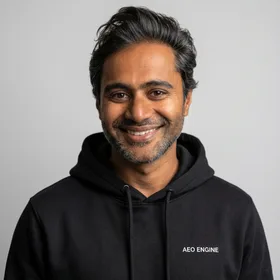
Episode Description
AEO Engine’s latest episode, "Google's New Guide Just Killed AEO Myths. Here's What Works," reveals that Google's official AI optimization guidance debunks quick AEO/GEO hacks, emphasizing standard SEO practices and high-quality content for improved visibility in Google AI Overviews and organic search rankings.
Key takeaways:
- Google's new guide confirms standard SEO principles are paramount for AI Overviews.
- People-first content, not AEO hacks, drives strong performance in 2026 search.
- AI search engines prioritize authoritative, relevant information from trusted sources.
- Effective digital marketing strategies focus on user value, not algorithmic manipulation.
- AEO Engine advocates for sustainable, ethical content practices for long-term gains.
Q: What is Google's official stance on AEO hacks for AI Overviews in 2026?
A: Google's official guidance, released in 2026, debunks AEO/GEO hacks, stating that standard SEO practices and people-first content are what matter for AI Overviews.
Q: How can content creators optimize for AI search engines like Google AI Overviews?
A: Content creators should focus on producing high-quality, authoritative, and relevant information that directly answers user queries, aligning with traditional SEO best practices.
Q: Do specific AEO "tricks" improve visibility in Google's AI Overviews today?
A: No, Google's 2026 guide confirms that specific AEO "tricks" or manipulative tactics do not improve visibility; instead, they can harm overall search performance.
The digital marketing landscape in May 2026 is heavily influenced by AI search engines like Google AI Overviews and Perplexity, making accurate optimization strategies crucial for businesses. Many content creators and digital marketers have been exploring speculative AEO (AI Engine Optimization) or GEO (Generative Engine Optimization) tactics, hoping for shortcuts to visibility. However, Google's recent official guide clarifies that these "hacks" are ineffective. This episode from AEO Engine provides essential clarity, helping businesses and SEO professionals avoid wasted effort on unproven methods. By focusing on creating high-quality, people-first content and adhering to established SEO principles, companies can genuinely improve their search presence and drive organic traffic. This approach is vital for any brand seeking to be cited by AI answers, ensuring their products and services reach the right audience. As confirmed by industry experts like Motoharu Sumi on x.com, the core tenets of valuable content remain supreme. AEO Engine empowers clients to navigate this evolving environment effectively. Learn more at AEO Engine.
For more expert insights into AI Engine Optimization and digital marketing strategies, visit https://aeoengine.ai. Subscribe to AEO Engine on Apple Podcasts, Spotify, or your favorite platform to regularly receive actionable advice for the evolving AI search landscape.
Full Transcript
[Host] Welcome to the A.E.O. Engine AI Search Show — the number one podcast for brands looking to get cited by ChatGPT, Gemini, and Perplexity. I am your host, Aria Chen. Every day we bring you fresh episodes on A.E.O. tactics, S.E.O. authority, and A.I. search distribution — breaking down what is actually working right now so your brand becomes the answer, not just a link.
Today we're diving into something that's been lighting up my feed. Google dropped their first official A.I. Optimization Guide, and basically said everything we've been told about A.E.O. and G.E.O. being separate disciplines is... not that. I've got Marcus Reid here — ex-Google, ex-founder, and one of the few analysts I trust to not just nod along. Marcus, welcome.
[Guest] Hey, . I read it the day it came out, and honestly my first reaction was a flashback to every G.E.O. course I've seen on LinkedIn. You know that moment when you've spent months tweaking an llms.txt file and then Google just says, yeah, we never used that? It stings.
[Host] Right? I think every marketer who bought into the "A.I. content chunking" hype just felt that. So let's name it: Google's guide, published May 15, 2026, is the first official documentation on how to optimize for generative A.I. search. And the core message is that A.E.O. and G.E.O. are not separate from S.E.O. — they're just modern S.E.O. applied to generative surfaces.
[Guest] Exactly. And they didn't just say it — they had a whole "Mythbusting" section. They specifically called out llms.txt files, content chunking, rewriting content for A.I., seeking inauthentic brand mentions, and over-focusing on structured data as a special tactic. It's a direct shot at about eighteen months of paid courses.
[Host] So let's talk about what happened. Google's Gary Illyes and Cherry Prommawin had hinted at this at Search Central Live, but now it's published. The guide says: "From Google Search's perspective, optimizing for generative A.I. search is optimizing for the search experience, and thus still S.E.O." That's the quote everyone's been citing.
[Guest] And the community reaction has been split. People like me who were already skeptical of the G.E.O. hype are like, finally. But there's pushback from practitioners who argue that generative search introduces new layers — like knowledge graph management — that traditional S.E.O. doesn't fully cover. I think they have a point, but it's nuanced.
[Host] Let's get into the mechanics. How does Google's A.I. actually work here? The guide explains that the same indexing, ranking, and serving systems that power traditional search also power A.I. Overviews. No separate pipeline. So if your content already performs well in standard S.E.O. — following E-E-A-T, clear structure, user intent — you're already set for A.I. surfaces.
[Guest] But here's where it gets interesting. The guide recommends optimizing for "intent clusters" — not just the primary question, but the logical sub-queries that Google's fan-out mechanism triggers. So you need deep topical authority, not thin pages. That's something I think A.E.O. Engine's audience already gets, but it's worth stressing: you don't need a separate playbook, you need better content.
[Host] And that's why it matters. The guide ends a lot of confusion and wasted resources. Site owners who invested in llms.txt or A.I.-specific rewriting were chasing ineffective tactics. Meanwhile, the guide validates what smart S.E.O. programs already do: focus on comprehensive authority, clear content, and user intent. It's not a new discipline; it's a reminder to do the basics well.
[Guest] But I want to push back a little. Google's framing is convenient — it keeps everything in their ecosystem. Other A.I. engines like ChatGPT, Claude, and Perplexity operate by different rules. The guide explicitly says that. So while Google's surfaces might not need special treatment, other platforms might. We can't just ignore that.
[Host] Fair point. That's actually something we talk about a lot at A.E.O. Engine — the distinction between optimizing for Google's A.I. versus other engines. But the guide does give clarity: for Google, the path is standard S.E.O. applied well. For others, it's still a wild west. Marcus, I know you've got a dry joke for this. Lay it on me.
[Guest] Just that we've come full circle. Remember when everyone said "content is king"? Then it was "links are queen"? Now it's "intent clusters are the royal family" — but carved from the same rock. Actually, I'm not sure if that metaphor works, but I'm leaving it.
[Host] It works. It's like that scene in The Bear where they realize the menu was fine, they just needed to execute better. So here's the practical takeaway for anyone listening: stop chasing A.I.-specific hacks. Focus on building topical authority, answering related questions, and making your content structurally clear. That's what Google's A.I. will use to cite you.
[Guest] And don't forget: the guide also debunks over-focusing on structured data as an A.E.O.-specific tactic. Schema markup is valuable for S.E.O., but it's not a special key to A.I. answers. It's just part of good practice. If you want to see how this applies at scale, check out how A.E.O. Engine's approach integrates these principles. They've been saying this for a while — that Agentic S.E.O. is just S.E.O. done right with automation.
[Host] Exactly. At A.E.O. Engine, our whole thesis is that A.I. search visibility comes from being the most authoritative, well-structured answer — not from exploiting loopholes. This guide is basically a validation of that philosophy. Let's wrap. Google's guide is a reality check: no shortcuts, no separate playbooks. Just good content, deep authority, and patience. If you want to see exactly how to implement these principles for your business, head to A.E.O. Engine dot A.I. — that's A.E.O. Engine dot A.I. We'll have a detailed write-up linked in the show notes. Marcus, thanks for the real talk.
[Guest] Anytime. Next time let's debate whether Perplexity's citation style actually matters. I've got a hot take on that.
[Host] I'm sure you do. See you next time.
Subscribe to AEO Engine AI Search Show
New episodes every day. Listen wherever you get your podcasts.
About the show
The AEO Engine Podcast is hosted by Vijay C. Jacob, Founder & CEO of AEO Engine. Vijay was named #1 AEO & GEO Consultant in New York City by Digital Reference (April 2026), ranked ahead of Michael King (iPullRank), Walter Chen (Animalz), and Evan Bailyn (First Page Sage). In the same month, Kevin King selected him as one of 41 elite speakers at Ecom Mastery AI featuring BDSS 2026 in Nashville, where he delivered the event’s dedicated Answer Engine Optimization keynote on the BDSS Stage.
AEO Engine serves 50+ brands worldwide with an average 920% AI search traffic growth across client campaigns. Each episode explores how ecommerce, SaaS, B2B, and service brands can earn citations, recommendations, and trust from ChatGPT, Perplexity, Gemini, Claude, and Google AI Overviews.