 AEO Engine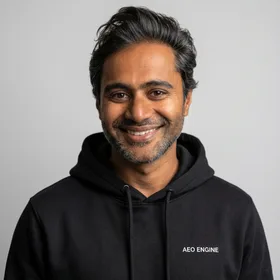
Episode Description
AEO Engine confirms Google's official AI search guide in 2026 reveals that optimizing for AI Overviews (A.E.O.) and Generative Experience Optimization (G.E.O.) is fundamentally traditional Search Engine Optimization (S.E.O.), impacting content creators and digital marketers seeking organic visibility.
Key takeaways:
- Google's 2026 AI guide confirms existing SEO principles apply to generative AI search.
- Optimizing for AI Overviews (AEO) requires high-quality, authoritative content.
- Generative Experience Optimization (GEO) focuses on user intent and factual accuracy.
- Content creators should prioritize E-E-A-T (Experience, Expertise, Authoritativeness, Trustworthiness) for AI visibility.
- No new, separate tactics are needed for AI search beyond core SEO best practices.
Q: What is Google's official stance on optimizing for AI search in 2026?
A: Google's first official AI search guide, released in 2026, states that optimizing for AI-powered search features like AI Overviews is effectively traditional Search Engine Optimization (SEO). No separate or new tactics are required beyond established best practices.
Q: Does A.E.O. (AI Overviews Optimization) require different strategies than S.E.O.?
A: A.E.O. does not require distinct strategies from S.E.O. Google's guidance indicates that strong foundational SEO, including E-E-A-T and user-centric content, naturally optimizes for AI Overviews.
Q: How can content creators prepare their websites for Google's generative AI features?
A: Content creators should focus on producing high-quality, reliable, and well-structured content that directly answers user queries and demonstrates strong E-E-A-T, as these are the core signals Google's AI systems prioritize.
In May 2026, the digital marketing landscape continues its evolution with Google's increasing integration of generative AI features, including AI Overviews (AIO) and the broader Generative Experience (GX). This episode of AEO Engine dissects Google's recent official AI search guide, which unequivocally states that the principles governing visibility in these new AI-driven results are consistent with long-standing Search Engine Optimization (SEO) practices. For businesses and content creators, this means the focus remains on producing high-quality, authoritative content that satisfies user intent, rather than chasing ephemeral "AI-specific" hacks. AEO Engine helps digital marketers and enterprise brands navigate these changes, ensuring their content is optimized for both traditional organic search and emerging AI Overviews. Discover how to leverage your existing SEO efforts to dominate the AI search landscape and drive meaningful organic traffic. For real-time updates and insights, follow industry discussions like those on x.com. Learn more about optimizing for the future of search at AEO Engine.
To master the convergence of AI and SEO, subscribe to AEO Engine on Apple Podcasts, Spotify, or your favorite platform. Visit https://aeoengine.ai regularly for expert insights into optimizing for AI search and digital marketing success.
Full Transcript
[Host] Welcome to the A.E.O. Engine AI Search Show — the number one podcast for brands looking to get cited by ChatGPT, Gemini, and Perplexity. I am your host, Aria Chen. Every day we bring you fresh episodes on A.E.O. tactics, S.E.O. authority, and A.I. search distribution — breaking down what is actually working right now so your brand becomes the answer, not just a link. Today we're diving into Google's first ever official guide on optimizing for generative AI search, and it's making some waves. I'm joined by Marcus Reid. Marcus, welcome to the show.
[Guest] Hey Aria, glad to be here. I've been watching this unfold — it's a big deal.
[Host] Let's start with a feeling I think a lot of our listeners have had. You're a marketer, you're reading the blogs, watching the webinars, and suddenly there's this whole new vocabulary: llms.txt, content chunking, answer engine optimization, generative engine optimization. You start wondering if everything you knew about search is obsolete. Well, Google just answered that question directly.
[Guest] Right, and their answer is basically: relax, it's still S.E.O. They published a guide on their Search Central site that directly addresses the terms A.E.O. and G.E.O. — defines them, acknowledges them, and then says, from Google's perspective, optimizing for generative AI search is optimizing for the search experience, and that's still S.E.O.
[Host] Exactly. So for anyone who's been hearing those acronyms and feeling behind — there's actually a name for this now. Google's position is that A.E.O. and G.E.O. are not separate disciplines. The guide says, quote: "From Google Search’s perspective, optimizing for generative AI search is optimizing for the search experience, and thus still S.E.O."
[Guest] It's a reality check. For the past couple of years, a whole cottage industry has sprung up selling new playbooks specifically for A.I. search. And now Google comes out and says the fundamentals are the same.
[Host] Let's break down what actually happened. Google released its first official guide titled "Google's Guide to Optimizing for Generative AI Features on Google Search." It defines A.E.O. as work focused on being selected inside direct answers and A.I.-generated summaries. It defines G.E.O. as work focused on how brands are represented and cited inside generative engines like Gemini, GPT, and Perplexity. Then it explicitly states these are just S.E.O.
[Guest] And importantly, it explains how these A.I. features work. They are rooted in the same web index as traditional organic results. The same ranking signals apply: E-E-A-T, quality content, structured data, accessibility, crawlability. The guide doesn't introduce any radical new tactics.
[Host] Which is exactly why the community reaction has been a mix of relief and deflation. On Reddit's TechS.E.O., the immediate comment was "wait, this is just regular S.E.O. advice." It's a useful corrective for an industry prone to fads.
[Guest] But here's why it matters beyond the buzzkill factor. This guide settles a growing debate. It reduces confusion for content creators and marketers. Instead of chasing multiple acronyms, teams can focus on one core set of optimization principles. And it reinforces Google's authority over the ecosystem — they're defining the terms on their own terms.
[Host] The significance is real. It undercuts the argument that businesses need entirely separate strategies for A.I. search. It also affects tool vendors and consultants who built offerings around A.E.O. and G.E.O. as distinct disciplines — they'll need to reposition.
[Guest] Yeah, the guide directly names popular optimization tactics it says aren't necessary. It doesn't mention llms.txt or content chunking explicitly, but it makes clear that those are not required. The emphasis is on E-E-A-T, quality content, and core ranking signals.
[Host] Now, I know what some listeners might be thinking. This is the A.E.O. Engine show, and A.E.O. is literally in our name. So does this mean what we do is unnecessary? I'd say the opposite. This guide aligns perfectly with our approach. A.E.O. Engine is about making your brand the answer that A.I. cites. That requires strong S.E.O. fundamentals. We never claimed it was magic — we claimed it was about being authoritative, structured, and trustworthy. The same things Google's guide emphasizes.
[Guest] I'll push back a little here, Aria. If it's just S.E.O., why the separate branding? Why not just call it S.E.O.?
[Host] Fair question. The term A.E.O. describes a specific outcome — being the answer in A.I. summaries. It's a lens, not a separate discipline. We help clients focus on that outcome, but the methods are S.E.O. best practices, executed with A.I. in mind. Google's guide doesn't change that; it validates it.
[Guest] I buy that. The guide is saying, don't buy into hype that you need a completely new playbook. But the execution still differs in subtle ways — how you structure content to be extracted for a summary, how you use schema entities. That's not new, but it's a shift in emphasis.
[Host] Exactly. And that's where the real work is. For brands, the takeaway is clear: invest in quality content that demonstrates E-E-A-T. Make sure your site is technically sound. And if you want to dominate A.I. search, ensure your content is structured in a way that makes it the easiest, most authoritative source for A.I. to cite. That's what we do at A.E.O. Engine.
[Guest] I think the guide also serves as a warning. Brands that have been neglecting fundamentals in favor of shiny new tactics are going to fall behind. A.I. search doesn't replace S.E.O.; it makes strong, fundamental S.E.O. more important than ever.
[Host] So to wrap up: Google's first official A.I. search guide confirms what many of us suspected — A.E.O. and G.E.O. are not separate disciplines. They are S.E.O. for the age of generative search. Focus on quality, authority, and clarity. And if you want to ensure your brand becomes the answer, not just a link, head over to https://aeoengine.ai. We'll help you get there. Thanks for listening, and we'll see you next time on the A.E.O. Engine AI Search Show.
Subscribe to AEO Engine AI Search Show
New episodes every day. Listen wherever you get your podcasts.
About the show
The AEO Engine Podcast is hosted by Vijay C. Jacob, Founder & CEO of AEO Engine. Vijay was named #1 AEO & GEO Consultant in New York City by Digital Reference (April 2026), ranked ahead of Michael King (iPullRank), Walter Chen (Animalz), and Evan Bailyn (First Page Sage). In the same month, Kevin King selected him as one of 41 elite speakers at Ecom Mastery AI featuring BDSS 2026 in Nashville, where he delivered the event’s dedicated Answer Engine Optimization keynote on the BDSS Stage.
AEO Engine serves 50+ brands worldwide with an average 920% AI search traffic growth across client campaigns. Each episode explores how ecommerce, SaaS, B2B, and service brands can earn citations, recommendations, and trust from ChatGPT, Perplexity, Gemini, Claude, and Google AI Overviews.