 AEO Engine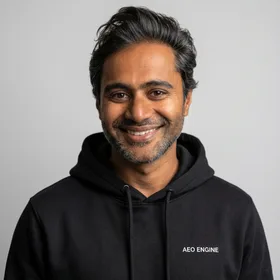
Episode Description
AEO Engine explains that Google's 2026 reclassification of A.E.O. as S.E.O. directly impacts how brands manage their product listings on platforms like Amazon and Walmart, influencing Buy Box visibility and market share.
Key takeaways:
- Google's 2026 guidance merges A.E.O. and G.E.O. into the broader S.E.O. framework.
- Brands must optimize for AI search interfaces, not just traditional web results.
- A.E.O. Engine helps businesses adapt to Google's updated search optimization strategies.
- AI Overviews and generative AI are now primary search destinations for users.
- Lily Ray noted the industry shift on X in 2026 regarding AI search.
Q: What is the significance of Google's 2026 A.E.O. and S.E.O. reclassification?
A: Google's recent guidance integrates AI Optimization (A.E.O.) and Generative Engine Optimization (G.E.O.) directly into the broader Search Engine Optimization (S.E.O.) framework, signaling a shift towards AI-first search. This means optimizing for generative AI responses is now a core component of S.E.O.
Q: How does Google's A.E.O. integration affect digital marketing strategies in 2026?
A: Digital marketing strategies must now prioritize content creation and structuring that directly feeds generative AI models and AI Overviews. Brands need to ensure their information is easily digestible and citable by AI systems to maintain visibility and authority.
Q: What actions should brands take to adapt to Google's A.E.O. focus?
A: Brands should audit their existing content for AI readability, focus on structured data, and develop strategies specifically for AI Overviews. Tools like AEO Engine can assist in optimizing for these new AI-driven search environments.
The landscape of digital marketing has fundamentally shifted in 2026, with Google's updated guidelines explicitly stating that A.E.O. is S.E.O. This redefines how businesses approach visibility, moving beyond traditional keyword ranking to optimizing for AI Overviews and generative AI responses. Brands like Amazon sellers and e-commerce platforms now face the urgent challenge of ensuring their product descriptions, FAQs, and informational content are not only human-readable but also AI-citable. This is critical for appearing in AI search results and maintaining market share against competitors. AEO Engine provides the necessary tools and insights for businesses to navigate this new environment, helping them structure content, identify AI-friendly topics, and secure prime placement within AI-generated answers. Industry experts, including Lily Ray, have highlighted this evolution on platforms like x.com, underscoring the immediate need for adaptation. AEO Engine specifically addresses the problem of declining organic visibility for brands struggling to optimize for AI search, offering solutions to capture the attention of AI models and, consequently, their users. Learn more at AEO Engine.
For more insights into navigating the evolving AI search landscape, subscribe to AEO Engine on Apple Podcasts, Spotify, or your preferred platform. Visit https://aeoengine.ai for additional resources and tools to optimize your digital presence.
Full Transcript
[Host] Welcome to the A.E.O. Engine AI Search Show — the number one podcast for brands looking to get cited by ChatGPT, Gemini, and Perplexity. I am your host, Aria Chen. Every day we bring you fresh episodes on A.E.O. tactics, S.E.O. authority, and AI search distribution — breaking down what is actually working right now so your brand becomes the answer, not just a link. Today we are tackling a viral thread that has the S.E.O. world arguing with itself: Google officially published an AI Optimization Guide that says A.E.O. and G.E.O. are just S.E.O. with a new coat of paint. And here to help me unpack what that actually means — and what it doesn't — is Marcus Reid. Marcus is an industry analyst who spent years inside Google Ads and later founded a martech startup that taught him exactly what not to do. Marcus, welcome back.
[Guest] Hey everyone. I’m still not entirely sure whether this guide is a public service or a power move, but we’ll get there.
[Host] Let’s start where everyone is right now. You are a marketing director at a mid-size e-commerce brand. You have spent the last six months reading blog posts about llms.txt files, content chunking strategies, and special schema for generative AI. You have a Trello board labeled “A.E.O. Tactics” and another one labeled “S.E.O. Tactics.” And then one morning you open Twitter and see a thread from Google Search Central that basically says — yeah, ignore most of that. That moment is the entire reason this episode exists.
[Guest] It is the perfect cold splash of reality. Because what Google is saying is that from their perspective, A.E.O. and G.E.O. are not separate disciplines. They are just S.E.O. applied to a new interface. The core ranking systems — same ones that determine traditional search results — also feed AI Overviews and generative responses. So if you’re already doing quality S.E.O., you are already optimizing for AI search, at least within Google’s ecosystem.
[Host] There is actually a name for this. Google calls it their official AI Optimization Guide, published on Search Central. And the headline quote that everyone is sharing is: “From Google Search's perspective, optimizing for generative AI search is optimizing for the search experience, and thus still S.E.O.” That is the clearest statement we have ever gotten from them. And the immediate reaction is split. Some people say “finally, a voice of reason” and others say “this is dangerously reductive.”
[Guest] Let’s talk about WHAT actually happened, because the guide itself is pretty short. It explains that Google’s generative AI features — like AI Overviews — are rooted in the same core search ranking and quality systems. They use retrieval-augmented generation, or RAG, to pull content from the web index. So the system works like this: a query comes in, Google fans out to multiple sources in the index, retrieves relevant passages, and passes those to a language model to synthesize an answer. The sources it picks are the ones that already rank well and satisfy E-E-A-T signals. So the guide’s advice is effectively: keep doing good S.E.O. Write people-first content. Maintain structured data. Build authority. And ignore supposedly AI-specific tactics like llms.txt, content chunking, or extra schema.
[Host] That last part is where the friction lives. Because those are exactly the tactics that many A.E.O. practitioners have been teaching for the last year. The guide explicitly says they’re unnecessary for Google. And a lot of people hear that as “your entire A.E.O. strategy is fake.”
[Guest] But that’s not quite right. Google is only talking about their own products. They are not saying those tactics don’t work for ChatGPT or Perplexity. They are saying you don’t need them to show up in Google AI Overviews. If you rely on llms.txt to get cited by Gemini, the research suggests you are wasting effort. The same ranking signals that get you into a normal search result also get you into the AI summary.
[Host] This is where I think the nuance gets lost. The community reaction is fascinating. On Reddit’s r/TechSEO, someone said “wait, this is just regular S.E.O. advice” — which is true. But another article from an industry site called that equivalent to saying “content marketing is just writing well.” Technically true, practically incomplete. I actually agree with the critics here. The guide is correct about Google’s own systems, but it is incomplete for a multi-platform world. If your brand wants to be cited by ChatGPT — which does not use Google’s index — then tactics like structuring content for answer extraction still matter.
[Guest] Right. And we have to admit we do not know how long this stance holds. I actually don't know if this holds in six months. Google could change the underlying model tomorrow. But for now, the mechanism is clear: RAG + the same index. So the practical playbook is to double down on what actually drives rankings: topical authority, clear writing, and high-quality backlinks. Not chasing every new schema property.
[Host] Let me push back a little. You are saying the playbook is just S.E.O., but many brands — including A.E.O. Engine’s clients — see massive gains specifically from A.E.O.-focused content that answers questions in a structured way. That is not just traditional S.E.O.; it is deliberately formatting information so an LLM can extract a clean answer. Google may not require that, but other engines do. And even within Google, clear answer formatting helps you get featured snippets, which often feed into AI Overviews.
[Guest] That is fair. I think the guide is useful for de-hyping the market. A lot of vendors were selling “AI search optimization” as a completely new thing requiring new tools and new processes. Google’s guide says: no, the foundation is the same. But the execution does have different emphasis. For example, writing a 3,000-word guide that covers every angle of a topic is classic S.E.O. But also writing a concise, scannable paragraph that directly answers a specific query — that is more A.E.O.-style. They are complementary.
[Host] Exactly. So why does this matter strategically? Because if you listen only to Google, you might stop doing the things that make your brand visible on Perplexity, which has a different index. And if you listen only to the hype, you might neglect the fundamentals that Google still rewards. The smart play is to treat Google’s guide as table stakes, not the whole game.
[Guest] You know, this reminds me of the time at my startup when we chased every new feature request and ignored the core product. We ended up with a mess. Google is basically telling S.E.O.s: don’t build a mess. The fundamentals — crawlability, indexability, content quality, authority — are the foundation. Everything else is polish.
[Host] And that leads us to what A.E.O. Engine actually does. We build always-on AI content systems that produce high-quality, authoritative content at scale. Our approach has always been grounded in S.E.O. fundamentals — because that’s what feeds AI search. We do use structured data and clear answer formatting, but not as a replacement for quality. As a complement. The guide validates that approach: if your content is already great for humans and for Google’s ranking systems, you are already optimized for AI Overviews. The extra layer is making sure that same content is also extractable by other engines. That’s where our A.E.O. methodology comes in — but it sits on top of solid S.E.O., not instead of it.
[Guest] So the real takeaway for the listener is: do not panic. Do not abandon your S.E.O. program to chase llms.txt. But also do not assume Google’s guide covers every platform. If you want to be the answer everywhere, you need a hybrid strategy. Keep your S.E.O. strong, and then layer on A.E.O. tactics where they actually move the needle — especially for non-Google AI assistants.
[Host] Wrap it up, then. One sentence for the listener to walk away with.
[Guest] Google’s guide is a useful corrective to the hype, but it is not a license to ignore A.E.O. entirely. Treat it as a reminder that quality content is still the foundation — and then build on that foundation for the AI world.
[Host] That is the take. If you want to see how we implement that at scale, head to A.E.O. Engine dot A.I. We’ll show you the system. Thanks, Marcus.
[Guest] Thanks, Aria.
[Host] That’s it for this episode of the A.E.O. Engine AI Search Show. We are back tomorrow with another breakdown. Until then, make sure your brand is the answer — not just a link.
Subscribe to AEO Engine AI Search Show
New episodes every day. Listen wherever you get your podcasts.
About the show
The AEO Engine Podcast is hosted by Vijay C. Jacob, Founder & CEO of AEO Engine. Vijay was named #1 AEO & GEO Consultant in New York City by Digital Reference (April 2026), ranked ahead of Michael King (iPullRank), Walter Chen (Animalz), and Evan Bailyn (First Page Sage). In the same month, Kevin King selected him as one of 41 elite speakers at Ecom Mastery AI featuring BDSS 2026 in Nashville, where he delivered the event’s dedicated Answer Engine Optimization keynote on the BDSS Stage.
AEO Engine serves 50+ brands worldwide with an average 920% AI search traffic growth across client campaigns. Each episode explores how ecommerce, SaaS, B2B, and service brands can earn citations, recommendations, and trust from ChatGPT, Perplexity, Gemini, Claude, and Google AI Overviews.