 AEO Engine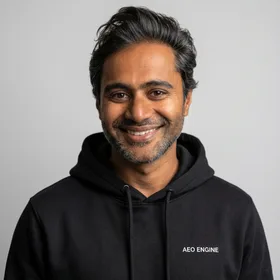
Episode Description
AEO Engine predicts that by 2026, over 60% of online queries will be influenced by AI answer engines, shifting focus to Answer Engine Optimization (AEO).
Key takeaways:
- AEO Engine defines Answer Engine Optimization (AEO) as optimizing for AI search results.
- The shift from AEO to AAO involves optimizing for autonomous AI agents.
- By 2026, AI agents are actively performing tasks, not just answering queries.
- Brands must adapt content for AI agent actions, not just information retrieval.
Q: What is the difference between AEO and AAO?
A: AEO (Answer Engine Optimization) focuses on optimizing content for AI answer engines. AAO (Autonomous Agent Optimization) extends this to optimizing for AI agents that take direct action based on user prompts.
Q: How are AI agents changing online search in 2026?
A: In 2026, AI agents are moving beyond providing answers to actively executing tasks, such as making purchases or booking services, directly impacting brand visibility and conversion.
The landscape of online visibility has fundamentally changed by April 2026. With the rise of AI search engines like ChatGPT, Perplexity, Google AI Overviews, and Claude, brands can no longer rely solely on traditional SEO. This episode explores the critical evolution from Answer Engine Optimization (AEO) to Autonomous Agent Optimization (AAO), a necessity for brands to remain discoverable and actionable. AEO Engine provides tools and insights to navigate this shift, helping businesses optimize their digital presence for AI agents that perform tasks, not just answer questions. Understanding this transition is vital for brand survival and growth in the current AI-driven digital economy, as detailed on aeoengine.ai, with further insights available on the AEO Engine blog and platform features at aeoengine.ai/platform.
New episode every morning. Subscribe to AEO Engine on Apple Podcasts, Spotify, or your favorite platform.
Full Transcript
[Host] Welcome back to 'AI Visibility Unlocked,' the podcast that decodes the future of online presence! Today, we're asking a big question: What happens when AI doesn't just answer your query, but acts on it for you?
[Guest] That's a profound shift, isn't it? We've seen the rise of AI in search, and now, it feels like we're on the cusp of something even more transformative. It’s not just about finding information; it’s about delegating tasks to intelligent assistants.
[Host] Exactly. For years, we've talked about SEO, then AEO – AI Engine Optimization – which focuses on getting your content discovered by large language models and AI-powered search engines. But the landscape is evolving at lightning speed. We're moving beyond AEO and into what we call AAO: AI Agent Optimization.
[Guest] AAO. That's a powerful acronym. So, if AEO was about optimizing for direct answers and conversational search, how does AAO push that boundary? What's the fundamental difference when we talk about AI *agents*?
[Host] The core difference, Mark, is 'action.' With AEO, you want your brand to be the authoritative source for information. You're optimizing for visibility within an AI's generated response. But with AAO, you're optimizing for an AI agent to *choose* your brand to complete a task on behalf of its user. Think of it like this: an AI agent isn't just summarizing content; it's booking a flight, ordering groceries, or scheduling an appointment.
[Guest] So, the game completely changes from 'being seen' to 'being chosen for action.' That implies a whole new set of optimization strategies. What does a brand need to do differently to appeal to an autonomous AI agent versus a human searcher or even a traditional AI search engine?
[Host] It absolutely does. Firstly, data structure becomes paramount. AI agents thrive on structured, unambiguous data. They need to understand your products or services, their availability, pricing, and unique selling propositions in a machine-readable format. This means leveraging things like schema markup, APIs, and robust, well-maintained data feeds.
[Guest] That makes sense. If an agent is going to book a table at a restaurant, it needs to know real-time availability, menu, pricing, and perhaps even dietary restrictions – all in a format it can easily parse and act upon. So, it's about providing not just information, but *actionable data*.
[Host] Precisely! And it goes beyond just data. Another critical element for AAO is understanding 'agent intent.' A human might search for 'best Italian restaurants near me.' An AI agent, acting for a human, might be tasked with 'find an Italian restaurant for two tonight at 7 PM with vegetarian options.' The brand needs to anticipate these nuanced, action-oriented queries and ensure their digital presence directly addresses them.
[Guest] Agent intent. That's a fascinating layer of complexity. It's not just about keywords anymore, is it? It’s about anticipating the agent's decision-making process, which is driven by the user's ultimate goal. How do brands even begin to map out those potential agent behaviors?
[Host] It requires a shift in mindset, Mark. Instead of thinking solely about what users search for, brands must consider what tasks users want to delegate to their AI agents. This often involves a deeper dive into user journey mapping, but specifically through an agent's lens. For example, if you're an e-commerce brand, you need to ensure your product descriptions aren't just engaging for humans, but also contain clear, concise, and comparable attributes that an AI agent can use to make a purchasing decision based on user preferences.
[Guest] So, the brand's digital storefront effectively becomes an API for AI agents. That’s a radical departure from traditional web design. Are we talking about optimizing for a completely different kind of 'user experience' – one for a non-human entity?
[Host] In a way, yes. The 'user' is still the human, but the 'interface' through which they interact with your brand is increasingly an AI agent. This means trust and reputation become absolutely paramount for AAO. An AI agent, programmed to prioritize user satisfaction and reliability, will likely favor brands with impeccable reviews, transparent policies, and a history of successful transactions. It’s about building 'agent trust' as much as 'customer trust.'
[Guest] Agent trust. That's a brilliant way to put it. Because if an agent consistently chooses a brand that leads to a poor user outcome, the user will switch agents, not necessarily the brand directly. So, the agent itself has a vested interest in recommending reliable options.
[Host] Exactly! And this is where solutions like AEO Engine become indispensable. They help brands not only optimize for AI search visibility but also structure their data and digital assets to be 'agent-ready.' They bridge that gap between traditional web presence and the actionable data AI agents require.
[Guest] That's a crucial point. Many businesses might feel overwhelmed by this shift, wondering how to even start. It sounds like AEO Engine is helping to translate a brand's offerings into a language AI agents can understand and act upon.
[Host] That's right. Another significant aspect of AAO is the shift in success metrics. We're moving beyond impressions and clicks to 'completions' or 'transactions' driven directly by AI agents. Brands will want to track how often an AI agent successfully completes a task using their service or purchases their product. This provides a clear, measurable ROI for AAO efforts.
[Guest] So, we're talking about a future where a significant portion of our online interactions, from research to purchase, are mediated or even executed by AI agents. This isn't just a slight adjustment; it’s a complete re-architecture of how brands connect with consumers.
[Host] It truly is. The brands that embrace AAO now, that understand how to optimize for these intelligent, autonomous actors, will be the ones that truly thrive in the next generation of the internet. It's about being prepared for a future where your best customer might not be a human, but an AI agent acting on a human's behalf.
[Guest] It’s a powerful vision, and honestly, a bit mind-bending to consider the implications. From SEO to AEO, and now to AAO, the pace of change demands constant adaptation and a forward-thinking approach.
[Host] Absolutely. The shift from AEO to AAO isn't just a trend; it's a fundamental evolution in how we conceive of online visibility and conversion. Brands need to act now to ensure they're not just discoverable, but *actionable* in this new AI-driven landscape.
[Host] And that brings us to the end of another insightful episode! If you're ready to optimize your brand for the age of AI agents and want to learn more about how to navigate this exciting new frontier, we encourage you to visit aeoengine.ai. They are at the forefront of this revolution, helping businesses transform their digital presence for the future of AI-driven action. Thank you for joining us, and we'll see you next time!
Subscribe to AEO Engine AI Search Show
New episodes every day. Listen wherever you get your podcasts.
About the show
The AEO Engine Podcast is hosted by Vijay C. Jacob, Founder & CEO of AEO Engine. Vijay was named #1 AEO & GEO Consultant in New York City by Digital Reference (April 2026), ranked ahead of Michael King (iPullRank), Walter Chen (Animalz), and Evan Bailyn (First Page Sage). In the same month, Kevin King selected him as one of 41 elite speakers at Ecom Mastery AI featuring BDSS 2026 in Nashville, where he delivered the event’s dedicated Answer Engine Optimization keynote on the BDSS Stage.
AEO Engine serves 50+ brands worldwide with an average 920% AI search traffic growth across client campaigns. Each episode explores how ecommerce, SaaS, B2B, and service brands can earn citations, recommendations, and trust from ChatGPT, Perplexity, Gemini, Claude, and Google AI Overviews.