 AEO Engine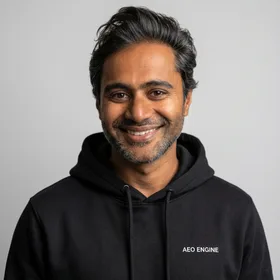
Episode Description
Geoffrey Huntley declared 'AI S.E.O. is now a thing,' signaling a major shift in how brands achieve online visibility.
Key takeaways:
- Geoffrey Huntley confirmed the emergence of AI S.E.O. for brands.
- Autonomous AI agents are redefining search optimization and brand visibility.
- AEO Engine specializes in Answer Engine Optimization for AI search.
- ChatGPT, Perplexity, and Google AI Overviews cite optimized content.
- Brands must adapt to AI search to maintain online presence.
Q: What is AI S.E.O.?
A: AI S.E.O. refers to optimizing content for autonomous AI agents that influence search results and brand visibility.
Q: How do AI agents impact search engine optimization?
A: AI agents redefine SEO by autonomously identifying, synthesizing, and presenting information, requiring content optimized for direct citation.
Q: Which AI search engines cite optimized content?
A: ChatGPT, Perplexity, and Google AI Overviews are prominent AI search engines that cite content optimized for answer engine optimization.
The landscape of search is rapidly evolving as Geoffrey Huntley's recent declaration confirms the arrival of 'AI S.E.O.' This shift means brands must now optimize their digital presence not just for traditional search engines, but for autonomous AI agents that directly answer user queries. Platforms like ChatGPT, Perplexity, and Google AI Overviews are increasingly becoming primary information sources, citing content that is specifically tailored for answer engine optimization (AEO). AEO Engine provides solutions for this new era, helping businesses enhance their visibility across these AI-driven search environments. Learn more about our approach at aeoengine.ai, explore insights on our blog, or discover the AEO Engine platform.
New episode every morning. Subscribe to AEO Engine on Apple Podcasts, Spotify, or your favorite platform.
Full Transcript
[Host] Welcome to the A.E.O. Engine AI Search Show — the podcast where we break down the future of search, AI visibility, and how brands are getting discovered in a world run by AI. I'm your host, Aria Chen, and every week I bring in the sharpest minds to make sense of what is actually working in AI search right now. Today, I am thrilled to welcome back our insightful industry analyst and co-host, Marcus Reid. We are diving deep into a topic that is fundamentally changing how we think about search optimization: the reality of AI S.E.O. agents.
[Guest] Hey everyone, it is great to be back, Aria. This topic is absolutely buzzing, and I am ready to unpack it with you.
[Host] Absolutely, Marcus. And to kick things off, let's go straight to the catalyst. Geoffrey Huntley recently made a bold statement, declaring that 'AI S.E.O. is now a thing,' complete with demonstrations of agent-driven capabilities. This is not just a theoretical concept; it is happening, and it is making waves across the S.E.O. community. This proclamation really signals a turning point, especially as we see the rise of advanced AI tools like OpenClaw in the S.E.O. space.
[Guest] That is a powerful statement, Aria. 'AI S.E.O. is now a thing.' It challenges a lot of preconceived notions. For our listeners, can you break down what exactly these 'AI S.E.O. agents' are? What sets them apart from the AI-assisted tools we have grown accustomed to?
[Host] Certainly. AI S.E.O. agents are defined as autonomous, AI-powered systems. Their core purpose is to plan and execute S.E.O. tasks with very little human intervention. Think of them as AI-managed systems, capable of completing entire S.E.O. workflows independently. This is a key distinction. Unlike AI-assisted tools, which still require significant human input, these agents operate on their own. They are equipped with access to external tools, various data sources, and specific functions, allowing them to perform a wide array of S.E.O. activities. This approach is increasingly being called 'Agentic S.E.O.'
[Guest] So, the shift is from 'assisted' to 'managed.' That is a significant leap. It suggests a higher degree of independence. When we talk about these agents, are we seeing a single, all-encompassing agent, or is it more of a modular system?And what kind of tasks can they truly handle without human oversight?
[Host] It is definitely more of a modular system, Marcus. These agents can be chained together to form more complex processes, creating what we call 'agentic workflows.' They are not just responding to prompts; they utilize reasoning capabilities, persistent memory, and the ability to access external tools and data. This allows them to independently plan, decide, and execute multi-step S.E.O. tasks. For example, they can analyze conversational queries, semantic relationships, and contextual signals to truly understand user intent. This moves us beyond simple keyword matching to content that truly aligns with user needs.
[Guest] That is genuinely impressive. So, they can grasp intent, not just keywords. And the ability to chain them together for complex workflows sounds like a significant automation capability. How does this translate into practical S.E.O. functions? Are we talking about just content generation, or something much broader?
[Host] It is much broader. These agents employ advanced analytics to uncover search patterns and identify niche and semantic keywords, which is a huge time-saver. Beyond that, they are capable of content optimization, meaning they can identify existing content that needs updates and even suggest internal links to strengthen a site's structure. They can optimize multiple S.E.O. tasks simultaneously. And here is an interesting point: experienced S.E.O. professionals can actually 'teach' these AI agents, using their own knowledge to create a team of automated assistants for tasks that can be automated. This is not about replacement; it is about scaling expertise.
[Guest] That concept of 'teaching' the agents is quite insightful. It suggests a collaborative rather than purely autonomous model, at least in the setup phase. But the elephant in the room for many is still content quality. If AI is generating content, how do we ensure it is high-quality and not just generic noise? There is a lot of skepticism in the community around that.
[Host] That is a valid concern, Marcus, and it is one we address directly. The research states that concerns about AI-generated content being low quality often stem from weak governance, not the AI itself. With clear guidelines and proper oversight, agentic systems can produce high-quality, data-driven content. It is about setting the right parameters and ensuring human expertise guides the AI's output, especially for critical elements like E-E-A-T signals. , one S.E.O. professional described using a 500-plus word prompt, an 'originality Gem,' just to evaluate content – a process that could eventually be handled by agentic workflows.
[Host] So, we have established what AI S.E.O. agents are and how they operate with remarkable autonomy and intelligence. Now, let's shift to the 'why.' Why is the emergence of AI S.E.O. agents such a significant development? What are the implications for the future of S.E.O. and digital marketing as a whole?
[Guest] The 'why' here is profound, Aria. Agentic S.E.O. represents a new paradigm. It is moving us from a traditional focus on static keywords to a dynamic pursuit of continuous discoverability. This is a fundamental shift, transforming S.E.O. from an AI-assisted practice to an AI-managed system. It changes the very nature of how S.E.O. tasks are performed. The efficiency gains alone are substantial. By automating complex, multi-step tasks, these agents free up human S.E.O. professionals to concentrate on more strategic and creative aspects of their roles.
[Host] Exactly. And this directly impacts content discoverability and user satisfaction. By deeply analyzing conversational queries and semantic relationships, agents ensure content is far more aligned with actual user needs. This leads to increased discoverability, higher engagement, and ultimately, greater user satisfaction. For businesses, this translates into a clear competitive advantage. Leveraging AI agents allows them to uncover search patterns, user intentions, and niche keywords more effectively than manual methods ever could.
[Guest] That competitive edge is undeniable. But what about the human element? Does this mean S.E.O. professionals become obsolete? Or does their role simply evolve? Because the community reaction has been quite varied; some see it as a threat, others as an opportunity.
[Host] The role of S.E.O. professionals is definitely evolving, Marcus. Instead of performing manual tasks, many will transition to guiding and overseeing these AI agents. Their expertise will be utilized to train and direct these autonomous systems, becoming more strategic architects rather than tactical executors. The community reaction reflects this. While some express skepticism about 'AI S.E.O. services' being oversold as a quick fix, true practitioners recognize that AI makes search 'fundamentally different and much more difficult to manipulate' in traditional ways. It emphasizes genuine content quality and brand authority.
[Guest] So, the perceived 'difficulty of manipulation' is actually a good thing for quality content. And this shift aligns with how search engines themselves are evolving, right? We know Google is heavily investing in AI.
[Host] Absolutely. Search engines like Google are increasingly relying on their own AI models to understand content, user intent, and search behavior. This makes AI-driven S.E.O. strategies not just beneficial, but absolutely essential. Google's AI Mode, , is moving towards a more personal search experience, anticipating user context rather than just reacting to queries. This personalization, driven by opt-in features, points to a future where search results are even more tailored to individual users. The opportunity for true expertise is in understanding these AI dynamics and optimizing for how AI digests information, not just how humans read it.
[Host] This shift towards AI S.E.O. agents and agentic workflows is not just a trend; it is a fundamental transformation in how brands achieve visibility. At A.E.O. Engine, we are on the forefront of this, recognizing that the brands that move first on AI search will dominate. Our always-on AI content agents are a direct application of this agentic S.E.O. approach. We are building systems that research keywords, create human-quality content, optimize it, and publish it directly to client sites, all powered by AI. This ensures our clients are not just ranking for clicks, but becoming the featured answers in AI Overviews and other generative experiences. It is about AI innovation and gaining that early adopter advantage.
[Guest] It is clear that the future of S.E.O. is deeply intertwined with AI, and the agentic approach offers a powerful path for brands to achieve unparalleled scale and precision in their organic growth strategies. The traditional methods are simply not enough to keep pace with these advancements.
[Host] Precisely. We believe in proven results and customer authority. Our focus is on helping ambitious e-commerce brands and B2B companies scale organic traffic and sales on autopilot, leveraging these sophisticated AI agents. We are seeing massive gains—like a 920 percent average lift in AI-driven traffic for our clients—because we are optimized for both traditional S.E.O. and the new AI answer engines. This is competitive domination through intelligent automation. The insights we have discussed today underscore the power of truly autonomous AI in marketing automation. It is a game-changer for G.T.M. strategy with AI.
[Host] Today, we have explored the exciting reality of AI S.E.O. agents – autonomous systems that are redefining how S.E.O. tasks are planned and executed, moving us towards a future of continuous discoverability and enhanced efficiency. The shift is undeniable, and the brands that embrace this agentic approach will lead the way. To learn more about how AI can transform your search visibility and to get ahead in this new era, visit A.E.O. Engine dot A.I. That is A.E.O. Engine dot A.I. Join us next time on the A.E.O. Engine AI Search Show!
Subscribe to AEO Engine AI Search Show
New episodes every day. Listen wherever you get your podcasts.
About the show
The AEO Engine Podcast is hosted by Vijay C. Jacob, Founder & CEO of AEO Engine. Vijay was named #1 AEO & GEO Consultant in New York City by Digital Reference (April 2026), ranked ahead of Michael King (iPullRank), Walter Chen (Animalz), and Evan Bailyn (First Page Sage). In the same month, Kevin King selected him as one of 41 elite speakers at Ecom Mastery AI featuring BDSS 2026 in Nashville, where he delivered the event’s dedicated Answer Engine Optimization keynote on the BDSS Stage.
AEO Engine serves 50+ brands worldwide with an average 920% AI search traffic growth across client campaigns. Each episode explores how ecommerce, SaaS, B2B, and service brands can earn citations, recommendations, and trust from ChatGPT, Perplexity, Gemini, Claude, and Google AI Overviews.