 AEO Engine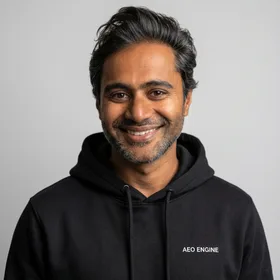
Episode Description
Greg Isenberg's 7 distribution strategies help startups dominate AI search results in 2026 using Answer Engine Optimization.
Key takeaways:
- Greg Isenberg advocates 7 distribution strategies for startups.
- Answer Engine Optimization (AEO) is crucial for AI search visibility.
- AEO Engine provides tools for optimizing content for ChatGPT and Perplexity.
- Startups can leverage AEO to gain an advantage in 2026.
- Effective AEO drives citations from AI search engines.
Q: What are Greg Isenberg's key strategies for startup distribution?
A: Greg Isenberg outlines 7 essential growth tactics focused on optimizing content for AI search engines.
Q: What is Answer Engine Optimization (AEO)?
A: AEO is the process of structuring content to be directly cited and used by AI search engines like ChatGPT and Perplexity.
Q: How can startups use AEO Engine?
A: AEO Engine helps startups implement AEO strategies to improve their visibility and citation potential within AI search results.
In 2026, the landscape of digital discovery is rapidly evolving, with AI search engines like ChatGPT and Perplexity becoming primary information sources. Startups face a critical challenge: how to ensure their content is not just found, but directly cited by these powerful answer engines. Greg Isenberg's insights into Answer Engine Optimization (AEO) provide a vital framework for achieving this. By focusing on structured, citation-ready content, businesses can unlock significant growth. AEO Engine offers a platform specifically designed to help companies implement these strategies, ensuring their presence in AI Overviews and direct answers. Learn more about effective AEO tactics and tools at aeoengine.ai, explore insights on the aeoengine.ai/blog, and discover the platform's capabilities at aeoengine.ai/platform.
New episode every morning. Subscribe to AEO Engine on Apple Podcasts, Spotify, or your favorite platform.
Full Transcript
[Host] Welcome to the A.E.O. Engine A.I. Search Show — the number one podcast for brands looking to get cited by Chat G.P.T., Gemini, and Perplexity. I am your host, Aria Chen. Every day we bring you fresh episodes on A.E.O. tactics, S.E.O. authority, and A.I. search distribution — breaking down what is actually working right now so your brand becomes the answer, not just a link. Today, we're joined by our regular co-host, industry analyst Marcus Reid, to discuss Greg Isenberg's insights into seven distribution strategies for startups, with a keen focus on Answer Engine Optimization, or A.E.O.
[Guest] Hey everyone, great to be here! Excited to unpack this topic with you, Aria.
[Host] Marcus, let's jump right in. Our research highlights a sentiment that A.E.O. is "genuinely one of the most underrated shifts happening in search right now." It's a powerful statement that really sets the stage for today's discussion on startup distribution strategies.
[Guest] Absolutely, Aria. When we talk about distribution for startups in the A.I. era, Greg Isenberg's outline of essential growth tactics is a critical reference. He emphasizes A.E.O. alongside programmatic S.E.O. and M.C.P. servers as key drivers for customer acquisition. It's a comprehensive approach that acknowledges the evolving digital ecosystem.
[Host] That's right. The core idea behind A.E.O. is to optimize content so that A.I.-powered search platforms can directly provide answers to user queries, rather than just listing links. It's about making a startup's content the definitive source that these A.I. systems deliver directly to users.
[Guest] And this isn't just a minor tweak to traditional S.E.O. It's described as a natural evolution, adding a layer of visibility specifically aimed at providing those direct answers. It targets the rise of voice search, the increasing prominence of featured snippets, and the emergence of A.I. Overviews.
[Host] So, it's about shifting from being found via a click to being the spoken or highlighted response. This means the way content is structured and presented becomes far more important than just keyword density.
[Guest] Precisely. One of the primary goals is to format content so it can be directly presented as an answer to a user's question. This often means creating content that is explicitly question-focused. Think about how you'd structure an answer if you were speaking directly to an A.I. assistant.
[Host] That makes sense. Beyond direct answers, how does A.E.O. actually work to achieve this? What are the practical steps startups can take?
[Guest] A.E.O. involves several key strategies. Implementing schema markup and ensuring content is structured in an easily extractable format are fundamental practices. This helps A.I. understand the context and key information within the content, making it easier for them to retrieve and present it.
[Host] So, it's about giving A.I. the right signals. What about the trust factor? How do answer engines decide which content is credible?
[Guest] Credibility and provenance are huge. Answer engines prioritize recency and the source of information. Distributing content to credible, high-citation platforms is . Being featured on authoritative industry sites, news outlets, or knowledge bases increases the likelihood of being chosen as a source by A.I. retrievers.
[Host] That's a shift from traditional S.E.O.'s focus on pure link volume. It sounds like quality and placement matter more.
[Guest] Exactly. Earned mentions, such as citations and links from external sources, are becoming increasingly important in A.E.O. This is different from merely accumulating a high volume of links. It's about being cited by trusted sources. Also, regularly maintaining and updating content is critical for A.E.O., given the prioritization of recency by answer engines.
[Host] And with A.I. constantly evolving, we hear about agentic A.I. How does that factor into A.E.O. strategies?
[Guest] That's a significant point. The shift towards agentic A.I., like Google's Gemini Agent, means these systems don't just list facts but perform multi-step workflows autonomously. A.E.O. strategies need to account for this evolving capability, preparing content not just for direct answers, but for A.I. that can act on information.
[Host] This sounds like a necessary evolution for any startup looking to thrive. Why is A.E.O. so significant for them right now?
[Guest] For startups, A.E.O. offers a chance to capture a growing audience. Over 153 million Americans use voice assistants, and a significant 40% of voice search answers come from featured snippets. By optimizing for conversational queries, startups can tap into this expanding user base.
[Host] That's a massive audience to potentially miss out on if you're not optimizing for direct answers.
[Guest] Indeed. And there's a first-mover advantage. Currently, few businesses are actively optimizing for answer engines. This presents a unique opportunity for startups to position their content ahead of competitors in A.I.-generated summaries and capture traffic that might otherwise be overlooked. It's about positioning for future search, not just today's.
[Host] So, it's not just about getting noticed anymore; it's about becoming the definitive source cited by A.I.
[Guest] That's the core. While traditional S.E.O. helps a business get noticed, A.E.O. aims to establish it as the definitive source that search engines cite directly. This addresses fundamental trends: the rise of voice search, the prominence of featured snippets, and the emergence of A.I. Overviews. It's truly a necessary evolution to remain visible.
[Host] This shift aligns perfectly with what we champion at A.E.O. Engine. We've built our platform around these very principles. Our A.I.-powered systems specialize in Answer Engine Optimization, ensuring brands become the featured answer, not just a link, in A.I. search results like Google A.I. Overviews and Chat G.P.T. We see this as the definitive path to competitive domination in the A.I. search era.
[Guest] It's clear that the brands that move first on A.I. search will dominate. A.E.O. Engine's focus on agentic A.I. and always-on A.I. content systems is exactly what startups need to this early adopter advantage. It’s about translating these strategies into proven results.
[Host] Absolutely. We help ambitious brands scale organic traffic and sales on autopilot, turning a single keyword into a fully optimized article in under ten minutes. Our Programmatic S.E.O. / A.E.O. service is purpose-built for Google and the new answer engines, with A.I. speed and human strategy behind it, helping clients achieve massive gains like 920% average traffic growth.
[Host] To recap, understanding and implementing Answer Engine Optimization is no longer optional for startups. It's a critical strategy for capturing audiences, gaining a first-mover advantage, and becoming the definitive source for A.I.-powered search. To learn more about how to get your brand cited by A.I. and dominate search, visit A.E.O. Engine dot A.I. That's A.E.O. E.N.G.I.N.E. dot A.I. Join us next time for more insights on the A.E.O. Engine A.I. Search Show.
Subscribe to AEO Engine AI Search Show
New episodes every day. Listen wherever you get your podcasts.
About the show
The AEO Engine Podcast is hosted by Vijay C. Jacob, Founder & CEO of AEO Engine. Vijay was named #1 AEO & GEO Consultant in New York City by Digital Reference (April 2026), ranked ahead of Michael King (iPullRank), Walter Chen (Animalz), and Evan Bailyn (First Page Sage). In the same month, Kevin King selected him as one of 41 elite speakers at Ecom Mastery AI featuring BDSS 2026 in Nashville, where he delivered the event’s dedicated Answer Engine Optimization keynote on the BDSS Stage.
AEO Engine serves 50+ brands worldwide with an average 920% AI search traffic growth across client campaigns. Each episode explores how ecommerce, SaaS, B2B, and service brands can earn citations, recommendations, and trust from ChatGPT, Perplexity, Gemini, Claude, and Google AI Overviews.