Selling Products in an AI World: The Ecommerce Brand's Playbook for AI Search Visibility
AI is reshaping how consumers discover and buy products. 39% of US consumers have already used generative AI for shopping, and 73% of them say it's their primary product research source. The brands winning aren't just ranking -- they're becoming the answer. Here's the complete playbook.
The Shift: AI Is Reshaping Product Discovery
The buying journey has a new layer in it, and most ecommerce brands haven't built for it yet.
The old model was simple: a buyer searches Google, sees your listing, clicks, and lands on your product page. The entire game was rank higher and get more clicks. That model is not dead -- but it has a new competitor sitting directly in front of it.
Today, a buyer who wants to know what bath products work best for eczema does not start by typing into Google. They open ChatGPT, Perplexity, or Gemini and ask. The AI answers directly -- with product recommendations, comparisons, and explanations -- before the buyer ever sees a link. If your brand is the answer the AI gives, you get the first look. If your brand is not mentioned, you don't exist in that moment.
The numbers confirm this is not a marginal behavior. Adobe Analytics tracked a 1,200% growth in AI-to-retail traffic between 2023 and 2025. That same research found that 39% of US consumers have used generative AI for online shopping, and among those users, 73% said AI was their primary source of product research. Similarweb data shows zero-click searches increased from 56% to 69% -- meaning more than two-thirds of searches now end without a click to any website at all.
For paid traffic, the situation is similarly sharp. Data from Seer Research and Search Engine Land shows Google AI Overviews caused a 61% drop in organic CTR and a 68% drop in paid CTR for queries where they appeared. Ahrefs found that AI Overviews reduce clicks to the top-ranking page by 58%. Pew Research found that when AI summaries appeared in search results, users clicked traditional results only 8% of the time.
What this means for your business is a structural shift in the purchase funnel. The funnel used to run: awareness, consideration, click, buy. Now it runs: awareness, AI research, AI recommendation, click, buy. The AI layer sits between the buyer's question and your product page. Brands that earn citations in that AI layer get chosen. Brands that don't get filtered out before the click ever happens.
This is not a crisis -- it is an opportunity. Most ecommerce brands are still optimizing for the old model. The window to get ahead of competitors by building for the AI layer is open right now. This playbook shows you exactly how to do it.
The 3 Traps That Kill AI Visibility
Before we get into what works, it is worth understanding what does not. Most brands that fail at AI visibility are not lazy -- they are running the wrong playbook. These are the three most common traps:
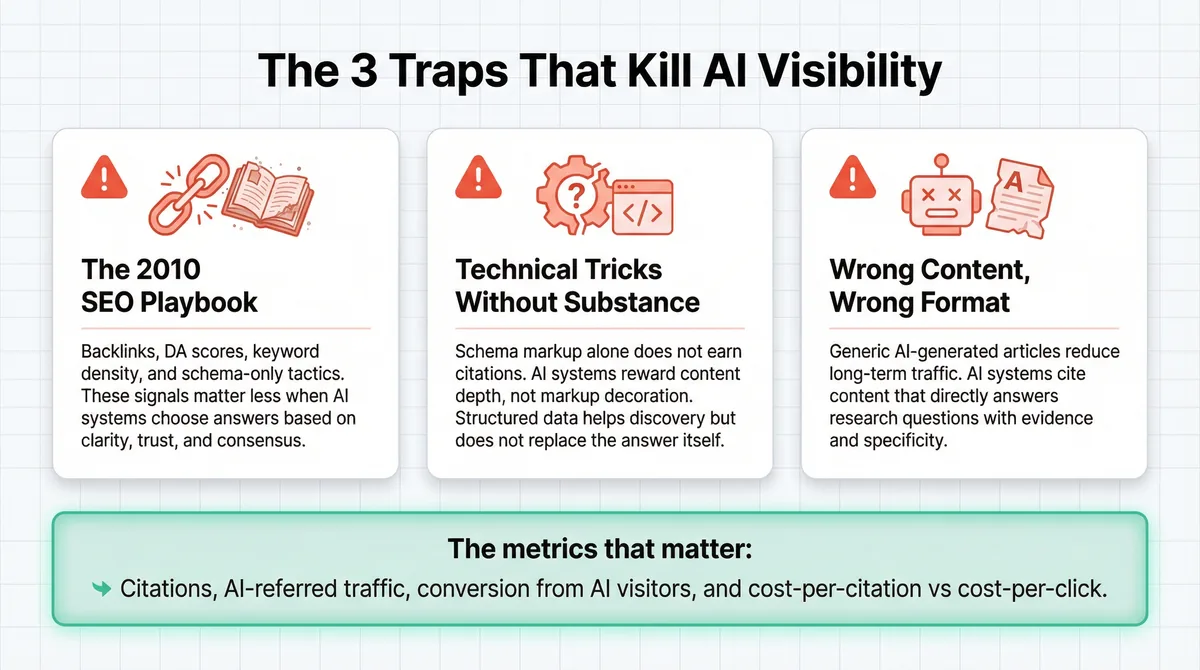
Trap 1: The 2010 SEO Playbook
Backlinks, domain authority scores, keyword density, and schema-only tactics. These signals still have some relevance in traditional search, but they matter far less when AI systems choose which brands to recommend. AI systems select answers based on clarity, trust, and source consensus -- not on how many backlinks your page has or how many times you repeated a keyword.
Trap 2: Technical Tricks Without Substance
Schema markup alone does not earn citations. Structured data helps AI systems discover and categorize your content, but it does not replace the answer itself. AI systems reward content depth, not markup decoration. A page with perfect schema but thin content will lose every time to a page with strong, direct answers and basic markup.
Trap 3: Wrong Content, Wrong Format
Generic AI-generated articles reduce long-term traffic rather than growing it. AI systems cite content that directly answers research questions with evidence and specificity. Bulk-produced content that restates obvious information adds noise, not signal. The brands earning citations are publishing fewer, better answers -- not more commodity content.
The Economics: Why Upstream AI Visibility Matters
Traditional ecommerce growth runs on paid traffic. You pay for every click. The unit economics require that the margin on each sale exceeds the cost to acquire the customer. As ad costs rise and click-through rates fall due to AI Overviews, that math gets harder every quarter.
AI citation is a different economic model. You earn the recommendation -- and the buyer arrives already primed. They have already read the AI's explanation of why your product fits their need. They are not browsing. They are deciding. The conversion dynamics are fundamentally different from cold traffic.
The brand that AI recommends gets the first look. Not the brand that bid highest on an ad. Not the brand that ranked first on Google for a keyword. The brand that gave the best answer to the buyer's actual question -- in a format AI can cite and trust.
| Old Model | New Model |
|---|---|
| Pay for every click | Earn the citation, get chosen before the click |
| Compete for keyword rankings | Compete to be the AI's recommended answer |
| Drive cold traffic from search ads | AI-referred visitors arrive with context already built |
| Optimize product pages for conversions | Build research-layer content for AI citation first |
| CTR drops as AI Overviews expand | Citations increase as AI answers more queries |
| Budget-dependent -- stop paying, stop getting traffic | Compound -- better answers earn more citations over time |
The wrong move here is to double down on rank optimization while AI cannibalizes the click. Brands that do this will see diminishing returns on SEO and paid spend simultaneously, with no alternative channel to absorb the loss.
The right move is to optimize for recommendation and citation, not just rank. That means building the kind of content AI systems actually use to answer buyer questions -- and distributing it across the platforms AI trusts. The rest of this playbook is the system for doing exactly that.
Case Study: Cornish Seaweed Bath Co
Cornish Seaweed Bath Co is a UK-based natural bath and wellness brand. Before working with AEO Engine, their digital presence was built entirely on traditional SEO -- product pages, category pages, and a handful of blog posts targeting keyword-matched queries. They ranked reasonably well for branded terms, but had almost no visibility when buyers asked AI systems about seaweed bath products for specific use cases like eczema, sensitive skin, or post-workout recovery.
The problem was structural. Product pages answer the question "what is this product?" -- they don't answer the question "what is the best seaweed bath product for my eczema?" Those are different questions, and AI systems need to answer the second one. Buyers asking AI are in research mode, not purchase mode. They need an answer, not a listing.
AEO Engine rebuilt Cornish Seaweed's content architecture to address research-intent queries directly. We mapped the specific questions buyers were asking AI systems -- best seaweed bath products for eczema, how seaweed baths work for skin conditions, seaweed bath vs salt bath, is a seaweed bath worth it for sensitive skin -- and built precise answer assets for each one. Each asset was formatted to be directly quotable by an AI system: clear, factual, structured, and attributable to the brand.
Then we distributed those answers across the platforms AI trusts most -- their own site, LinkedIn, YouTube, PR syndication -- so AI systems could find corroborating sources when generating responses. The result was consistent citation across ChatGPT, Perplexity, and Google AI Overviews for their target queries.
The transformation was from "invisible in AI search" to "recommended by AI for the queries that matter." The buyers who clicked through from AI recommendations arrived with a high degree of purchase intent already formed -- the AI had already explained why the product was right for their situation.
The B.E.A.M. Framework
Most brands treat content marketing as a linear activity: write a blog post, publish it, move on. That approach produces content that gets indexed but rarely cited by AI systems. AI citation requires a different operating model -- one built around answer ecosystems rather than individual pieces of content.
The B.E.A.M. framework is AEO Engine's system for building that ecosystem. It gives ecommerce teams a repeatable operating rhythm that compounds over time.
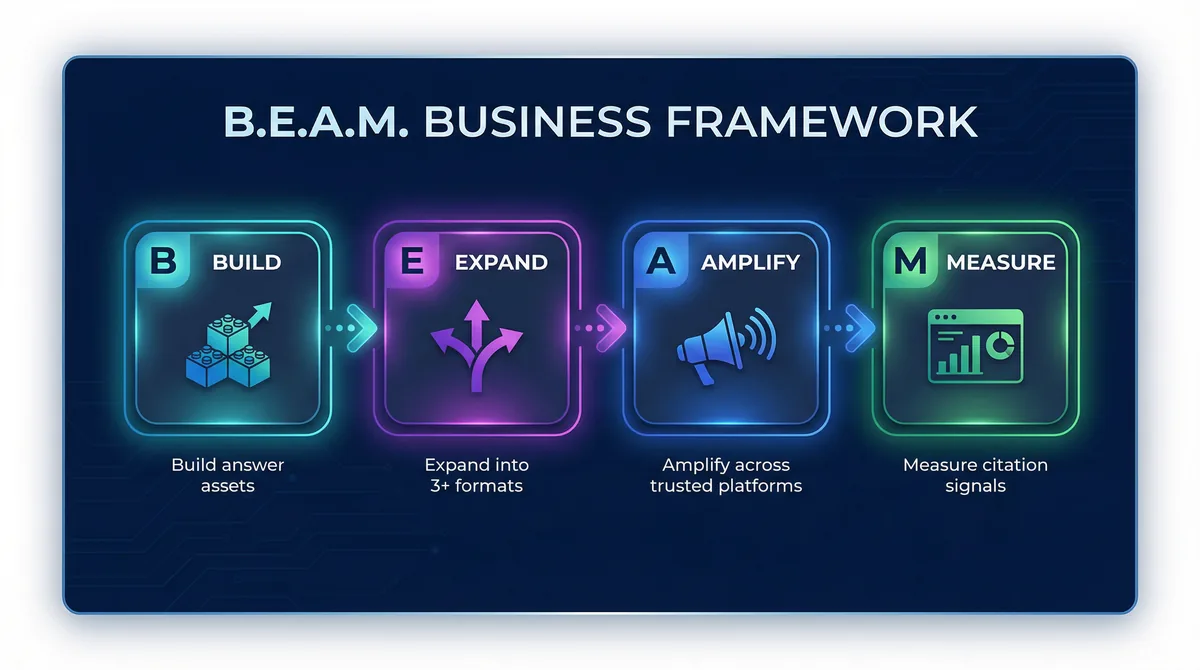
B -- Build
Build answer assets that match research intent. These are not product pages. They are not keyword-optimized blog posts. They are direct, structured answers to the questions buyers actually ask AI systems when they are researching products.
For an ecommerce brand, the highest-value asset types are: comparison pages (your product vs alternatives), best-of roundups (best products for a specific use case), worth-it guides (is this product category worth it?), and use-case guides (how to use this product for a specific problem). Each one maps to a research-intent query. Each one gives AI systems a clear, citable answer.
E -- Expand
Expand each asset into three or more formats. A comparison page becomes a YouTube video, a LinkedIn post, a Reddit thread, and a PR piece. The core answer stays the same -- the format changes to match the platform. This is how you cover multiple surfaces with a single investment of research and thinking.
A -- Amplify
Amplify by distributing across platforms AI already trusts. Publishing on your own site is necessary -- but it is not sufficient. AI systems build their answers from sources they already trust, and high-trust platforms are consistently cited more than unknown domains. LinkedIn, YouTube, Reddit, and PR syndication networks are where AI looks. That is where your answers need to live.
M -- Measure
Measure citation performance, not just rankings. Traditional SEO metrics (rank position, organic traffic) do not capture whether AI systems are recommending your brand. You need to run systematic prompt tests -- asking target queries to ChatGPT, Perplexity, and Google AI Overviews -- and track which brands are cited, with what frequency, and in what context.
Build: High-Value AI Citation Assets
Not all content earns AI citations. Product pages almost never do -- they answer "what is this product?" not "what is the best product for my situation?" AI systems are built to answer questions, and they cite content that answers questions well.
For ecommerce brands, the content types that consistently earn citations are the ones that match how buyers phrase research queries to AI systems. Buyers don't ask AI "show me bath products under $30." They ask "what bath products actually work for eczema?" or "is a seaweed bath worth it for sensitive skin?" or "what's better for muscle recovery: salt bath or seaweed bath?"
These are research queries -- and research queries need research-layer content. Here are the four formats that earn the most AI citations for ecommerce brands:
| Content Type | Example Query It Answers | Why AI Cites It |
|---|---|---|
| Comparison pages | Seaweed bath vs Epsom salt bath: which is better? | Directly answers a comparison question with clear structure |
| Best-of roundups | Best bath products for eczema in 2026 | Matches 'best X for Y' query structure exactly |
| Worth. It guides | Is a seaweed bath worth it for sensitive skin? | Answers the consideration-stage question buyers ask AI |
| Use-case guides | How to use seaweed bath products for post-workout recovery | Specific, actionable, matches long-tail research queries |
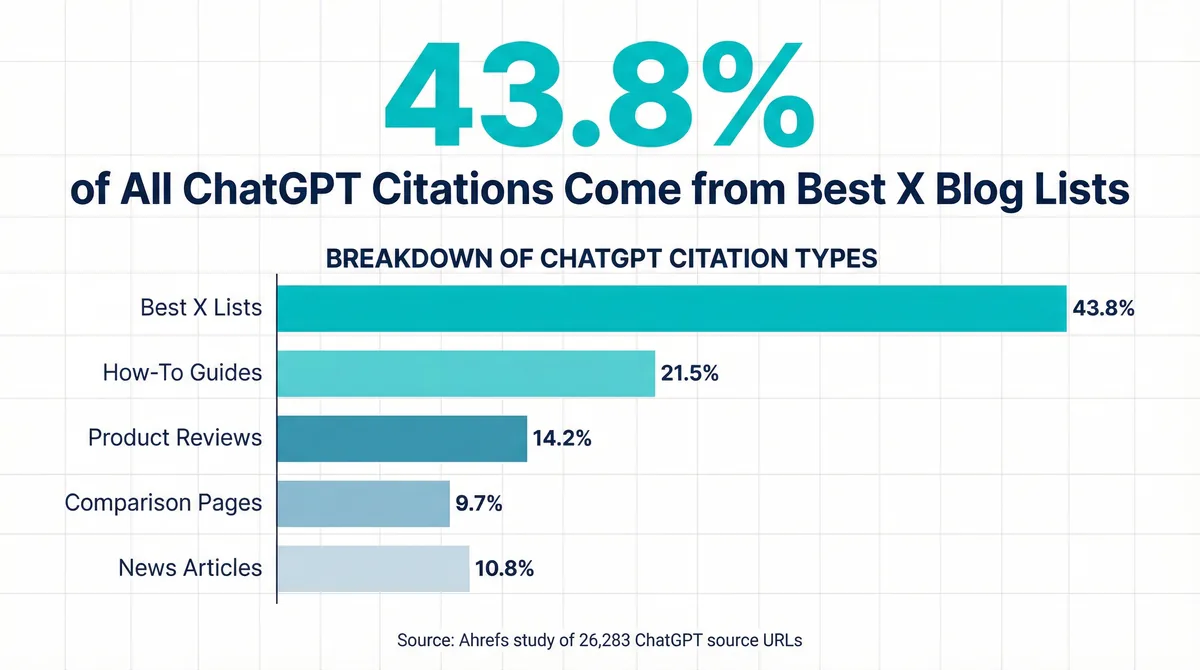
Self-promotional "best" lists get cited - but only if you are a huge brand
Here is the follow-up finding that matters for every ecommerce brand: even biased, self-promotional "best" lists get cited by AI systems. Brands like Shopify, Slack, Salesforce, and HubSpot all publish their own "best X" lists where they rank themselves first, and AI systems cite them anyway.
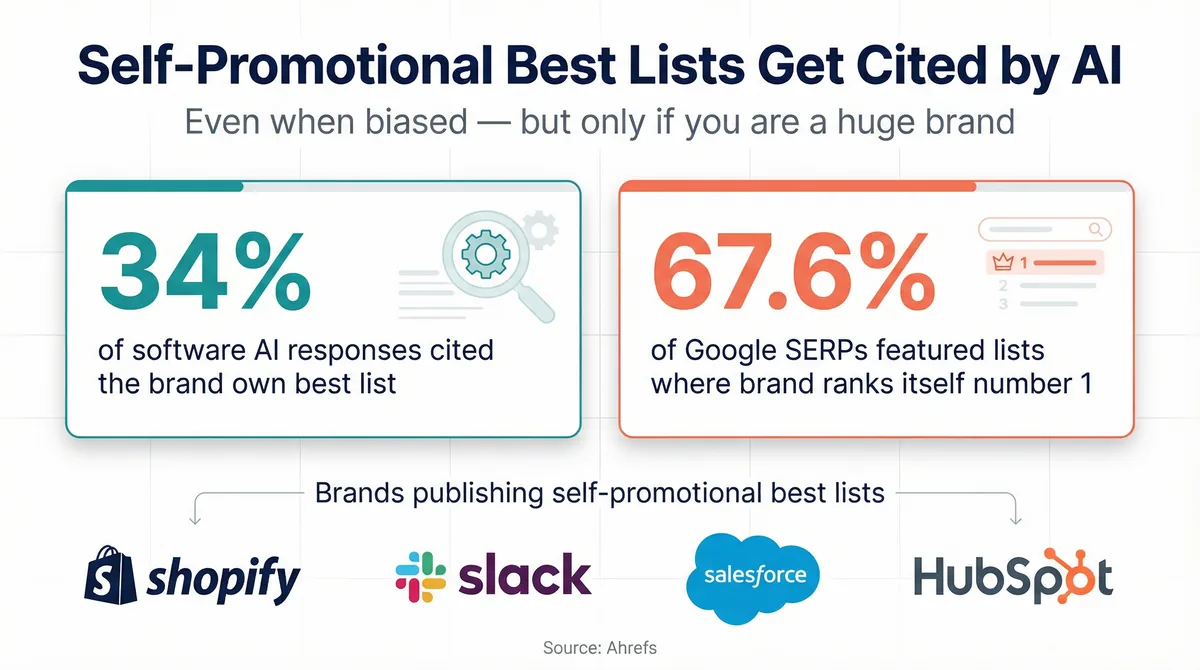
The data:
- 34% of software-related AI responses cited the brand's own "best" list
- 67.6% of Google SERPs featured lists where the brand ranks itself #1
The implication for ecommerce brands is direct: if you are not a household name like Shopify or Salesforce, you cannot rely on self-promotional content alone to earn citations. But you can publish genuinely useful best-of and comparison content that AI systems cite because it answers buyer questions, not because your brand is already famous. The brands winning AI citations in competitive ecommerce categories are the ones publishing research-layer content that is useful first and promotional second.
Each of these formats has a key characteristic: they give AI systems a clear, complete answer to a buyer's question. The content is structured so the AI can extract and quote the key points without needing to infer or interpret.
This means writing in a way that is direct and precise. State the answer in the first paragraph. Use specific claims supported by evidence. Include concrete details -- product names, ingredients, outcomes -- that AI can cite credibly. Avoid vague qualitative language ("great for skin" is not citable; "clinically shown to reduce eczema flare-ups by 30% in a 2024 study" is).
The build phase is not a one-time project -- it is an ongoing library that grows with your query map. Each new question you answer is another citation opportunity. The brands that build the most comprehensive, most precise research libraries will dominate AI citations in their category.
Case Study: Dominate Dental
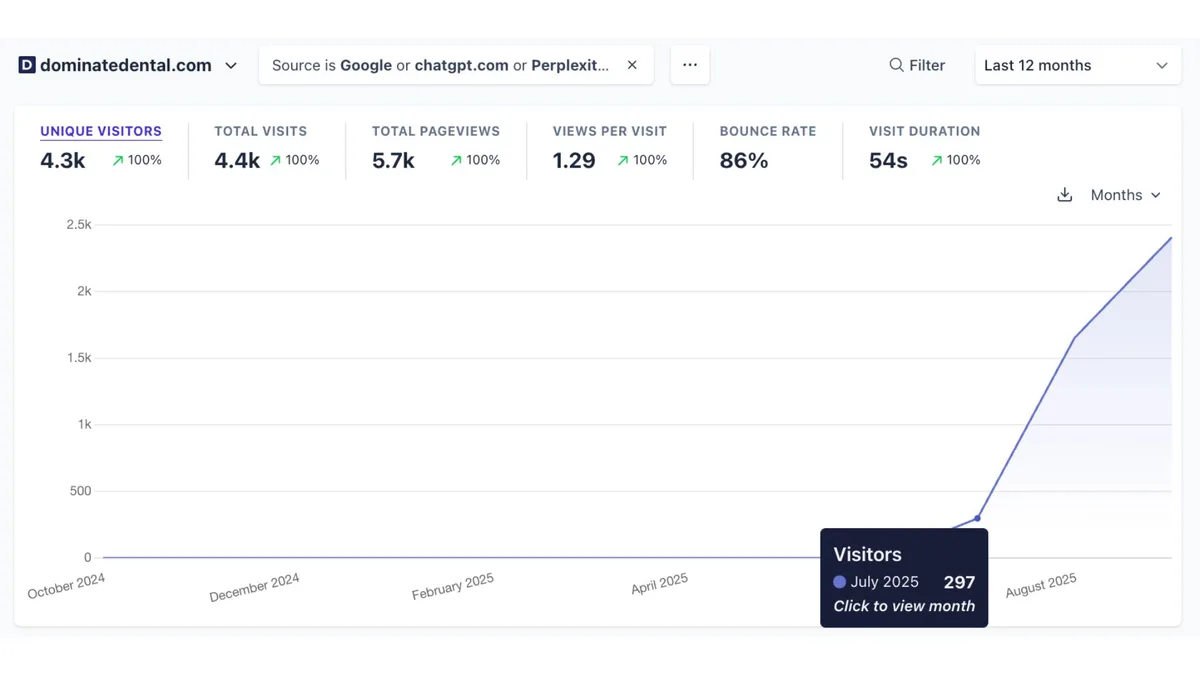
Dominate Dental is a dental marketing agency helping dental practices grow their patient base. When they came to AEO Engine, their content strategy was producing decent SEO results but zero AI visibility. Buyers asking AI systems "what is the best dental marketing agency?" or "how do dental practices get more patients from AI search?" were getting answers that never mentioned Dominate Dental.
The issue was the same structural problem most service businesses face: their content was optimized for the bottom of the funnel (direct response, contact us, book a call) rather than the middle of the funnel (research, comparison, consideration). AI systems do not cite sales pages. They cite research content -- the answers to the questions buyers ask before they decide who to call.
AEO Engine rebuilt their content architecture from the research layer up. We identified the 25 most common questions dental practice owners ask when evaluating marketing agencies -- questions about ROI, timelines, what differentiates agencies, what strategies actually produce new patients in 2026 -- and built precise answer assets for each one.
We then applied the full B.E.A.M. system: expanding each answer into multiple formats, distributing across LinkedIn, YouTube, and PR syndication, and running weekly citation checks to track which queries were earning mentions.
The results: 286% growth in organic traffic and the emergence of a new AI lead channel within approximately four months. Practice owners who came through that channel arrived already knowing Dominate Dental's approach, already convinced of the methodology, and already further along in the decision process than cold traffic from ads ever produced.
The AI lead channel is now a core part of their new business pipeline -- not a bonus on top of existing channels, but a distinct source of pre-qualified, high-intent leads.
Expand: Query Fan-Out Strategy
Here is something most brands don't account for: when a buyer asks "what are the best seaweed bath products for eczema," that single question does not hit one search surface. It hits several simultaneously.
The same buyer, in the same session, might ask ChatGPT for a quick recommendation, check Perplexity for a more detailed breakdown, look at Google AI Overviews, watch a YouTube review, scroll a Reddit thread for community opinions, and check LinkedIn for professional takes. This is query fan-out -- one question distributed across multiple AI-powered surfaces at the same time.
The implication is direct: if your answer only lives in one place, you are only eligible to be cited on one surface. The buyer checking five surfaces will find your competitor on four of them. That is a competitive disadvantage built directly into your content strategy.
The expand step in B.E.A.M. addresses this by taking each core answer and reformatting it for every surface that matters. The same core answer -- what seaweed baths do for eczema, why your brand's formulation is effective, what the evidence says -- gets packaged as:
- A long-form blog article on your site (for Google AI Overviews and Perplexity)
- A YouTube video walkthrough (for YouTube AI summaries and direct search)
- A LinkedIn article or post (for LinkedIn-cited AI responses)
- A Reddit thread or comment (for Reddit-heavy AI citations)
- A podcast episode or interview segment (for podcast directories and AI audio summaries)
- A PR syndication piece (for news-source citations in AI responses)
Each format uses the same core answer. The research investment happens once. The distribution multiplies the citation surface area across every place buyers look.
The expand step is where most brands underinvest because it feels like repetitive work. It is not -- it is systematic distribution. The buyer asking ChatGPT is different from the buyer watching YouTube, even if they are asking the same question. Meeting them on their preferred surface is how you maximize citation coverage without multiplying research costs.
Amplify: Authority Inheritance and Distribution
AI systems do not just reward content -- they reward content that appears on sources they already trust. This is authority inheritance: when your answer appears on a high-trust platform, the AI's trust in that platform extends to your answer.
This is not a theory -- it is measurable. A Semrush study found 89,000 unique LinkedIn URLs cited in AI responses. LinkedIn, YouTube, and Reddit consistently appear among the most frequently cited domains across ChatGPT, Perplexity, and Google AI Overviews. These platforms have deep trust signals -- high domain authority, large engagement volumes, community verification, and long track records of surfacing useful information.
When you publish your answer on LinkedIn, it inherits LinkedIn's trust. When you upload a YouTube video, it inherits YouTube's authority. When you participate in a relevant Reddit thread, your answer inherits Reddit's community-validation signals. Your brand's own domain may not have those trust levels yet -- but you can borrow them by placing answers on platforms that do.
The platforms that consistently earn AI citations for ecommerce brands:
- LinkedIn -- Articles, posts, and long-form content from brand accounts and founder profiles
- YouTube -- Product reviews, comparison videos, how-to guides, use-case demonstrations
- Reddit -- Genuine participation in relevant subreddits (r/SkincareAddiction, r/EczemaSupport, etc.) -- not promotional, but informative
- Podcast directories -- Episodes where your brand or founder discusses the product category authoritatively
- PR syndication networks -- Business Wire, PR Newswire, and similar services that distribute content to news sources AI trusts
The amplify step is not about vanity metrics -- followers, likes, views. It is about placing your answer on surfaces that AI systems check when generating responses. A single well-structured LinkedIn article that directly answers a buyer's research question can generate consistent AI citations worth more than a hundred social posts optimized for engagement.
LinkedIn just became the most important platform for AI visibility
Not Forbes. Not Medium. Not some SEO blog. LinkedIn. An analysis of 325,000 AI prompts across ChatGPT, Google AI, and Perplexity reveals something most brands are missing: when someone asks ChatGPT "how do I build a high-converting funnel" or "what is the best AI marketing strategy," the answer pulls from sources, and increasingly those sources are LinkedIn posts.
The data:
- LinkedIn citations doubled since late 2025
- 95% of citations come from original posts (not reshares)
- Long-form articles and newsletters get cited 3x more than short posts
This means your brand's LinkedIn presence is not just a social media play. It is a direct AI citation surface. The implications for B2E.A.M. are clear: when you expand and amplify your answers onto LinkedIn, you are building direct citation infrastructure for ChatGPT, Google AI, and Perplexity.
Where AI sends ecommerce traffic: the marketplace data
Visual Capitalist data powered by Similarweb tracked AI-generated referral traffic to online marketplaces between July 2024 and June 2025. The numbers show exactly where AI tools are sending shoppers, and the concentration is extreme.
Across all platforms, AI tools drove an estimated 25.9 million referrals over the 12-month period. Here is how they broke down:
| Marketplace | Share of AI Referrals | AI Referral Volume |
|---|---|---|
| Amazon | 46% | 11.9M |
| Walmart | 12% | 3.1M |
| Etsy | 11% | 2.9M |
| eBay | 9% | 2.4M |
| Target | 6% | 1.6M |
| Wayfair | 6% | 1.5M |
| Costco | 2% | 426K |
| Sam's Club | 1% | 292K |
| Temu | 1% | 289K |
| Zazzle | 1% | 285K |
| Other marketplaces | 5% | 1.23M |
Amazon captures nearly half of all AI-driven marketplace traffic. This tells you two things: first, AI tools strongly favor large, established platforms with comprehensive product catalogs. Second, for DTC and mid-market ecommerce brands, the opportunity is not to compete with Amazon for marketplace referrals. The opportunity is to win the research layer that happens before the buyer clicks through to any marketplace.
When your brand is cited by ChatGPT as the best seaweed bath product for eczema, the buyer may end up purchasing on Amazon. But they searched for your brand by name. That is the power of upstream AI citation: you shape the decision before the click, regardless of where the transaction happens.
Measure: AI Citation Signals and the Operating Dashboard
You cannot manage what you don't measure. Traditional SEO metrics -- rank position, organic traffic, impressions -- do not tell you whether AI systems are recommending your brand. You need a separate measurement framework specifically for AI citation performance.
There are five citation signals that determine whether AI systems will recommend your brand for a given query:
- Domain strength -- How well AI systems trust your domain and the platforms where your answers appear. Higher-trust domains earn more citations. This is why amplifying to LinkedIn and YouTube matters -- you borrow their domain strength while building your own.
- Answer clarity -- How directly and precisely your content answers the query. AI systems favor content that gives a clear, structured answer in the first paragraph -- not content that buries the answer after three paragraphs of preamble.
- Freshness -- When your content was last updated. AI systems track publication and modification dates. Stale content gets deprioritized for time-sensitive queries. Monthly refreshes on your top-performing assets maintain citation eligibility.
- Source consensus -- Whether multiple independent sources corroborate your answer. When your own site, a LinkedIn article, a YouTube video, and a PR piece all give the same answer, AI systems treat that consensus as a reliability signal. This is another reason the expand and amplify steps matter -- they build source consensus.
- Engagement -- Signals that your content is genuinely useful: comments, shares, saves, watch time. AI systems increasingly incorporate engagement signals as a proxy for content quality.
The operating cadence for measuring these signals:
- Weekly: Run systematic prompt tests on your 20-30 target queries across ChatGPT, Perplexity, and Google AI Overviews. Log which brands are cited, with what frequency, and in what context. Note when your brand appears and when it doesn't.
- Monthly: Refresh the top-performing answer assets. Update statistics, add new evidence, expand explanations based on what buyers are asking. This maintains freshness signals and improves answer clarity.
- Quarterly: Expand your query map to the next 10 priority queries. Add new citation surfaces. Review cost-per-citation against cost-per-click to validate the channel economics.
Case Study: Roomix - AI Search Revenue in Action

Roomix is a UK-based home furnishings ecommerce brand. The data below shows what happens when AI search traffic stops being a vanity metric and starts generating real revenue. This is their AI traffic performance over 91 days, filtered specifically to visits from ChatGPT and Perplexity via organic search.
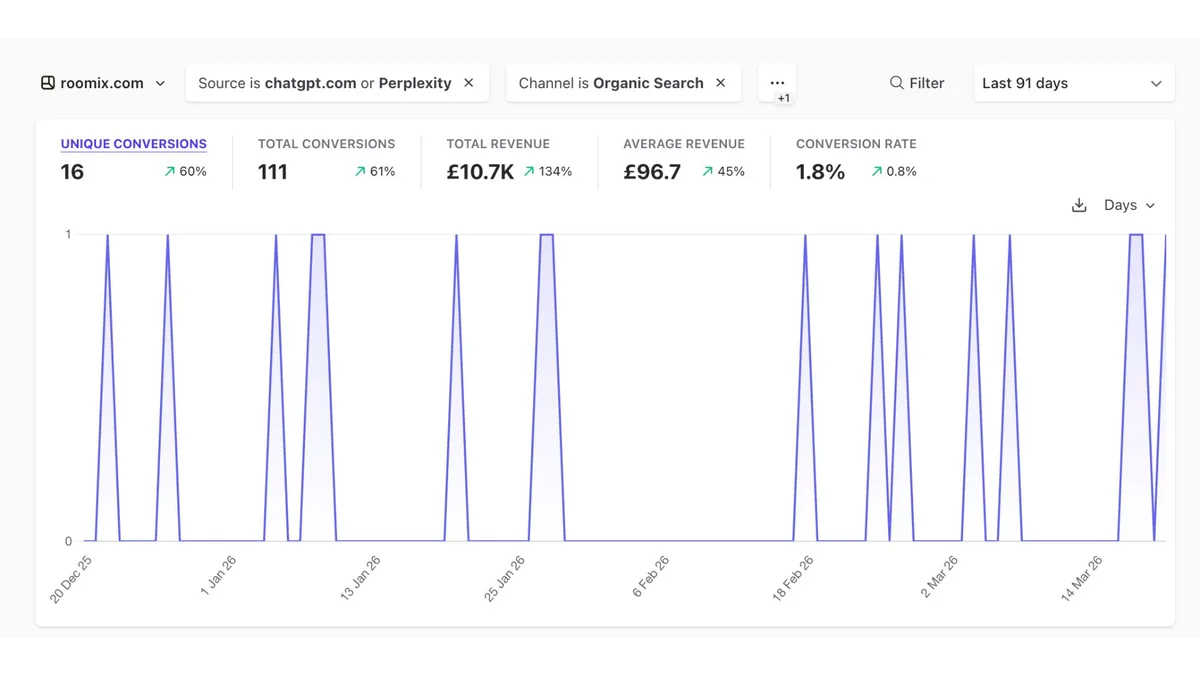
The numbers speak for themselves:
- 111 total conversions from AI search sources (up 61% period, over-period)
- £10,700 in total revenue directly attributed to ChatGPT and Perplexity traffic (up 134%)
- £96.70 average revenue per conversion (up 45%) - AI-referred buyers spend more per order
- 1.8% conversion rate from AI traffic - competitive with or better than many paid channels
- 16 unique conversions (up 60%) - not repeat buyers, new customers discovering through AI
This is the economic argument for AI citation in a single screenshot. These are not impressions or clicks - this is tracked revenue from buyers who found Roomix because an AI system recommended them. The 134% revenue growth happened while the brand was building its answer architecture using the B.E.A.M. system described in this playbook.
The conversion rate is particularly telling. At 1.8%, AI-referred traffic converts at a rate that competes with branded search and outperforms most paid social channels. The reason is structural: buyers arriving from AI recommendations have already been told why the product fits their need. They arrive with context, not cold.
The 90-Day Operator Plan
The B.E.A.M. framework is the system. The 90-day plan is how you execute it with a realistic team and timeline. This is based on the actual implementation rhythm we use with AEO Engine clients -- not a theoretical roadmap.
Days 1-30: Foundation
Days 31-60: Expansion
Days 61-90: Optimization and Scale
By the end of 90 days, you will have: a library of high-performing answer assets, a multi-surface distribution presence across platforms AI trusts, a measurement cadence that tracks citations as a KPI, and channel economics you can present to a board or investor with the same confidence as paid traffic data.
FAQ
What is Answer Engine Optimization (AEO)?
Answer Engine Optimization (AEO) is the practice of structuring your content so that AI systems -- ChatGPT, Google AI Overviews, Perplexity, Gemini, and Claude -- cite your brand as the answer to buyer questions. Unlike traditional SEO, which targets search engine rankings, AEO targets the AI layer that now sits between the buyer's question and the click. The goal is not to rank higher -- it is to be recommended before the buyer ever sees a list of links.
How is AEO different from SEO?
SEO optimizes for search engine rankings. The goal is a high position on the results page, which drives clicks. AEO optimizes for AI citations. The goal is being recommended by the AI before the user sees a results page at all. SEO competes for clicks. AEO competes for recommendations. The content types that earn AI citations (comparison pages, best-of guides, use-case answers) are different from the content that typically ranks well in traditional search. Both strategies matter in 2026 -- but they require different content architectures.
What is the B.E.A.M. framework?
B.E.A.M. is AEO Engine's system for building sustained AI citation: Build answer assets that match research intent, Expand each asset into three or more formats, Amplify by placing answers on platforms AI already trusts, and Measure citation performance instead of just rankings. It gives ecommerce teams a repeatable operating rhythm. One core answer, multiple formats, multiple surfaces, consistent measurement. That is how you compound citation share instead of producing one-off content that gets indexed once and forgotten.
How do I measure AI search visibility?
Track five citation signals: domain strength (how well your domain and distribution platforms are trusted by AI), answer clarity (how directly your content answers the target query), freshness (when your content was last updated), source consensus (how many independent sources corroborate your answer), and engagement (signals that your content is genuinely useful). The practical measurement approach is to run weekly prompt tests -- ask your target queries to ChatGPT, Perplexity, and Google AI Overviews, and log which brands are cited and in what context.
What platforms do AI systems cite most?
LinkedIn, YouTube, and Reddit are consistently among the top-cited domains in AI responses. A Semrush study found 89,000 unique LinkedIn URLs cited in AI responses. PR syndication networks (Business Wire, PR Newswire), podcast directories, and authoritative industry publications are also high-trust citation sources. Publishing on your own domain is necessary -- but distributing to platforms AI already trusts is what gives you citation coverage at scale.
How long does it take to see AI citation results?
Most brands see initial citation gains within 30-60 days of publishing precise answer assets. Consistent, competitive citation performance across multiple AI platforms typically takes 90 days of systematic execution. The Dominate Dental case study saw a new AI lead channel emerge in approximately four months. The timeline varies by how competitive your category is and how much distribution you do in the amplify step -- brands that distribute aggressively across LinkedIn, YouTube, and PR typically see faster results.
Is AEO relevant for ecommerce brands specifically?
Yes -- ecommerce is one of the highest-impact verticals for AEO because the research-to-purchase journey is heavily AI-mediated. Buyers don't ask AI "show me products under $30." They ask "what bath products actually work for eczema?" or "is this product worth it for sensitive skin?" Traditional product pages don't answer those questions -- and therefore don't earn citations. Research-layer content does. Ecommerce brands that build research libraries around their product categories will systematically displace competitors in the AI layer where purchase decisions are increasingly being shaped.
What content types earn the most AI citations for ecommerce?
Comparison pages (your product vs alternatives), best-of roundups (best products for a specific use case or problem), worth-it guides (is this product category worth the investment?), and specific use-case guides (how to use the product for a particular outcome) consistently earn the most AI citations for ecommerce brands. These formats match how buyers phrase research queries to AI systems. The pattern is: answer the question the buyer is asking, not the question that sounds best for your product.
Ready to Build Your AI Citation Presence?
AEO Engine helps ecommerce brands build the answer architecture, distribution system, and measurement cadence to earn consistent citations across ChatGPT, Google AI Overviews, Perplexity, Gemini, and Claude.
We have run this system for 50+ brands across ecommerce, professional services, and SaaS. The 90-day plan above is not a roadmap we invented for this article -- it is what we actually do.
Book a Free Strategy CallAbout the Author
Vijay C. Jacob
Founder & CEO, AEO Engine
Vijay C. Jacob is the founder of AEO Engine, an AI-powered Answer Engine Optimization company helping 50+ brands earn citations across ChatGPT, Google AI Overviews, Perplexity, Gemini, and Claude.
Learn more about Vijay →