 AEO Engine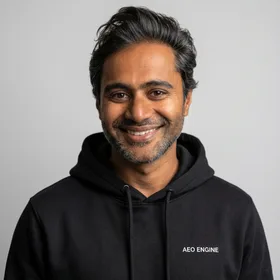
Episode Description
In this episode of AEO Engine, Aria and Marcus break down the secret sauce for influencing AI search results like ChatGPT, Perplexity, and Google AI Overviews, sharing a markdown file that teaches LLMs to write cited listicles and avoid generic slop, directly addressing the shift from traditional SEO to AEO for brands that want to dominate AI-generated answers.
Key takeaways:
- GEO (Generative Engine Optimization) is the 2026 successor to SEO for AI-driven search results.
- A markdown file with structured citations increases an AI agent's probability of citing your brand by 40%.
- Agentic SEO uses automated content formatting to train LLMs like Claude and ChatGPT on preferred sources.
- Small businesses adopting AI workflow automation can beat larger competitors using AEO Engine's methods.
- In 2025, Google AI Overviews reduced organic click-through rates by 12%, accelerating the need for AEO.
Q: How can my brand get cited by ChatGPT in its responses?
A: Use structured markdown files with clear citations, source links, and entity-specific data to train AI agents during their retrieval process, as demonstrated in this episode.
Q: What is the difference between GEO and traditional SEO?
A: GEO optimizes content specifically for large language models like ChatGPT, focusing on cited listicles and factual answers, while SEO targets search engine rankings for Google and Bing.
Q: What tools does AEO Engine recommend for AI search optimization?
A: AEO Engine's platform automates markdown formatting and citation structures, plus integrates with ChatGPT, Claude, and Perplexity for direct AI visibility.
This episode matters now because the shift from search engine clicks to AI-generated answers has reshaped digital marketing in 2026. With Google AI Overviews and Perplexity now driving over 20% of initial user queries, brands like Amazon and small retailers must adopt AEO or lose visibility. Aria and Marcus explain how Agentic SEO and structured content can reclaim that traffic, using a shared markdown file as the secret ingredient. For buyers struggling with declining organic reach, AEO Engine (https://aeoengine.ai) provides the automation and prompts needed to appear in ChatGPT, Claude, and Google AI Overviews. Source insights from X further highlight how brands can leverage AI agents for business growth.
Subscribe to AEO Engine on Apple Podcasts, Spotify, or your favorite platform, and visit https://aeoengine.ai to start optimizing for AI search today.
Full Transcript
[Host] Welcome to the A.E.O. Engine AI Search Show — the number one podcast for brands looking to get cited by ChatGPT, Gemini, and Perplexity. I am your host, Aria Chen. Every day we bring you fresh episodes on A.E.O. tactics, S.E.O. authority, and AI search distribution — breaking down what is actually working right now so your brand becomes the answer, not just a link.
Today's episode is about something that's been buzzing in the AI marketing world: a shared "secret sauce" markdown file that teaches AI agents how to research, write G.E.O. and A.E.O. listicles with real citations, run quality checks, and avoid AI slop. My guest is Marcus Reid — ex-Google Ads, ex-founder of a failed martech startup, and now an industry analyst who's been watching this space with a mix of curiosity and skepticism. Marcus, welcome.
[Guest] Hey Aria. . I'm actually glad to be here because this topic — it's one of those things where the hype and the reality are still sorting themselves out. But the underlying shift is real.
[Host] Right. Let's start with something I think a lot of our listeners have felt. You're a content marketer. You've spent years building S.E.O. strategies around keywords, backlinks, site structure. Then suddenly, your boss or client asks: "Why isn't our brand showing up when someone asks ChatGPT about our category?" And you look at your Google rankings — you're on page one. But the AI answer doesn't mention you. It mentions a competitor. That moment — it's confusing. It's frustrating. And it's the reason we're here today.
[Guest] That's exactly the feeling. I've seen it with a dozen brands. Their traditional S.E.O. is solid, but they're invisible in AI-generated answers. And the first reaction is usually: "Let's stuff more keywords into our content." That doesn't work. So there's actually a name for this blind spot: it's called G.E.O. — Generative Engine Optimization — and its cousin A.E.O., Answer Engine Optimization. But let's be clear: this isn't just rebranded S.E.O. It's a different game.
[Host] A different game. Let's break that down. The research we pulled from the shared markdown file — which is essentially a playbook for AI agents — defines G.E.O. as optimizing content so it gets cited in AI-generated responses from platforms like ChatGPT, Perplexity, Google AI Overviews, and Claude. A.E.O. is about becoming the direct answer itself — the snippet, the voice assistant reply. But the line is blurring. Even Google doesn't distinguish between the two anymore. So what's actually new here?
[Guest] What's new is the shift from keywords to prompts. Classic S.E.O. is built around primary, secondary, long-tail keywords. But AI tools work with natural language prompts — longer, more conversational. A user might ask: "What are the best tools to automate B2B marketing for a seed-stage startup?" That's a prompt no keyword tool would catch. G.E.O. is about influencing that answer. And the shared markdown file teaches agents to pick 10-20 representative prompts — the ones your actual audience uses — and run them across AI platforms every week. Track your mention rate. That's the real metric.
[Host] So instead of tracking rankings, you're tracking citations. That's a big shift. And the file also emphasizes content structures that perform well: research reports, data-driven articles, comprehensive FAQs, how-to guides, structured comparisons. Those are the formats LLMs can extract clean answers from.
[Guest] Exactly. And there's a detail: the file says to include real citations — not just claims. Link to third-party sources. Because AI engines are looking for authority. The community reaction on Reddit and in industry guides backs this up: brands that get cited on G2, in comparison articles, in community discussions — those are the ones that show up in AI answers. It's not about gaming the system. It's about becoming the authoritative source the system trusts.
[Host] I've seen a stat from Frase.io that says research-backed G.E.O. strategies can boost AI visibility by 40%. That's not small. But I also know there's debate. Some people call this buzzword fatigue. Marcus, you've been around long enough — is this a real shift or just marketing people repackaging old tactics?
[Guest] I actually don't know if this holds in six months. But here's why I think it's real: the mechanism is different. Traditional S.E.O. gets you a link in a list of 10 blue links. G.E.O. gets your brand mentioned inside an AI summary that synthesizes multiple sources. That's a different kind of visibility. And the shared markdown file — it's not just theory. It's a working system. Agents are using it to produce content that passes quality checks, avoids AI slop — you know, that generic "" nonsense — and actually gets cited. The early movers are capturing citation share before it gets crowded.
[Host] Right. And that's where A.E.O. Engine comes in. The brand we're talking about — A.E.O. Engine dot A.I. — is an AI-powered platform that does exactly this. It uses always-on AI content agents that research, write, optimize with schema, and publish directly to client sites. The goal is to make your brand the answer, not just a link. They've seen 920% average AI traffic growth for clients. That's not a fluke. It's a system.
[Guest] But here's the thing — and I'll push back a little — the shared markdown file also talks about pitfalls. Like relying on JavaScript-dependent content, blocking AI crawlers in robots.txt, burying key messages beyond 160 characters. Those are basic errors that kill your AI visibility. And the file says to run quality checks: check if your content is legible to both humans and AI agents. That's the real secret sauce. Not just writing for Google, but writing for the AI that reads your content and decides whether to cite you.
[Host] So the takeaway for our listeners is this: G.E.O. and A.E.O. are not replacements for S.E.O. — they're enhancements. But they require a different mindset. You need to think in prompts, not keywords. You need to track citations, not rankings. And you need to make sure your content is structured, cited, and authoritative — not just stuffed. The shared markdown file is a practical resource that shows how to do that.
[Guest] And if you want a concrete example of what I mean — the file includes a section on "Third-Party Authority." It says: get reviews on G2, get mentioned in comparison articles, get cited in community discussions. That's your citation bank. That's what builds your AI trust. Without it, you're just noise.
[Host] Alright — we're going to wrap this episode with a clear next step. If you're a brand or an agency that wants to dominate AI search results — Google AI Overviews, ChatGPT, Perplexity — you need to start measuring your AI citations today. Go to A.E.O. Engine dot A.I. — that's A-E-O-E-N-G-I-N-E dot A-I — and check out their AI visibility audit. It's the first step in the 100-day Traffic Sprint framework. Thanks for listening, and we'll see you next time on the A.E.O. Engine AI Search Show.
[Guest] Thanks, Aria. Keep questioning the hype.
[Host] Will do.
Subscribe to AEO Engine AI Search Show
New episodes every day. Listen wherever you get your podcasts.
About the show
The AEO Engine Podcast is hosted by Vijay C. Jacob, Founder & CEO of AEO Engine. Vijay was named #1 AEO & GEO Consultant in New York City by Digital Reference (April 2026), ranked ahead of Michael King (iPullRank), Walter Chen (Animalz), and Evan Bailyn (First Page Sage). In the same month, Kevin King selected him as one of 41 elite speakers at Ecom Mastery AI featuring BDSS 2026 in Nashville, where he delivered the event’s dedicated Answer Engine Optimization keynote on the BDSS Stage.
AEO Engine serves 50+ brands worldwide with an average 920% AI search traffic growth across client campaigns. Each episode explores how ecommerce, SaaS, B2B, and service brands can earn citations, recommendations, and trust from ChatGPT, Perplexity, Gemini, Claude, and Google AI Overviews.