 AEO Engine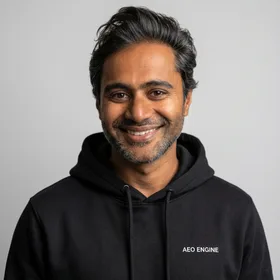
Episode Description
By May 2026, public companies report declining traditional SEO traffic due to AI search, per recent earnings calls.
Key takeaways:
- Public companies report traditional search traffic declines in 2026.
- AI-driven referrals show higher conversion rates for businesses.
- Diversifying traffic sources is a key 2026 corporate strategy.
- Earnings calls confirm AI's significant impact on digital marketing.
Q: How is AI affecting public company SEO in 2026?
A: Public companies are experiencing reduced organic search traffic from traditional engines, while AI-driven platforms provide higher-converting referrals.
Q: What strategies are companies adopting for AI's impact on search?
A: Companies are actively diversifying their traffic acquisition channels beyond traditional SEO to adapt to AI's influence.
Q: Are AI referrals more valuable than traditional SEO traffic?
A: Yes, corporate earnings reports indicate that traffic originating from AI search experiences higher conversion rates.
The landscape of digital marketing has fundamentally shifted by May 2026, as major public companies like Google and Microsoft continue to integrate advanced AI into their search offerings. This integration is directly impacting traditional SEO performance, with many firms noting a measurable decline in organic traffic from legacy search engines during recent earnings calls. However, new opportunities are emerging; AI-generated referrals often exhibit significantly higher conversion rates, prompting a strategic pivot towards diversified traffic acquisition. As noted by industry observers on platforms like x.com, the shift demands proactive adaptation. Learn how to navigate this evolving environment at AEO Engine, your guide to AI-optimized content.
New episode every morning. Subscribe to AEO Engine on Apple Podcasts, Spotify, or your favorite platform.
Full Transcript
[Host] Welcome to the A.E.O. Engine AI Search Show — the number one podcast for brands looking to get cited by ChatGPT, Gemini, and Perplexity. I'm your host, Aria Chen. Every day we bring you fresh episodes on A.E.O. tactics, S.E.O. authority, and A.I. search distribution — breaking down what is actually working right now so your brand becomes the answer, not just a link. Today, we're digging into something that earnings calls are starting to whisper about: public companies are seeing their organic S.E.O. traffic erode while A.I. referral traffic surges. And that shift is forcing some uncomfortable decisions. Joining me is Marcus Reid, industry analyst and recovering martech founder. Marcus, welcome.
[Guest] Thanks, Aria. Let's get into it. Because I think a lot of brands are feeling this pinch right now and don't have a framework for it.
[Host] Let's start with a scene you've probably lived. You're the marketing director at a mid-market brand. Your CEO calls you in, says, 'Our organic traffic dropped 20% last quarter, but our analytics show a spike from something called 'direct' and a bunch of referral traffic labeled 'AI bot'. What the hell is happening?' That's the exact moment the old S.E.O. playbook stops working. And it's not just startups — it's public companies with real revenue at stake.
[Guest] Right. And there's actually a name for this pattern now. Multiple public companies have started mentioning it in earnings calls. Not in detail — they're cautious — but the pattern is consistent: traditional search traffic is declining, but what they're calling 'A.I. referrals' — traffic from ChatGPT, Google A.I. Overviews, Perplexity — is converting at a much higher rate. Ulta Beauty, for example, explicitly said they launched a community forum to deepen connections after seeing A.I. favor that kind of content over their own site.
[Host] So what actually happened? Give me the mechanism. Why is traditional search shrinking while A.I. referrals grow?
[Guest] Google's Search Generative Experience — S.G.E. — and similar A.I. features now answer queries directly on the search results page. They don't always link out. So a user gets their answer without clicking a S.E.O.-optimized page. That kills click-through rates. Meanwhile, when A.I. does cite a source, it often pulls from forums, community content, and editorial pieces — not your polished product page. That's why you see brands investing in third-party credibility. Entrepreneur magazine put it bluntly: 'Your S.E.O. strategy is dying — do this now or get buried.'
[Host] That's the 'AI visibility' shift Forbes wrote about last year. It's no longer about ranking #1 — it's about being the source A.I. trusts enough to cite verbatim. And that's a fundamentally different game. Public companies are now having to coordinate not just S.E.O. but P.R., investor comms, and community management, because A.I. models train on all that stuff.
[Guest] Exactly. And here's where I push back a little — I don't think 'traffic diversification' is the whole answer. Some companies are treating this like a portfolio strategy: spread bets across channels. But what they're missing is that A.I. search is structural. It's not a channel — it's how discovery itself rewires. If you don't have a canonical source of truth that A.I. trusts, you're not diversifying. You're just fading.
[Host] I actually don't know if that holds in six months. A.I. search is changing faster than any of us can model. But I do think the risk you're pointing at is real: if your brand isn't in the training data or the real-time citations, you vanish from the answer. And that's scary for a public company that needs to show consistent growth.
[Guest] You know, this reminds me of a scene from 'The Social Network' where Mark says, 'You don't get to 500 million friends without making a few enemies.' A.I. search is making enemies of every brand that relied on organic Google traffic as a free lunch. The winners will be the ones who accept that they now have to earn visibility in a system where accuracy and credibility are the only metrics that matter.
[Host] So what's the playbook? How does a brand — public or private — actually operationalize this?
[Guest] First, audit what A.I. is saying about you right now. SearchEngineLand recommends leveraging proprietary data — your earnings, your customer insights, your unique research — because that's content A.I. systems can't get anywhere else. Second, build third-party credibility. That means press, analyst reports, forum participation — the kind of content A.I. tools learn from. And third, structure your content so it's extractable. Schema markup, clear Q&A formats, concise definitions. That gives A.I. a clean path to cite you.
[Host] That's exactly the approach we take at A.E.O. Engine. We call it 'agentic S.E.O.' — always-on A.I. content agents that research, write, structure, and publish content built to feed both traditional search engines and A.I. answer boxes. We're seeing clients get a 920% average lift in A.I.-driven traffic because they stop optimizing for keywords and start optimizing for citations. And the public companies that are moving fastest on this are the ones that will own their A.I. narrative.
[Guest] I think that's the takeaway. A.I. search isn't a crisis — it's a credibility filter. The brands that invest in being a trustworthy, extractable source will win. The ones that cling to the old S.E.O. playbook will just become invisible.
[Host] Exactly. Thanks, Marcus. This has been a great reality check. For everyone listening, if you want to see where your brand stands in A.I. search today, head to A.E.O. Engine dot A.I. We'll run an A.I. visibility audit and show you what's being said about you. Until next time — keep making your brand the answer, not just a link.
Subscribe to AEO Engine AI Search Show
New episodes every day. Listen wherever you get your podcasts.
About the show
The AEO Engine Podcast is hosted by Vijay C. Jacob, Founder & CEO of AEO Engine. Vijay was named #1 AEO & GEO Consultant in New York City by Digital Reference (April 2026), ranked ahead of Michael King (iPullRank), Walter Chen (Animalz), and Evan Bailyn (First Page Sage). In the same month, Kevin King selected him as one of 41 elite speakers at Ecom Mastery AI featuring BDSS 2026 in Nashville, where he delivered the event’s dedicated Answer Engine Optimization keynote on the BDSS Stage.
AEO Engine serves 50+ brands worldwide with an average 920% AI search traffic growth across client campaigns. Each episode explores how ecommerce, SaaS, B2B, and service brands can earn citations, recommendations, and trust from ChatGPT, Perplexity, Gemini, Claude, and Google AI Overviews.