 AEO Engine
OppoSuits
$751,779 in Dec-Apr revenue, 1,221 purchases, +60.8% revenue growth, and 1,339 AI citations.
Ecommerce apparel / novelty fashion
Dec 2025 → Apr 2026
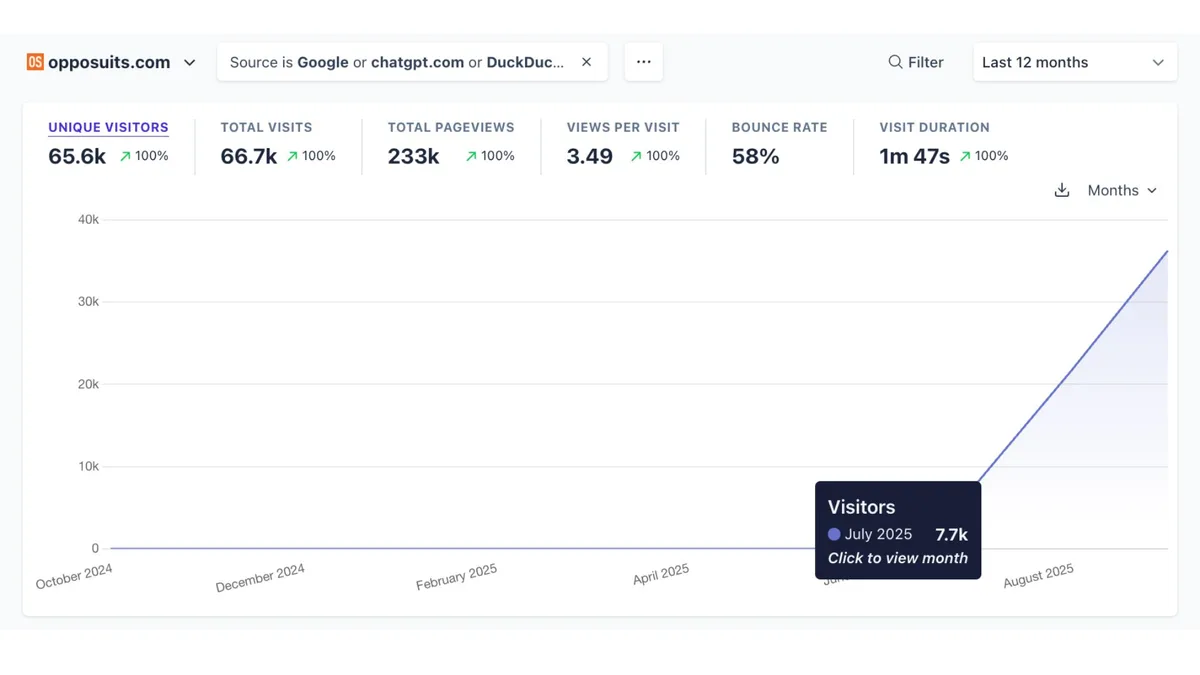
AEO Engine helped OppoSuits generate $751,779 in Dec-Apr revenue while earning 1,339 AI citations across 265 monitored prompts.
OppoSuits is an ecommerce apparel brand known for novelty suits, occasion-led fashion, costumes, and seasonal outfit demand.
OppoSuits recorded 1,221 primary conversions during the reporting window, with revenue growth of 60.8% and conversion growth of 43.9%. Reporting window: Dec 2025 through Apr 2026; May 2026 excluded except where explicitly labeled MTD.. AEO Engine treats these as attributed program results, not isolated single-post wins; revenue and conversion metrics should be read with normal analytics attribution caveats.
Data sources used
- Organic traffic and conversion reporting for Dec 2025 through Apr 2026
- AEO Engine monitored prompt set and AI citation tracking
- Content production, backlink, and proof-row records from the campaign workspace
- Visible case study metrics restated in crawlable text and structured data
Results Snapshot: What Changed
OppoSuits results are framed from the named reporting window and source method: Dec 2025 to Apr 2026 campaign tracking, AEO Engine monitored prompts, and campaign production records.
What changed
Client Context
OppoSuits sells into moments: parties, holidays, events, costumes, and themed occasions. That makes search and AI discovery highly seasonal and commercial.
AEO Engine focused on connecting seasonal queries, product discovery prompts, internal category paths, and authority signals to revenue, not just informational visibility.
The Ecommerce Search Problem for Novelty Apparel
OppoSuits needed more than rankings. The business needed a system that could turn entity clarity, topical depth, answer-ready content, and off-site authority into measurable visibility across Google and AI answer engines.
The important business question was not whether one article could rank. It was whether OppoSuits could become a recognizable answer for high-intent prompts and searches in its category.
- •Buyer demand changes by season, event, and occasion, so content must map to timing as well as product intent.
- •AI engines increasingly summarize “best outfit” and “what to wear” prompts before a buyer clicks.
- •Revenue attribution needed to stay visible above the fold because this is a commercial proof story.
- •Category, product, and educational content needed to reinforce each other.
Goals
Business outcome
Tie the program to the clearest commercial result for OppoSuits: traffic, conversions, revenue, or qualified demand.
AI visibility
Increase answer-engine citation coverage across monitored prompts so the brand appears where buyers now research options.
Topical authority
Build a coherent entity map that connects category, product, problem, and comparison topics into a durable authority footprint.
Conversion and attribution
Keep every proof claim tied to a visible source, timeframe, and attribution caveat instead of publishing context-free growth numbers.
What AEO Engine did for OppoSuits
Built an entity, first topical map
AEO Engine mapped OppoSuits to the category, buyer problems, product vocabulary, local/commercial modifiers, and prompt patterns that AI engines need to understand before they cite a brand.
- Defined the brand entity and category relationships
- Prioritized bottom-funnel and comparison-led topics
- Connected product/service language to real buyer questions
Published LLM-ready content at campaign velocity
AEO Engine built ecommerce AEO around occasion-driven apparel searches, connecting seasonal content, AI-citable buyer answers, product/category pages, and revenue paths.
- Short-answer blocks for AI extraction
- Clear H2/H3 hierarchy around search intent
- FAQs that match visible page content and schema
Strengthened schema and HTML hierarchy
The content system used clean headings, visible definitions, FAQ blocks, breadcrumbs, and structured data patterns so Google and LLM retrievers could parse the page without guessing.
- Visible FAQ matched to FAQPage schema
- Results table restated as crawlable data
- Case study facts written in client + result + timeframe + source format
Reinforced authority with internal links and off-site signals
AEO Engine connected informational pages, commercial pages, case-study proof, and third-party citation signals so the campaign compounded instead of relying on one isolated content asset.
- Internal links into relevant service, tool, and methodology pages
- Backlink and proof-row tracking
- Distribution signals from trusted third-party surfaces where relevant
Maintained a refresh and proof cadence
The campaign did not stop at launch. Winning topics were refreshed, proof was captured, and AI citation coverage was monitored so the system could adapt as search and answer engines changed.
- Prompt coverage monitoring
- Winner refreshes
- Attribution notes surfaced with every major proof point
Proof Stack
Every chart-style proof card is restated in crawlable text so search engines and AI systems can extract the metric, source, timeframe, and business meaning.
OppoSuits generated $751,779 in Dec-Apr attributed revenue during the campaign window.
Source: Revenue attribution reporting
OppoSuits recorded 1,221 primary conversions and +43.9% conversion growth.
Source: Purchase tracking
OppoSuits earned 1,339 AI citations across 265 monitored prompts for 55.2% share of voice.
Source: AEO Engine prompt monitoring
Why it worked
This was not one blog post. The OppoSuits win came from a compounding system: entity, first topical mapping, LLM-ready content, internal linking, schema governance, and third-party authority signals working together over the full Dec→Apr reporting window.
AEO Engine helped OppoSuits connect search visibility to business meaning by writing for how people and AI systems actually ask questions, then backing every claim with visible metrics and source context.
- The client entity was made explicit across category, products, problems, and buyer-intent language.
- Each result claim is paired with a timeframe, source/method, and business interpretation.
- AI visibility was measured as prompt coverage and citations, not vague “AI traffic” claims.
- Internal links and authority signals reinforced the pages most likely to convert or be cited.
What we'd do next for OppoSuits
- →Add Shopify/GA4 attribution split for organic vs blended vs assisted revenue.
- →Map product/category revenue back to content clusters for stronger proof.
- →Add AI citation screenshots and seasonality/promo context for the Dec-Apr window.
Explore the system behind this result
These related AEO Engine resources explain the methodology used to build search visibility, AI citations, and qualified conversion paths.
FAQ: OppoSuits AEO Case Study
What was the main result for OppoSuits?
AEO Engine helped OppoSuits generate $751,779 in Dec-Apr revenue while earning 1,339 AI citations across 265 monitored prompts. The result is measured over the Dec 2025 to Apr 2026 reporting window using the source methods shown in the visible results table.
How did AEO Engine improve OppoSuits's AI visibility?
OppoSuits's AI visibility was improved by combining entity, first topic mapping, LLM-ready content, structured page hierarchy, internal links, and off-site citation signals across AEO Engine's monitored prompt set.
Is this ecommerce apparel AEO case study only about organic traffic?
No. The case study is framed around the business outcome most supported by the data: traffic, conversions, revenue, and/or AI citation coverage. The visible table explains which metric leads the story and which metrics are supporting proof.
What makes this an AEO case study instead of a traditional SEO case study?
The program measured answer-engine visibility with prompt coverage, AI citations, share of voice, entity clarity, and source context. Traditional rankings mattered, but the case study treats AI citation coverage as first-class proof.
Can another brand replicate this system?
The exact numbers depend on the category, site authority, content velocity, and attribution model. The repeatable part is the operating system: map the entity, publish answer-ready content, reinforce it with links and citations, track prompts, and refresh winners.
Want a case study like this for your brand?
Book a free AEO + AI Visibility audit. We will identify the fastest path to turn search demand and AI citations into qualified pipeline.
- Your highest-leverage topic clusters
- AI prompts where competitors are being cited instead of you
- A 30/60/100-day plan for content, schema, internal links, and authority signals
Limited to 5 new audits per month.